

Stand-Up Pouch vs Flat Pouch vs Quad Seal: Which Format Fits Your Product?
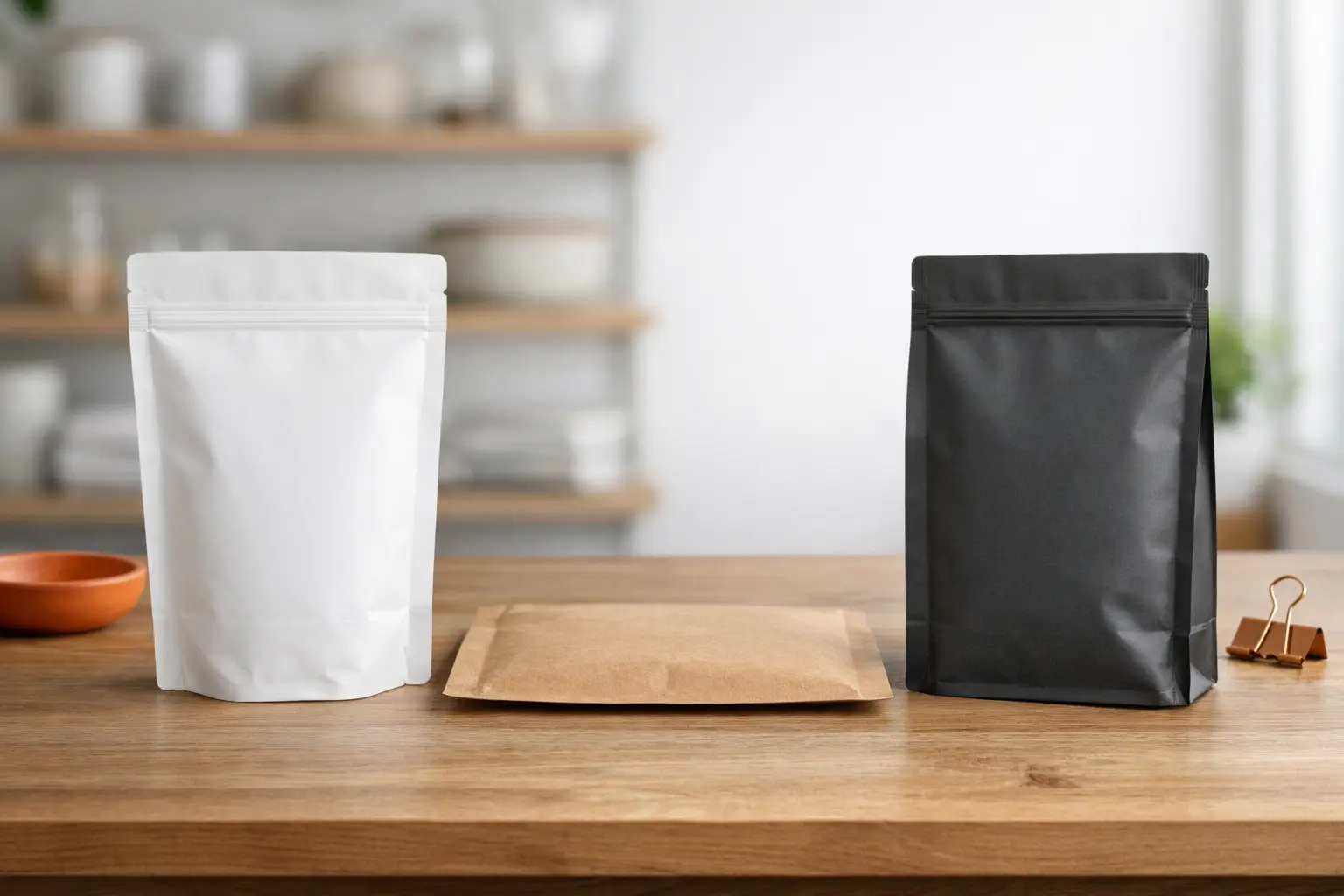
Choosing the right pouch format is one of the most important packaging decisions a brand can make. A pouch is not just a printed container. It shapes shelf presence, product protection, filling efficiency, shipping economics, consumer convenience, and even how buyers perceive quality. For many brands, the real decision is not whether to use flexible packaging. It is which flexible packaging format makes the most sense: a stand-up pouch, a flat pouch, or a quad seal pouch.
That decision matters because these formats solve different problems. A stand-up pouch helps products command attention on shelf and supports a wide range of closures and features. A flat pouch, often called a lay-flat pouch, minimizes material use and works well for simple, compact packs. A quad seal pouch creates a more reinforced, premium-looking structure that is especially useful for heavier fills and category segments such as coffee, pet food, granola, and bulk dry goods.
For procurement teams, operations leaders, brand managers, and founders, the wrong format can create unnecessary cost or underperform in retail. A pouch that looks attractive in a design mockup may be inefficient on the line. A pack that is cheap to produce may fail to stand out in-store. A structure that looks premium may be unnecessary for a lightweight product with low shipping stress. The best format is the one that fits the product, the channel, the fill process, the merchandising environment, and the growth stage of the brand.
This guide compares stand-up pouches, flat pouches, and quad seal pouches in detail. It explains how each format is built, where each one performs best, what tradeoffs to expect, and how to decide which one fits your product.
Which Stand up Pouch Format is Best?
If you need the short answer, a stand-up pouch is often the most versatile option for brands that want strong shelf presence, flexible sizing, good print area, and convenient features such as zippers or tear notches. A flat pouch is often the best fit when cost control, compactness, and shipping efficiency matter more than upright display. A quad seal pouch is often the right choice when the product is heavier, the brand wants a more premium profile, or the package needs added stability and reinforcement.
What is a Stand-up Pouch?
A stand-up pouch is a flexible package designed with a bottom gusset that allows it to stand upright when filled. This gives the format a strong retail advantage because the pouch presents itself vertically, making branding and product information easy to see. Stand-up pouches are widely used across food, beverages, pet food, cosmetics, pharmaceuticals, and retail applications because they balance visibility, convenience, and protective performance.
The strength of a stand-up pouch lies in its versatility. A brand can add zippers, spouts, windows, valves, hang holes, tear notches, matte or gloss finishes, and specialty films. The format works well for many products because it bridges technical performance and consumer usability. It can be engineered for dry goods, powders, frozen products, gummies, pet treats, coffee, supplements, or non-food items, while still offering a package shape consumers recognize and trust.
From a merchandising standpoint, stand-up pouches are popular because they can occupy less space than rigid containers while still maintaining a shelf-facing posture. From a logistics standpoint, they also reduce shipping weight and often lower storage overhead compared with jars, tins, or cartons. From a brand standpoint, they provide a large printable surface without forcing the product into a rigid format.
What is a Flat Pouch?
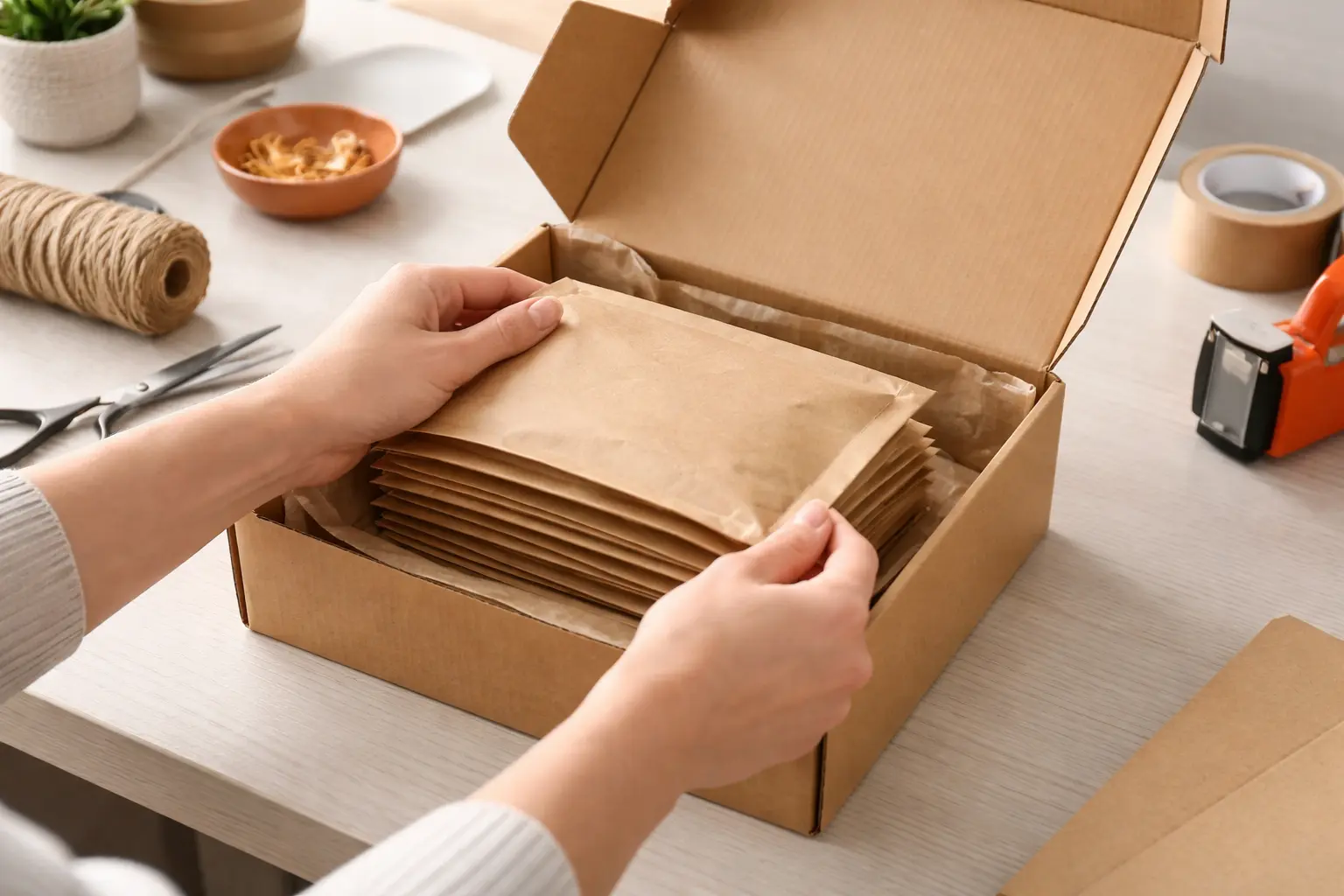
A flat pouch is a pouch format that lies flat when empty and does not rely on a bottom gusset to stand upright. In many packaging programs, flat pouches are selected because they are simple, compact, and efficient to store and ship. Flat pouches are streamlined, versatile, and well suited to products where storage and transportation efficiency are especially important.
Flat pouches are often a strong fit for sample packs, single-use products, smaller quantities, dry mixes, sachet-like applications, and products that will be displayed in bins, peg formats, cartons, or secondary packaging rather than standing independently on shelf. They can also work well in e-commerce or direct-to-consumer programs where upright in-store display matters less than cube efficiency and material economy.
The major advantage of a flat pouch is simplicity. It can be less complex to manufacture than more structured pouch formats, and in many cases it uses less material than a stand-up or quad seal construction. That does not automatically make it the cheapest packaging in every situation, but it often gives brands an efficient option for lower-profile applications.
What is a Quad Seal Pouch?
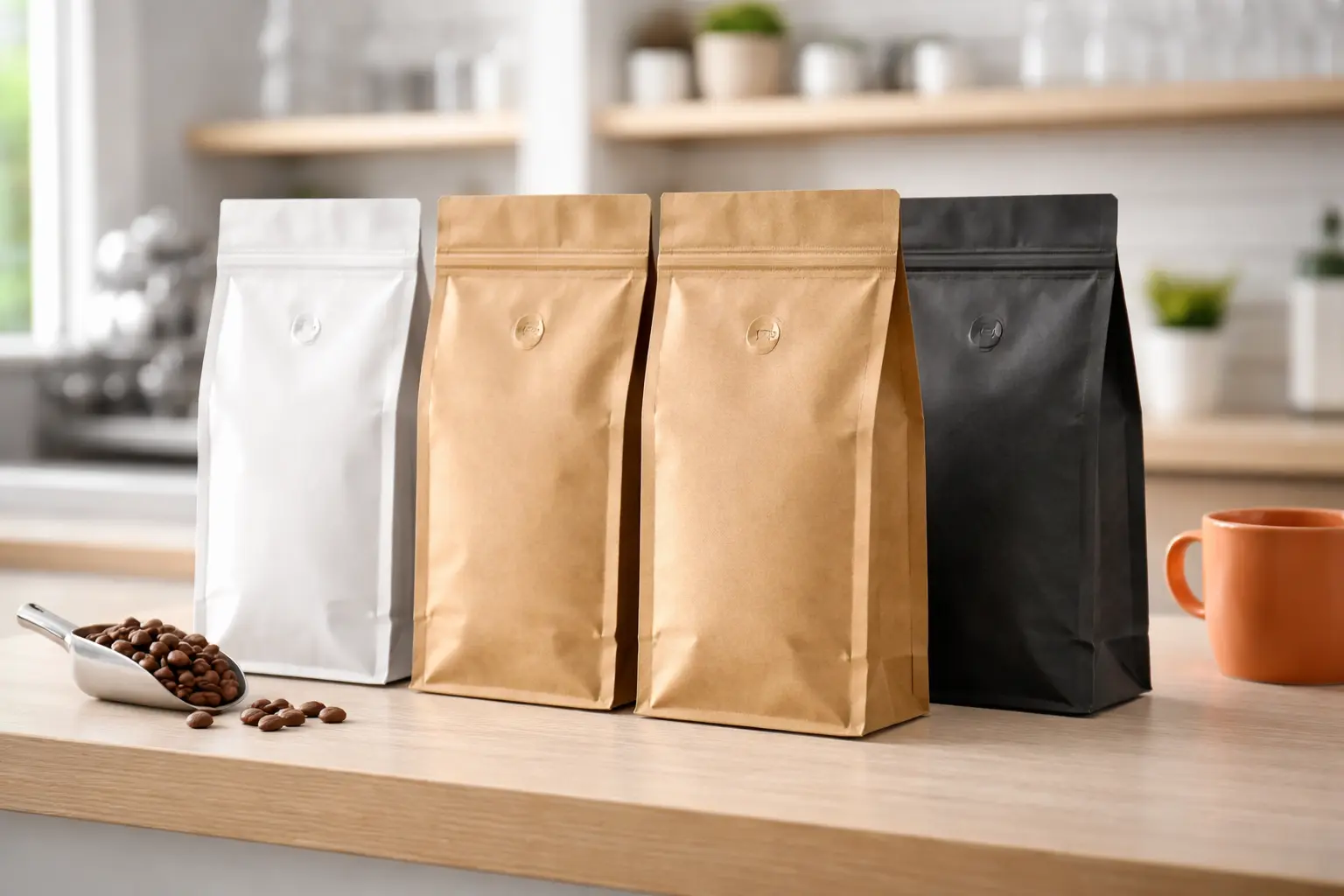
A quad seal pouch is a pouch format built with four corner seals and side gussets that reinforce the structure and help the pack stand with more stability. Quad seal bags are four-corner bags with two premade side gussets that provide reinforcement so the package can “stand tall and proud” on shelf, even after transportation stress. Quad seal bags are especially common in coffee, but are also used for pet food and treats, snacks, nuts, granola, pasta, beans, rice, and candy.
In practical terms, quad seal pouches are often chosen when a brand wants a more architectural package shape than a standard stand-up pouch. The format is associated with premium presentation, sturdiness, and stronger vertical structure, particularly for heavier or bulkier dry products. Depending on the design, it can offer more panel definition and better rigidity than lighter pouch styles. That makes it useful for premium coffee lines, pet foods, specialty grains, high-value dry goods, or any product that benefits from a more stable silhouette.
It is important to distinguish quad seals from other box-like formats. Quad seal bags differ from a box bottom bag because a quad seal bag uses a folded-over bottom with a middle seal, while a true box bottom bag uses a separate panel. In other words, quad seal and flat-bottom formats may overlap visually in the eyes of casual buyers, but they are not the same structure.
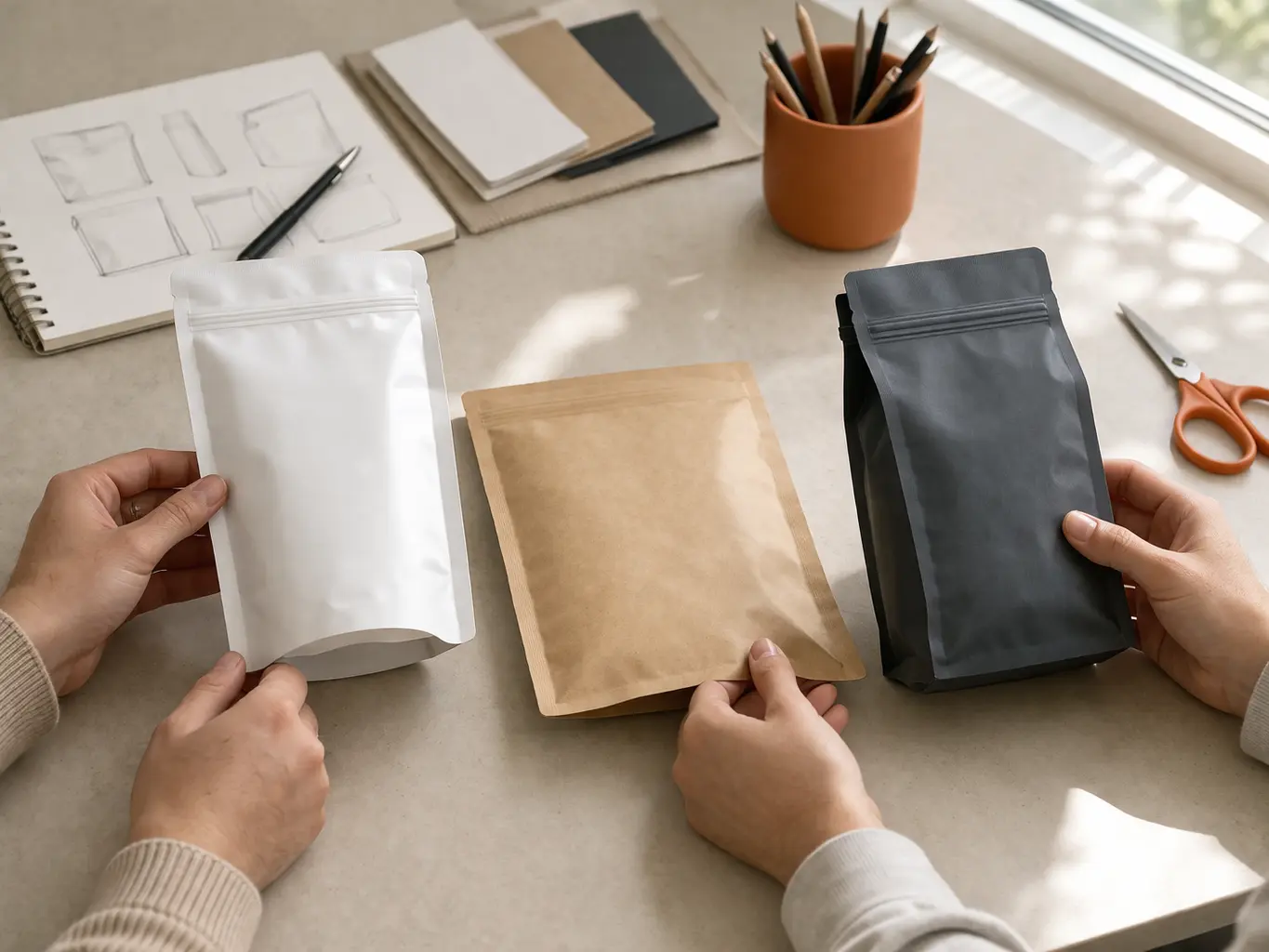
How Stand-Up Pouches, Flat Pouches and Quad Seal Pouches Differ Structurally?
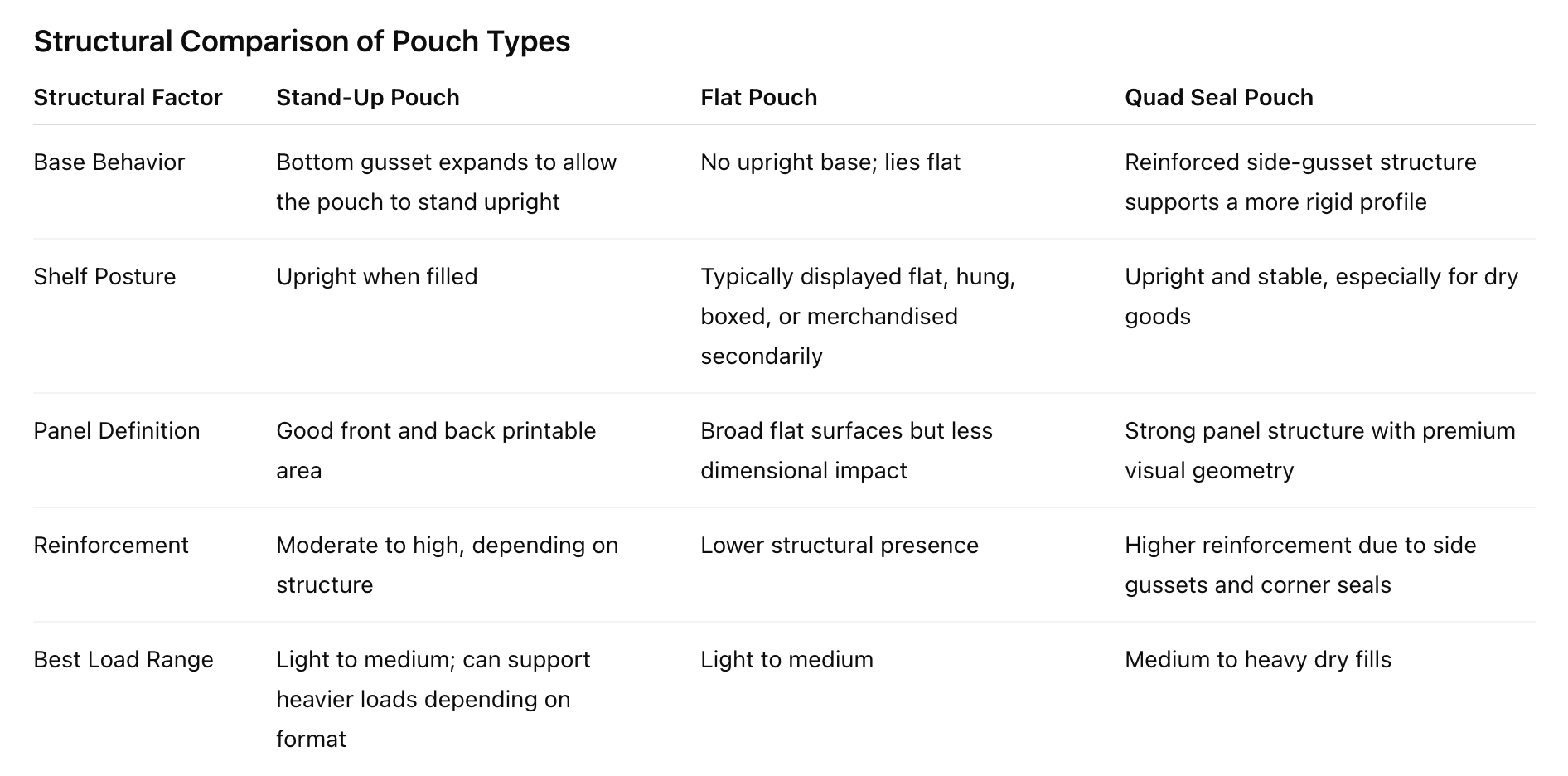
The most important differences among stand-up, flat, and quad seal pouches come from structure. A stand-up pouch depends on a gusseted bottom that expands so the pouch can stand when filled. A flat pouch remains relatively simple and low-profile, without a base intended for upright self-display. A quad seal pouch adds reinforcement through corner seals and gusset architecture, creating a more stable and premium body shape.
These structural differences influence almost everything else, including filling behavior, shelf stability, print presentation, shipping performance, and how the pack feels in the consumer’s hand. A brand choosing among them should not think only about appearance. It should ask how the structure behaves through manufacturing, transit, display, and repeated consumer use.
Shelf Presence and Merchandising Impact
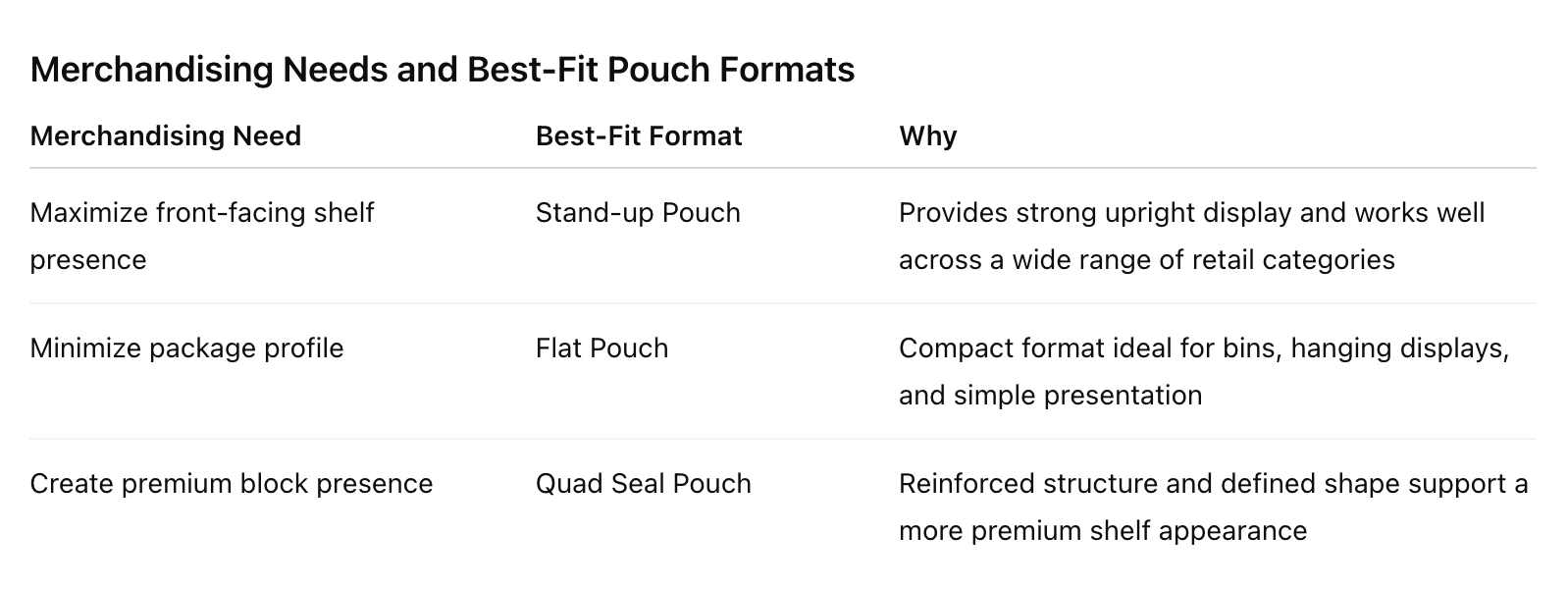
If the product will compete on a retail shelf, shelf presence is often the deciding factor. Stand-up pouches excel here because they face forward, present graphics clearly, and maintain a recognizable consumer-friendly shape. Stand-up pouch visibility and display appeal are major benefits in retail environments. That aligns with real-world merchandising behavior: upright packs are easier for consumers to scan, compare, and grab.
Flat pouches, by contrast, can be effective when displayed in bins, on pegs, in trays, or inside cartons, but they usually do not deliver the same self-merchandising presence on a shelf. If a brand is selling premium snacks, pet treats, or supplements in a crowded aisle, a flat pouch may not provide the same visual competitiveness unless the retail program uses secondary display support.
Quad seal pouches occupy a more premium position. They are especially effective when a brand wants an elevated, structured look. In categories like coffee or premium dry foods, the added form can communicate quality, sturdiness, and perceived value. Because the pack holds shape well, it can create a stronger block on shelf, which is especially useful when products are merchandised together in a brand family.
Cost, Material use, and Operational Efficiency
Many brands begin with cost. That is reasonable, but cost should be evaluated in context. A flat pouch may use less structure and may be more material-efficient for certain products, which can make it attractive for entry-level or high-volume programs. Lay-flat pouches are efficient for storage and transportation, which can translate into logistics advantages.
Stand-up pouches often sit in the middle. They usually cost more than a very simple flat pouch because the structure is more involved, but they can justify that cost through better shelf conversion, improved consumer usability, and broader merchandising flexibility. If better visibility leads to better retail performance, the incremental packaging cost may be worth it.
Quad seal pouches may command a premium relative to simpler formats because the structure is more specialized and often positioned for higher-value products. Flat-bottom formats are more complicated to manufacture than standard stand-up pouches, and quad seal bags are premium, customizable formats with added reinforcement and specialty features. While exact cost depends on run size, materials, printing method, and features, the broader rule is simple: the more structural sophistication and premium finishing required, the more carefully the economics should be evaluated.
The right question is not “Which pouch is cheapest?” It is “Which pouch gives the best total value for my product, channel, fill method, and brand strategy?”
Product fit: Which Products Work Best in Each Pouch?
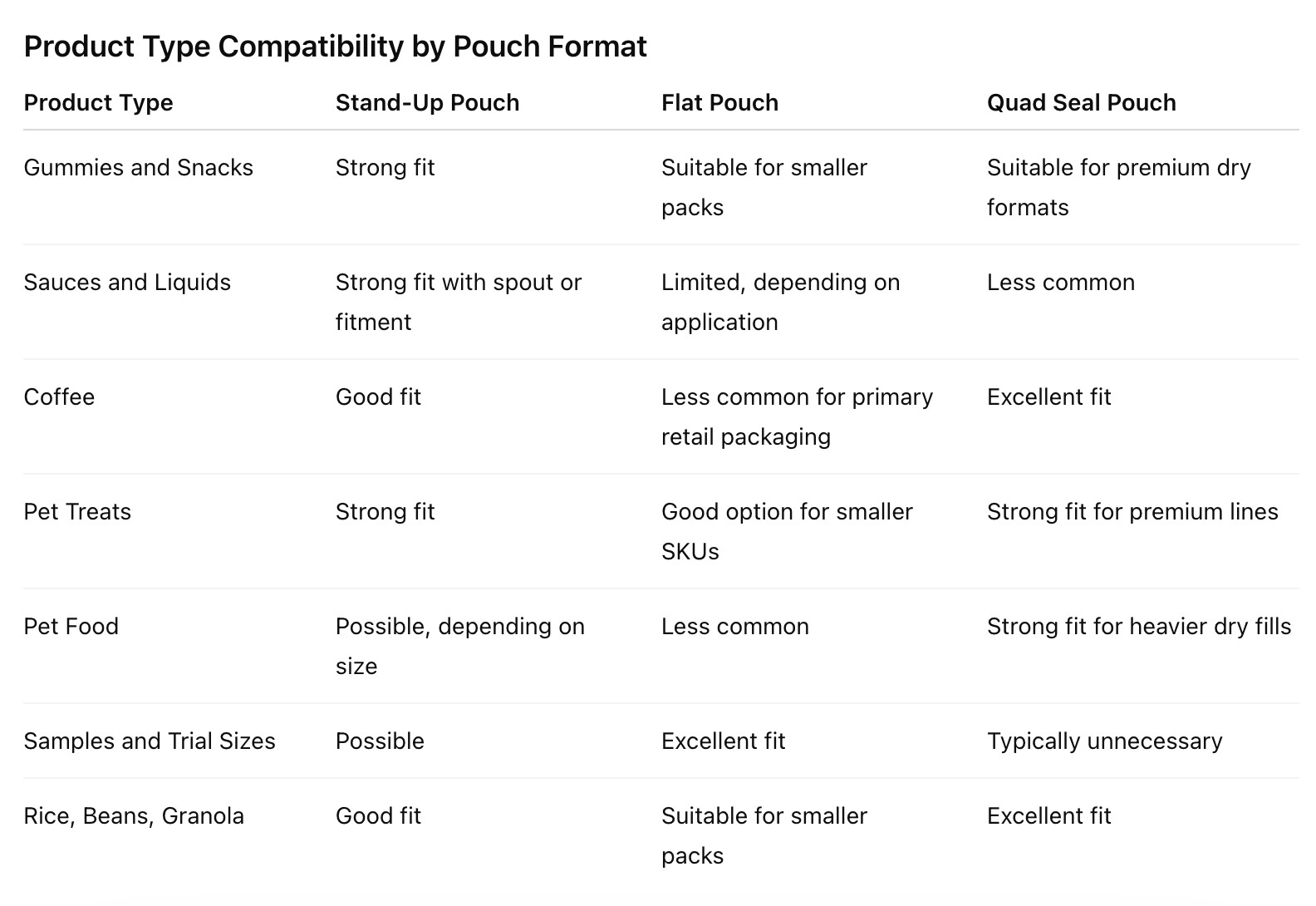
The best pouch format depends heavily on what is going inside. Stand-up pouches are widely used for snacks, sauces, powders, candies, frozen foods, supplements, and pet products because they combine usability and merchandising flexibility.
Flat pouches tend to work well for lighter, simpler, or more compact applications. Sample packs, trial sizes, powdered mixes, dry ingredients, confectionery, apparel accessories, and promotional items often fit comfortably in flat packs. They are also useful where the pouch will be hung, packed in a carton, or used as a secondary pack component.
Quad seal pouches are often better for heavier dry products or categories that benefit from a more substantial look. Coffee is the most obvious example, but pet food, snacks, nuts, granola, pasta, beans, rice, and candy are also often seen in qual seal pouches. .The format’s stability and reinforcement help the product look more substantial and reduce the visual collapse that can occur with lighter structures.
Brand Presentation and Print Strategy
Print surface is not only about available area. It is about how the pack presents branding in real retail conditions. Stand-up pouches provide strong front-facing branding and still allow brands to use back panels, side areas, and finishes effectively. They are a dependable platform for modern flexible packaging design because they give enough surface for hierarchy, compliance copy, icons, product photography, and storytelling without forcing brands into an over-structured form.
Flat pouches can provide broad printable surfaces as well, but the visual effect is different. Because the pack does not present vertically in the same way, the artwork must work harder when the pouch is merchandised in bins or hang displays. Flat pouches can look clean and efficient, but they do not inherently signal premium shelf dominance.
Quad seal pouches are often selected in part because the structure itself contributes to brand presentation. Quad seal pouches often have premium features such as high-gloss effects, soft-touch features, windows, valves, and photo-quality graphics as part of quad seal customization. When a product needs to project craft quality, specialty positioning, or a robust retail presence, quad seals can outperform flatter or simpler formats visually.
Convenience Features and Consumer Experience
Consumers do not judge packaging only at the moment of purchase. They continue judging it while opening, resealing, pouring, storing, and reusing it. Stand-up pouches perform well in this area because they can easily accommodate zippers, spouts, tear notches, and windows.
Flat pouches can also incorporate features such as tear notches, zippers, and hang holes, but the overall experience is often more minimal. That can be ideal for simple use cases, but less effective when a product is used repeatedly over time. For example, a flat pouch may work well for a one-time mix or sample, while a larger snack, supplement, or pet treat pack may benefit from the easier storage posture of a stand-up format.
Quad seal pouches often support premium convenience features too. It’s common to see quad seal pouches with zipper options, tin ties, pull tabs, degassing valves, windows, and specialty finishes for quad seal applications. Those features are especially important in coffee and dry food categories where freshness, aroma management, and resealability are part of the buying experience.
Barrier needs, Freshness, and Durability
No format decision is complete without discussing performance. The pouch style alone does not create a barrier. Materials and structure do that. However, format still matters because different products and channels place different demands on the packaging system. A light flat pouch may be enough for a short shelf-life dry product, while a premium quad seal coffee pouch may need a degassing valve, high barrier film, and stronger puncture resistance. A stand-up pouch for frozen foods may require materials chosen specifically for low-temperature durability, seal integrity, and abuse resistance.
This is one reason format selection should not happen in isolation. The brand should consider film structure, fill conditions, product sharpness, headspace, closure type, shipping hazards, and desired shelf life alongside the visual format. A stand-up pouch can be engineered into a high-performance barrier pack. A flat pouch can also be built with serious protective properties. A quad seal pouch may be preferred where reinforcement and premium dry-product presentation need to work alongside freshness protection.
Retail, e-Commerce, and Channel Strategy
Channel matters as much as product. In retail, stand-up and quad seals often outperform flat pouches when self-display is important. If the pack must sit on a shelf and win attention quickly, structure matters. In e-commerce, however, compactness, damage resistance, case packing, and freight efficiency may matter more than self-standing posture.
That means a brand selling primarily online may prefer a flat pouch or a simpler stand-up structure for certain SKUs, especially if the product ships in multipacks or subscription boxes. A brand selling in specialty grocery may prefer stand-up or quad seal formats that elevate shelf impact. A brand entering coffee retail might lean toward quad seal for premium positioning, while a brand launching gummies into convenience or natural channels might choose stand-up for versatility and consumer familiarity.
The best packaging program often aligns format to channel rather than forcing one pouch style across the whole portfolio. Entry-level SKUs, trial sizes, or online-only bundles may justify flat pouches. Core retail products may belong in stand-up pouches. Premium or bulk dry lines may benefit from quad seal.
How to Choose the Right Pouch Format for your Product
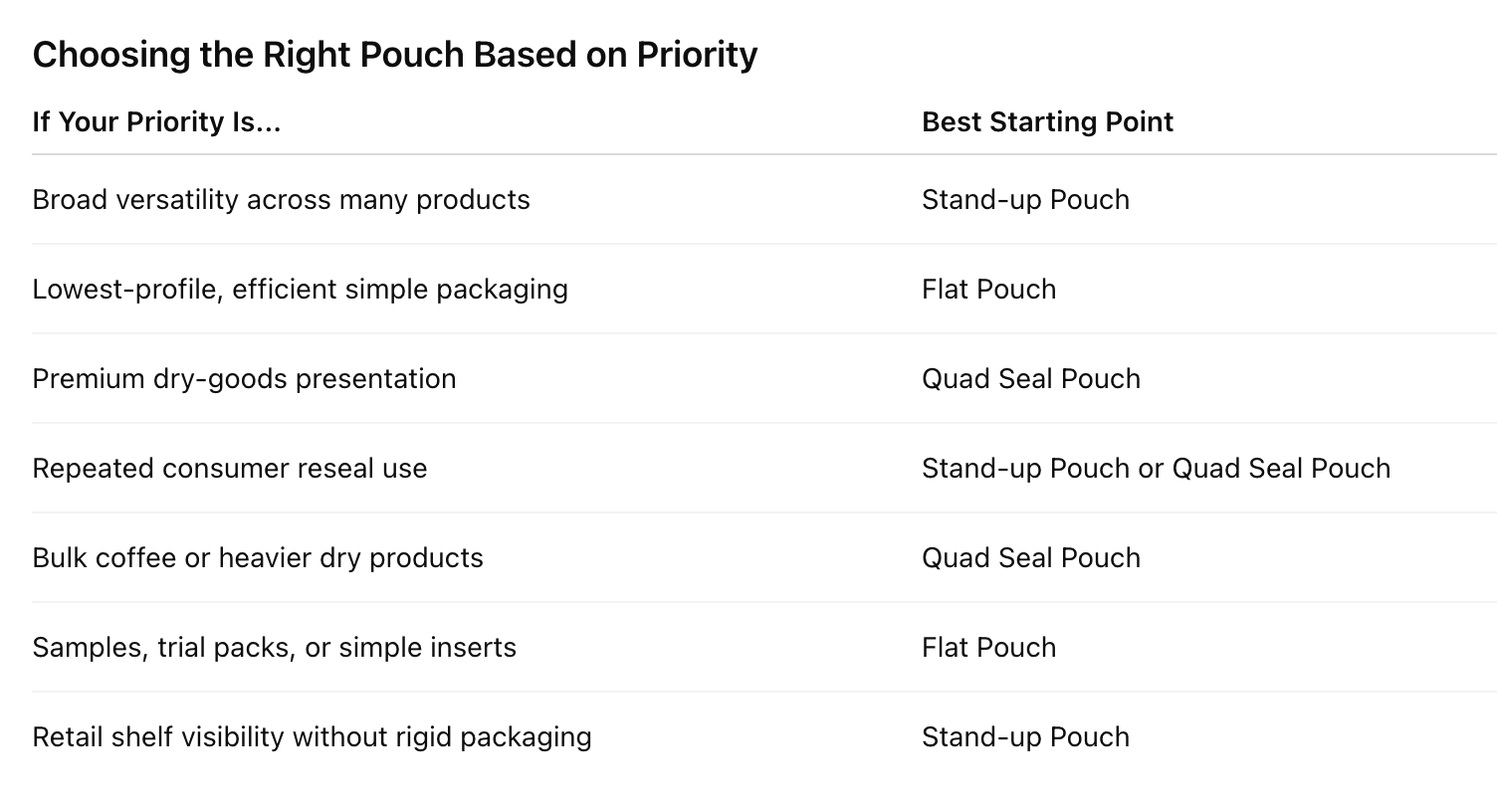
The simplest way to choose among the three formats is to work through a decision framework. First, define the product characteristics: weight, flow behavior, barrier sensitivity, puncture risk, and fill process. Second, define the channel: shelf retail, club, e-commerce, foodservice, or sampler program. Third, define the brand objective: cost efficiency, premium shelf impact, convenience, or operational simplicity. Fourth, define the must-have features: zipper, valve, spout, window, hang hole, gloss, matte, recyclable film, or low minimums.
Once those questions are answered, the correct direction often becomes clearer.
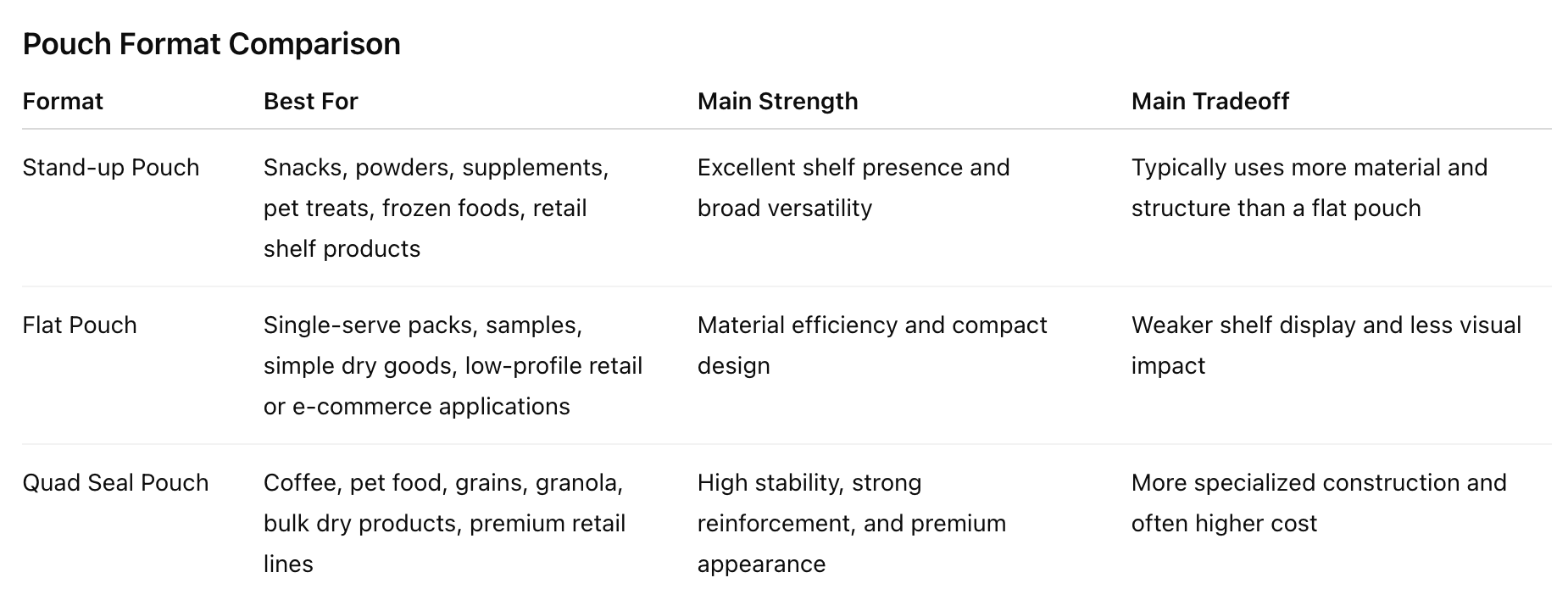
Stand-up Pouch vs Flat Pouch vs Quad Seal: Side-by-side Comparison
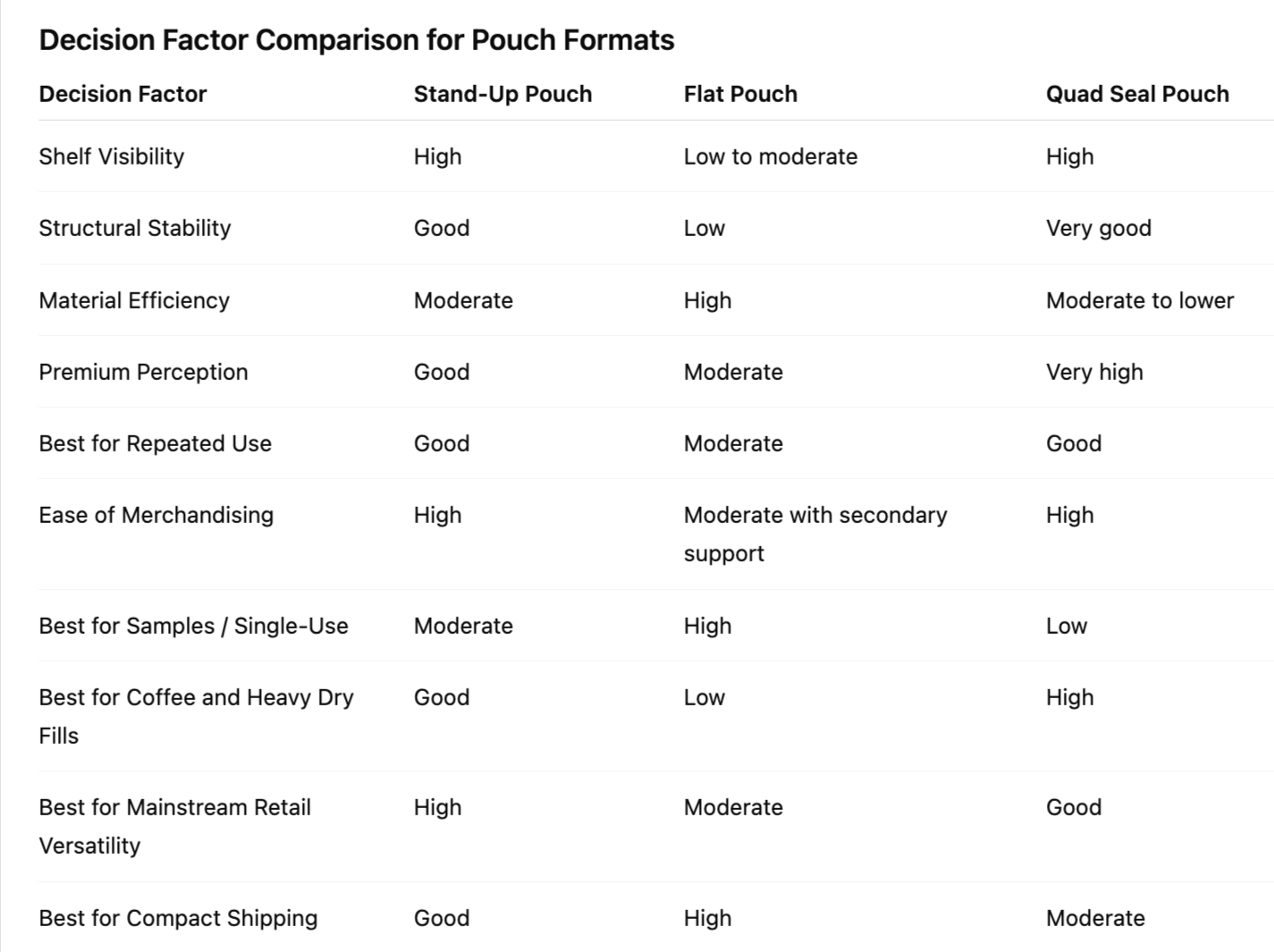
The table below summarizes the practical tradeoffs that most packaging teams care about.
Common Mistakes Brands make When Choosing Pouch Formats
One common mistake is choosing purely on appearance. A pouch may look attractive in a concept rendering but perform poorly in filling, distribution, or consumer handling. Another mistake is overbuying structure. Some brands choose a premium format when a simpler flat or stand-up pouch would perform just as well at lower cost. The reverse is also common: under-structuring a product that really needs more support, reinforcement, or premium shelf presence.
A third mistake is ignoring how the pack will actually be merchandised. If a flat pouch will be sold in a competitive shelf environment without trays or peg support, it may disappear visually. If a stand-up pouch is chosen for a product that is unusually heavy or angular, the format may not give the best stability. If a coffee product needs degassing and a premium block look, quad seal may be more appropriate than a basic stand-up construction.
Finally, many brands make the mistake of evaluating format separately from materials and features. In reality, the best results come from combining format choice with the right film structure, closure type, finish, and production method.
Which Format is Best for Food Packaging?
For many food products, the stand-up pouch is the best all-around choice because it balances visibility, convenience, and performance. Snacks, dried fruit, powders, frozen foods, gummies, granola, and supplements are especially strong stand-up pouch categories.
That said, a flat pouch can be the better answer for small serving sizes, sample programs, seasoning mixes, or products going into cartons. A quad seal pouch may be the best choice when the food product is heavier, premium positioned, or needs a more substantial shelf form, as in coffee, rice, beans, or specialty dry goods.
Which Format is Best for Pet Products?
Pet treats often perform very well in stand-up pouches because the format is consumer-friendly, resealable, and shelf-ready. Larger or more premium pet product lines may benefit from quad seal, especially if the product is heavier or the brand wants a sturdier premium look. Flat pouches may still be useful for trial sizes, topper packs, or promotional SKUs.
Which Format is Best for Coffee?
Coffee is the clearest case where a quad seal often deserves serious consideration. Quad seal bags perform strongly for coffee and offer features such as zippers, tin ties, degassing valves, and puncture resistance. That combination of shelf appearance, aroma management, durability, and premium feel makes quad seal especially compelling for whole bean or ground coffee.
Stand-up pouches can still work for some coffee products, particularly if the brand is prioritizing flexibility, smaller-format SKUs, or a more mainstream pouch profile. But if the goal is premium coffee merchandising with strong vertical form, quad seal is frequently the better fit.
FAQs
What are stand-up pouches made of?
Stand-up pouches are typically made from one or more flexible packaging materials such as polyethylene, polyester, polypropylene, nylon, metallized films, foil, or recyclable mono-material structures, depending on barrier and performance needs. The exact construction depends on product sensitivity, seal requirements, and channel demands.
How are stand-up pouches made?
Stand-up pouches are made by converting printed or unprinted flexible film into a pouch structure with seals and a bottom gusset so the pouch can stand when filled. Features such as zippers, tear notches, spouts, and windows may be added during the converting process.
How do you fill stand-up pouches?
Stand-up pouches can be filled manually, semi-automatically, or on automated packaging lines depending on volume and product type. The best setup depends on product flow, pouch size, closure style, and whether the package is premade or filled on specialized equipment.
How do you seal stand-up pouches?
Stand-up pouches are commonly heat sealed. Depending on the application, they may also include zipper closures, tin ties, or spouts for consumer resealability. The permanent seal depends on the sealant layer and packaging equipment settings.
Are flat pouches cheaper than stand-up pouches?
They often can be, especially in simpler applications, because they may use less structure and support efficient storage and shipping. However, total cost depends on material choice, features, print method, order volume, and merchandising requirements.
Are quad seal pouches better than stand-up pouches?
Not universally. Quad seal pouches are often better for heavier dry products, premium shelf presentation, and reinforced structure. Stand-up pouches are usually better when the brand needs broader versatility across many categories and sizes.