

How Do Gauge Vs Mil Vs Microns Compare in Packaging?

When packaging teams compare films, bags, or mailers, thickness is one of the first numbers they see and one of the easiest numbers to misread. A sourcing manager may request 2.5 mil poly mailers, a supplier may quote 250 gauge film, and a global plant may record the same thickness in microns. Those units are related, but they are not interchangeable unless everyone is working from the same convention.
For practical packaging work, the most important rule is simple: mil and microns are exact units of measure, while gauge is industry shorthand. That distinction matters because the wrong assumption can produce seal failures, punctures, over-specification, or unnecessary freight cost. If your team understands the unit system, confirms the supplier convention, and selects film by use case rather than familiarity, you can make better packaging decisions at lower risk.
What Does Gauge Vs Mil Vs Microns Mean in Packaging?
A mil is an exact imperial thickness unit equal to one thousandth of an inch, or 0.001 in. A micron is an exact metric thickness unit equal to one thousandth of a millimeter, or 0.001 mm. NIST conversion guidance supports the standard engineering relationship behind film conversions: 1 inch = 25.4 millimeters, which means 1 mil = 0.0254 mm = 25.4 microns.1
A gauge, by contrast, is a packaging and film industry shorthand. In many common film conversations, teams use the convention 100 gauge ≈ 1 mil ≈ 25.4 microns. That shortcut is convenient, especially in North American flexible packaging, but it is not fully standardized across every polymer, process, or supplier. ASTM D6988 and ISO 4593 both reinforce the importance of proper thickness determination rather than relying on shorthand alone.2 3
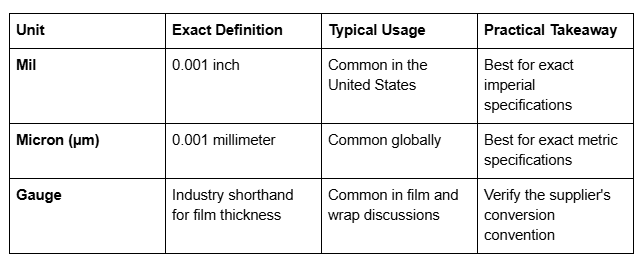
Because of that variability, the safest purchasing language is to specify mil or microns on purchase documents, then list gauge only as a secondary reference if your suppliers still use it.

How Does Packaging Thickness Conversion Work?
Packaging thickness conversion works best when you start from the exact units and treat gauge as a conditional shortcut. In exact math, mil converts to inches and microns convert to millimeters, so the bridge between the two is stable. Gauge is often aligned to that bridge through the common convention of 100 gauge per mil, but the article brief is right to caution that some specialty or oriented films may not use gauge in exactly the same way. That is why a data sheet or supplier confirmation should always outrank a verbal gauge label.
Mil to Microns: microns = mil × 25.4
Microns to Mil: mil = microns ÷ 25.4
Gauge to Microns: microns ≈ gauge × 0.254
Microns to Gauge: gauge ≈ microns ÷ 0.254
Gauge to Mil: mil ≈ gauge ÷ 100
Mil to Gauge: gauge ≈ mil × 100
A few worked examples make the relationship easier to remember. A 2.0 mil poly mailer is 50.8 microns, which is commonly described as 200 gauge. A 3.0 mil bag is 76.2 microns, or roughly 300 gauge. A 75 gauge shrink film is approximately 19.05 microns, which is why many teams round it to 19 microns in practice.
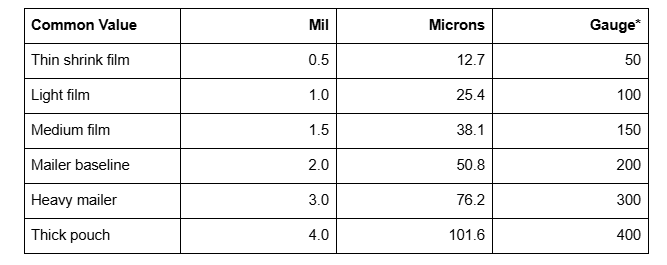
*Gauge values reflect the common film convention and should be verified for specific materials and supplier systems.
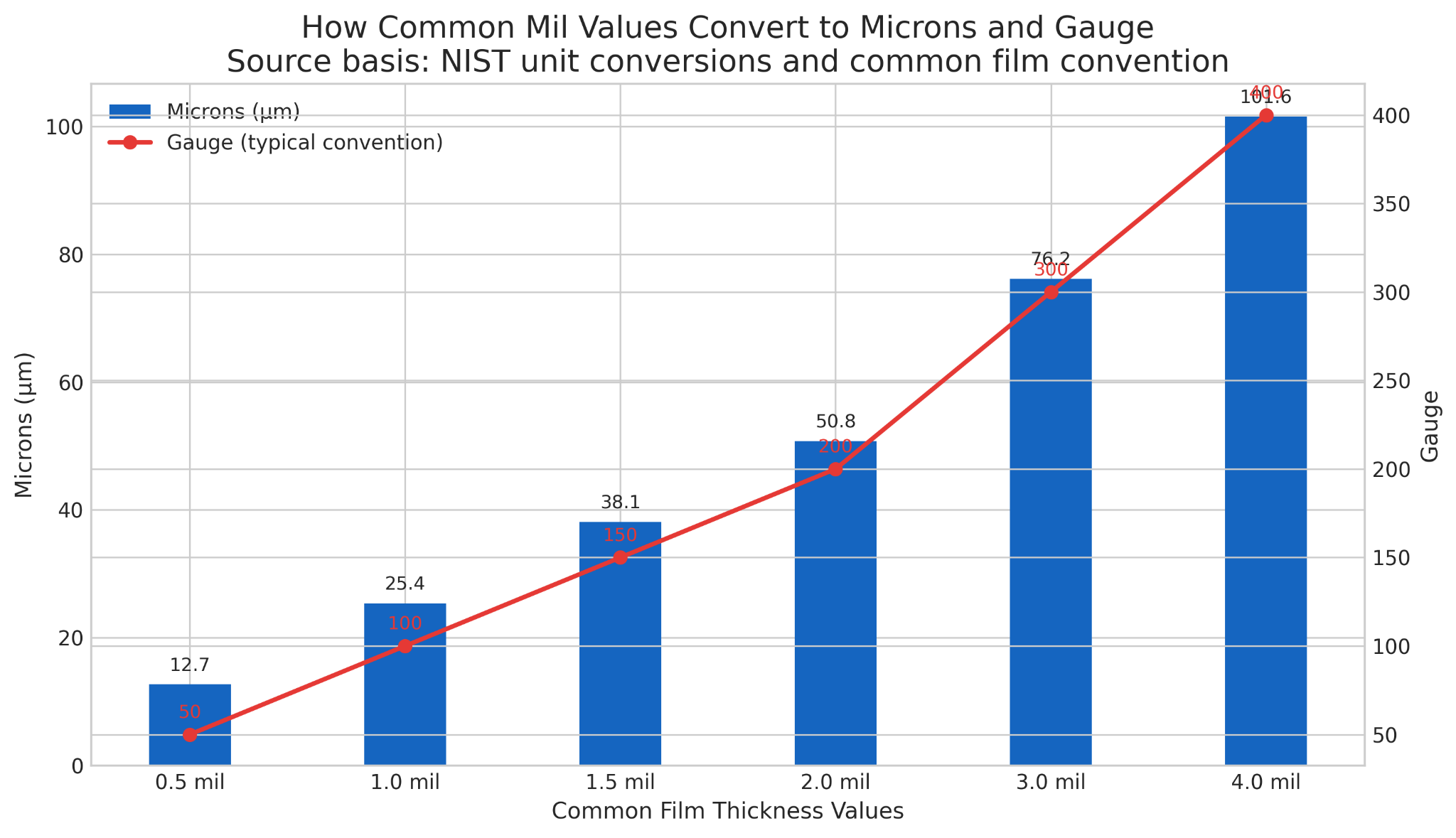
The chart above is especially useful for procurement and operations teams because it makes one pattern unmistakable: once you know the mil value, micron and gauge equivalents are straightforward. The conversion problem is rarely the math. The real problem is assuming everyone is using the same shorthand.
Why Is Gauge Not Always the Safest Thickness Language?
Gauge is popular because it is familiar, compact, and easy to quote in conversations about wrap or film. The problem is that familiarity is not the same as standardization. ASTM D6988 describes thickness determination as part of property testing, and ISO 4593 specifies mechanical scanning for plastic film or sheeting thickness measurement.2 3 Neither standard treats informal gauge language as a substitute for actual measured thickness.
In operational terms, that means a team can lose accuracy at three points. First, a buyer may assume 100 gauge always means the same thing across materials. Second, a supplier may describe a product in gauge for convenience while the technical data sheet reports the true thickness in mil or microns. Third, a quality team may inspect incoming rolls using exact units and discover that the commercial shorthand masked a mismatch. If you want fewer disputes and cleaner receiving checks, use gauge as a conversational aid, not as the only contractual number.
Which Thickness Ranges Are Typical for Common Packaging Applications?
Typical thickness ranges vary by package function, handling severity, and material construction. The values below are practical planning ranges based on the content brief, and they should be validated against your actual film structure, sealing method, and transit conditions.
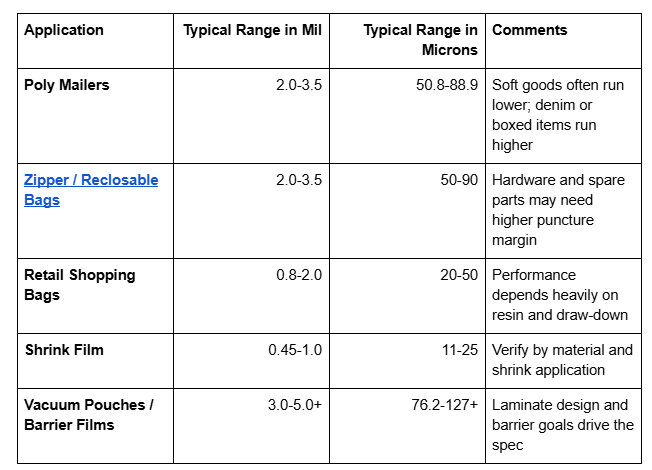
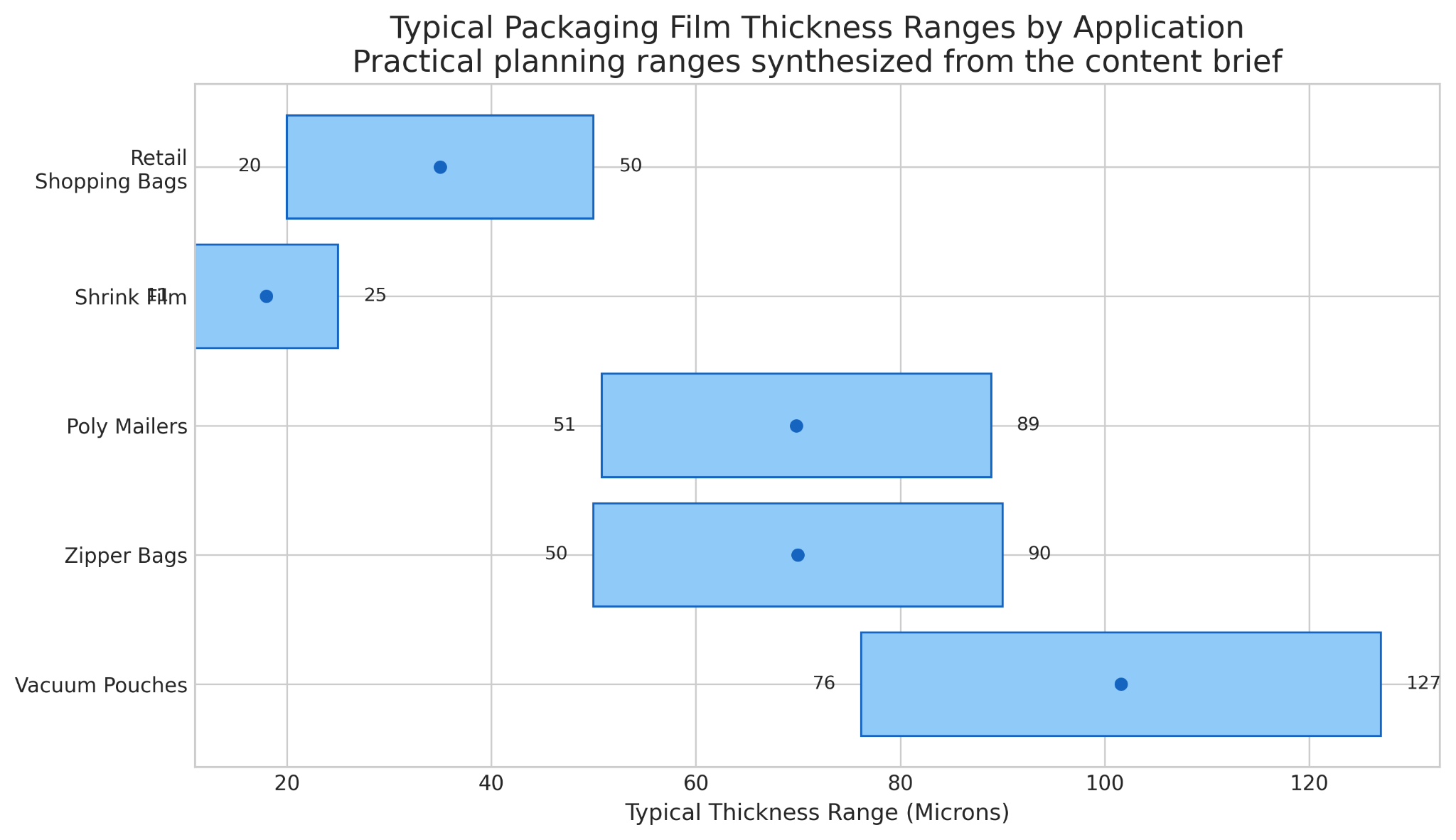
The chart shows why thickness should always be read in context. Shrink film may look thin next to a vacuum pouch, but that does not automatically make it under-specified. Each application asks the material to do a different job. A food pouch may need seal integrity and barrier performance. A poly mailer may need puncture tolerance through parcel networks. A retail bag may need low cost, acceptable feel, and enough strength for short carrying distances.
How Should You Choose the Right Thickness for Your Product?
The best way to choose thickness is to begin with the risk profile of the packed product, not with the unit you happen to know best. Product weight matters, but it is not the only factor. Corners, edges, part geometry, case packing density, drop exposure, conveyor handling, and shipping distance all influence how much abuse the film must survive.
For apparel in poly mailers, a range around 2.0 to 2.5 mil is often appropriate for soft garments without sharp edges. If the shipment includes denim, multiple folded items, or boxed accessories, moving toward 3.0 mil or higher can provide better puncture margin. For zipper bags, small spare parts and hardware often justify the upper end of the common range because puncture risk is driven by edges and point loading rather than weight alone. For vacuum pouches and barrier structures, thickness should be set only after you evaluate seal performance, oxygen and moisture needs, and the laminate construction.
A disciplined selection process usually follows four steps. First, define the job: containment, display, barrier, or shipping protection. Second, match the film family to the job. Third, short-list two adjacent thicknesses. Fourth, run a pilot that checks seal quality, machine settings, drop resistance, puncture performance, and customer experience. That pilot is often where teams discover they can safely down-gauge, or where they learn that a thicker film still fails because the polymer choice was wrong.
Why Does Material Matter Beyond Thickness Alone?
Two films can share the same micron value and still perform very differently. That is because strength depends on resin family, orientation, multilayer structure, sealing behavior, and test performance, not on thickness alone. ASTM D882 is used to evaluate tensile properties for plastics less than 1 mm thick, including tensile strength, yield behavior, strain at break, and modulus.4 ASTM D1709 is widely used to assess film impact resistance by the free-falling dart method.5 Those are the kinds of numbers that help explain why one 50 µm film survives handling better than another 50 µm film.
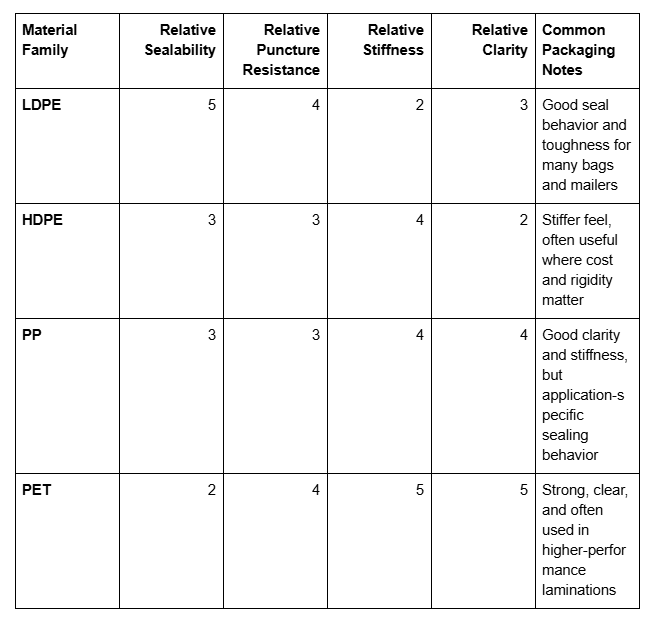
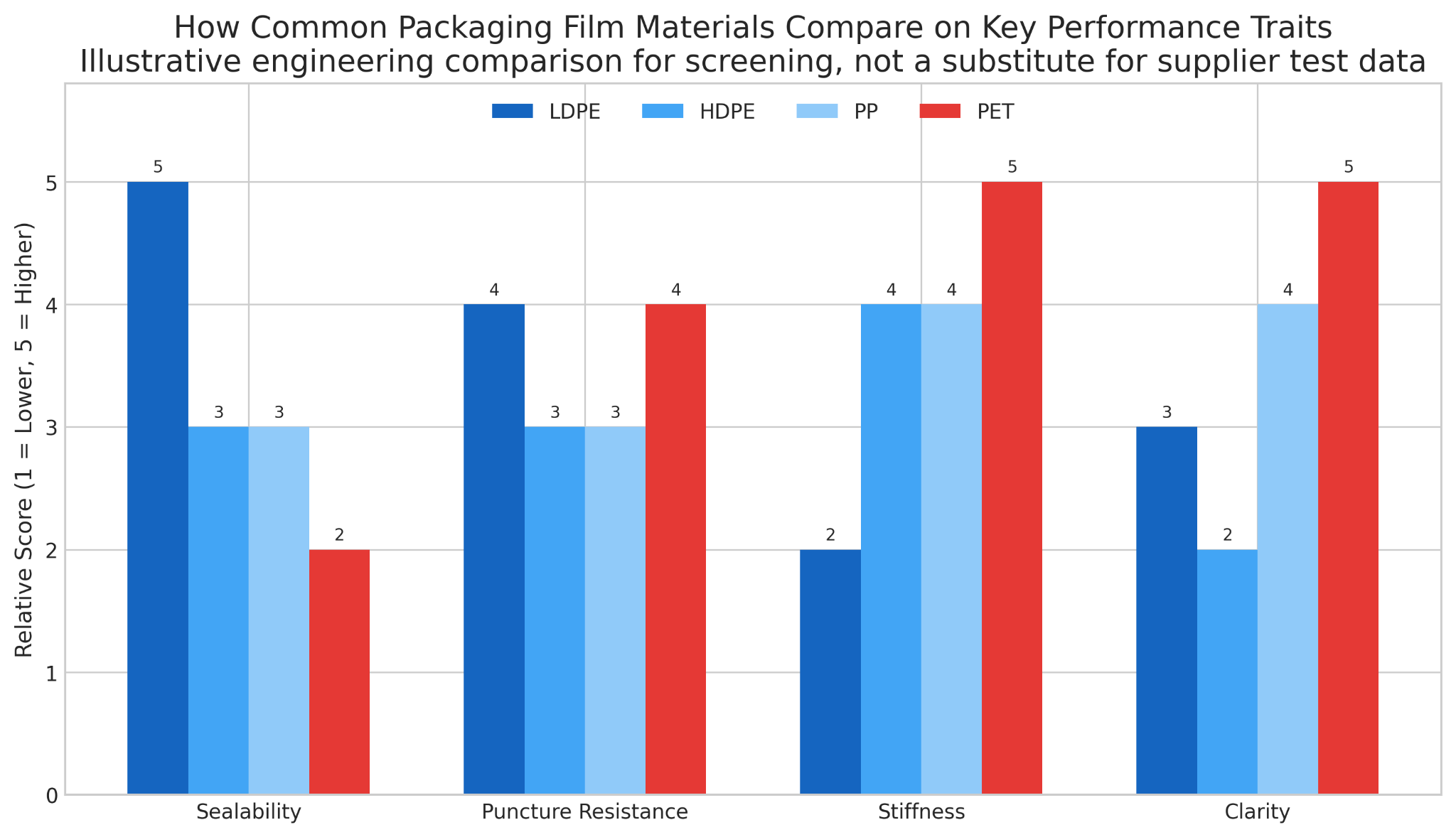
The practical lesson is that down-gauging can sometimes work without sacrificing performance if the new film has better mechanical properties, orientation, or layer design. The opposite is also true: simply adding thickness may raise cost without solving seal failure, tear initiation, or puncture problems.
How Should Teams Measure Thickness, Tolerances, and Incoming Quality?
Thickness measurement is not just a laboratory issue. It has direct consequences for procurement accuracy, quality control, and performance troubleshooting. ASTM D6988 covers determination of plastic film thickness when thickness is used directly in property testing, and it notes that SI units are the standard.2 ISO 4593 specifies mechanical scanning for thickness determination of plastic film and sheeting, while also noting that embossed products require different consideration.3
In practice, incoming quality checks should be designed around repeatability. Teams should confirm sampling location, instrument condition, pressure consistency, and reporting unit before they compare readings. A supplier may report nominal thickness in microns, while an internal team may record inspection results in mil. That is manageable as long as everyone converts from the same base relationship. It becomes a problem only when shorthand language replaces measured numbers.
For performance review, thickness should be checked alongside the property data that actually governs field success. ASTM D882 results help explain tensile and elongation behavior, while ASTM D1709 results help evaluate impact and puncture-related durability.4 5 If your application is sensitive to seal integrity, shipping abuse, or machine speed, those property values are often more informative than thickness alone.
Which Mistakes Create the Most Packaging Thickness Problems?
The first common mistake is assuming all gauge systems mean the same thing for every film. The second is selecting thickness before defining the actual hazard profile of the product and distribution path. The third is treating a thicker film as automatically stronger, even when the real issue is polymer choice, seal quality, or puncture resistance. The fourth is over-specifying film and quietly adding unnecessary material cost, pack weight, and sustainability burden.
A fifth mistake is neglecting pilot testing. A small side-by-side trial with two nearby thicknesses usually produces better decisions than a long internal debate. For packaging teams under cost pressure, those short trials can reveal whether down-gauging is realistic. For teams under damage pressure, the same trials can show whether the package needs a different resin family or structure rather than just more thickness.
What Are the Fastest Answers to Common Gauge Vs Mil Vs Microns Questions?
What Is Thicker: Mil Or Micron?
Neither unit is inherently thicker. They measure the same physical property in different systems. One mil equals 25.4 microns.1
What Is 1 Mil In Microns?
One mil equals 25.4 microns.1
Is Gauge the Same as Mil?
Not exactly. Gauge is often used as shorthand, and the common convention is 100 gauge ≈ 1 mil, but gauge is not fully standardized across every film type.
How Many Microns Is 2 Mil?
A 2 mil film is 50.8 microns.
How Many Mil Is 200 Gauge?
Under the common convention, 200 gauge ≈ 2 mil.
Does Higher Mil Always Mean Stronger Film?
No. Film strength also depends on resin, orientation, multilayer construction, sealing, and impact properties measured by tests such as ASTM D882 and ASTM D1709.4 5
What Thickness Poly Mailer Should I Use for Clothing?
Soft apparel often works well around 2.0 to 2.5 mil, while heavier garments or boxed items may justify 3.0 mil or more, depending on handling risk.
What Should You Remember Before Finalizing a Film Specification?
The simplest way to avoid confusion is to remember three rules. First, mil and microns are exact units; gauge is shorthand. Second, use the standard conversion basis of 1 mil = 25.4 microns and treat gauge as a typical convention unless the supplier confirms otherwise.1 Third, select thickness according to the product, package function, handling environment, and material properties rather than unit familiarity alone.
If you are writing a purchase specification, the safest wording is to state the exact target thickness in mil or microns, list any tolerance requirements, and verify the material family and critical performance tests. That approach reduces the risk of material mismatch, protects receiving teams from conversion confusion, and makes supplier discussions much easier. For most packaging organizations, a small pilot between two close thicknesses is still the best final check before a full rollout.
For related planning, you can also see our guides on how to choose the right mailer size and material, the beginner’s guide to flexible packaging films, and packaging sustainability: materials, recovery, and labeling.
Frequently Asked Questions: How Do Gauge Vs Mil Vs Microns Compare in Packaging
What Is the Difference Between Gauge, Mil, and Microns in Packaging?
The difference is that mil and microns are exact thickness units, while gauge is usually an industry shorthand. One mil equals 0.001 inch, one micron equals 0.001 millimeter, and the common film convention is 100 gauge ≈ 1 mil ≈ 25.4 microns. Because gauge is not fully standardized across every film type, buyers should confirm the exact thickness in mil or microns before approving a spec.
How Do I Convert Mil to Microns for Packaging Film?
To convert mil to microns, multiply the mil value by 25.4. For example, 2 mil = 50.8 microns and 3 mil = 76.2 microns. This is the most reliable way to compare US film specs with metric supplier data.1
How Do I Convert Gauge to Microns Without Making a Packaging Spec Error?
Under the common film convention, you can estimate microns by multiplying gauge by 0.254. For example, 200 gauge ≈ 50.8 microns and 300 gauge ≈ 76.2 microns. Because gauge may vary by material or supplier convention, it is safer to verify the final thickness in microns or mil on the technical data sheet.
Is Gauge the Same as Mil in Flexible Packaging?
Not exactly. In many packaging conversations, people use the shortcut 100 gauge ≈ 1 mil, but gauge is not an exact universal unit the way mil is. That is why procurement and quality teams should avoid treating gauge as the only contractual thickness language.
What Is 1 Mil in Microns?
One mil is 25.4 microns.1 This conversion comes from the standard relationship between inches and millimeters used in engineering and metrology.
How Many Microns Is 2 Mil Film?
A 2 mil film is 50.8 microns. In common film shorthand, that is also about 200 gauge.
How Many Mil Is 200 Gauge?
Using the common packaging film convention, 200 gauge is about 2 mil. Since gauge can be used differently in some specialty films, it is wise to confirm the exact thickness on the supplier specification.
What Thickness Poly Mailer Should I Use for Clothing?
For soft apparel without sharp edges, many teams start around 2.0 to 2.5 mil. If the shipment includes denim, multiple garments, or boxed accessories, 3.0 mil or more may provide better puncture resistance and handling protection.
Does a Higher Mil Always Mean a Stronger Packaging Film?
No. A thicker film may add durability, but strength also depends on material type, orientation, multilayer construction, seal quality, tensile performance, and impact resistance. Tests such as ASTM D882 for tensile properties and ASTM D1709 for dart impact are often more informative than thickness alone.4 5
Why Is Gauge Not Standardized Across All Plastic Films?
Gauge developed as a practical shorthand inside parts of the film industry rather than as a fully harmonized measurement unit. Different materials, converting practices, and commercial habits can affect how it is communicated. That is why exact units such as mil and microns are better for technical specifications and quality checks.
What Standards Are Used to Measure Plastic Film Thickness?
Two widely cited standards are ASTM D6988, which covers determination of plastic film thickness for testing contexts, and ISO 4593, which specifies mechanical scanning for plastic film and sheeting thickness measurement.2 3 These standards help teams measure thickness consistently instead of relying on shorthand labels.
How Do I Verify Incoming Film Thickness From a Supplier?
The safest approach is to compare the supplier data sheet, purchase specification, and receiving measurements in the same unit system. Teams should define where measurements are taken, what instrument is used, and what tolerance applies. If the supplier quoted gauge, convert it first and verify the exact thickness in mil or microns during inspection.
Can I Down-Gauge Packaging Film Without Losing Performance?
Sometimes, yes. Down-gauging can work when a new film structure has better resin properties, orientation, or multilayer design. The right way to evaluate it is through pilot testing that checks seals, puncture resistance, handling performance, and machine compatibility rather than relying on thickness alone.
Which Is Better for Procurement Specs: Mil, Microns, or Gauge?
For procurement, mil and microns are better than gauge because they are exact units. Gauge can still be listed as a helpful secondary reference, but the purchase document should use a measurable thickness value and any required tolerance.
What Should I Include in a Packaging Thickness Specification?
A strong specification should list the target thickness in mil or microns, the acceptable tolerance, the material family, and any critical performance requirements such as sealability, puncture resistance, or tensile properties. That gives suppliers and quality teams a much clearer basis for approval and inspection.