
What Is Rollstock Packaging and When Should You Use It?
If your brand is evaluating flexible packaging for scale, one of the most important questions to answer is whether you should buy premade pouches or move to rollstock packaging. For companies that package high volumes, run automated filling lines, or work with co-manufacturers using form-fill-seal equipment, rollstock can be one of the most efficient and cost-effective packaging formats available. At the same time, it is not automatically the best choice for every product, every production setup, or every stage of growth.
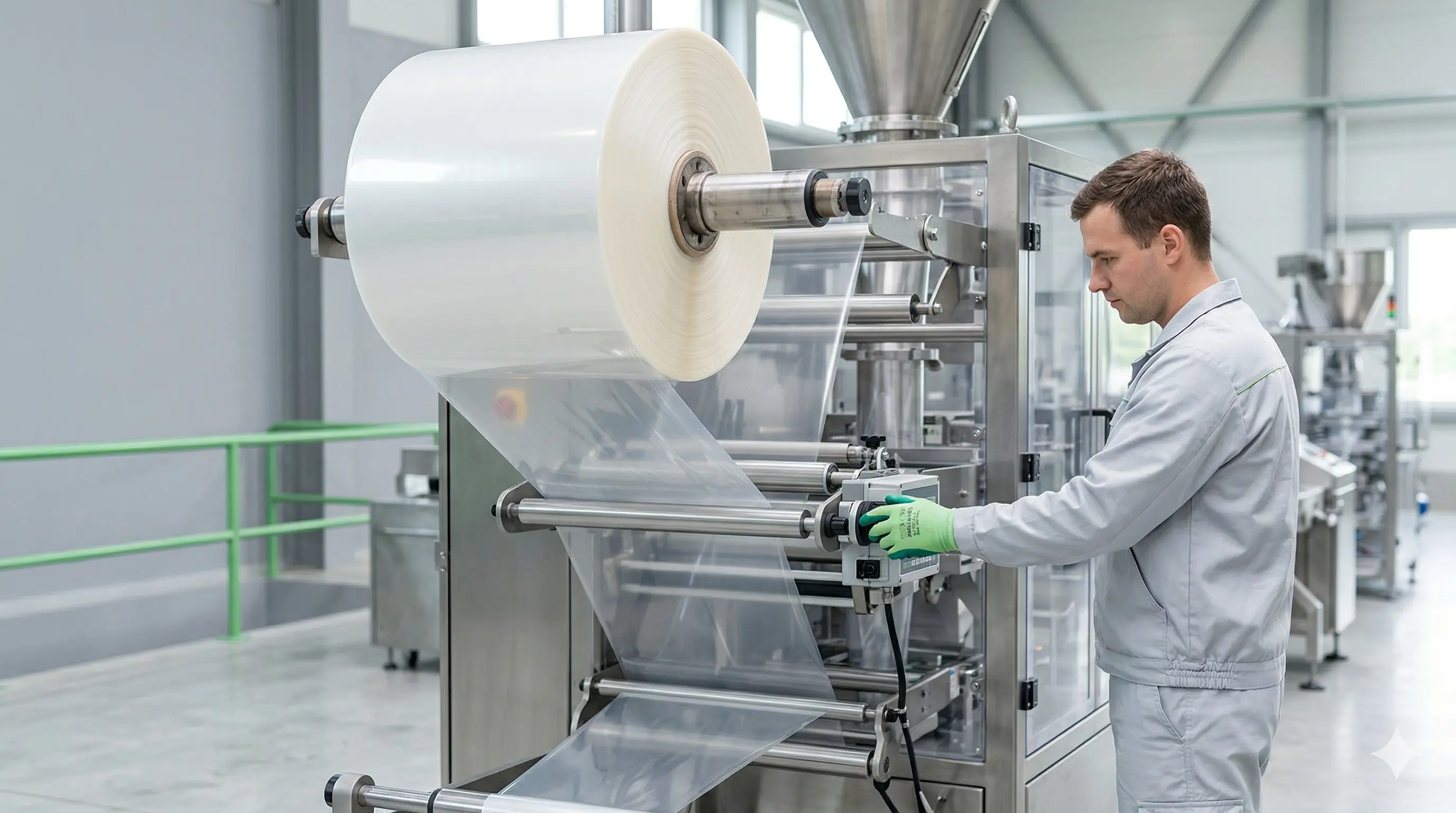
That is why the right answer starts with a clear definition. Rollstock packaging refers to flexible packaging material supplied on a roll rather than delivered as a finished pouch or bag. The film is fed into machinery that forms the package, fills it with product, seals it, and cuts it to final shape during production. EcoPackables defines rollstock as continuous rolls of flexible packaging materials such as plastic, paper, foil, or laminates used in form-fill-seal machines to create pouches or bags.
In other words, instead of receiving packaging that is already converted into a pouch, the manufacturer receives printed or unprinted film on a roll. That roll becomes the finished package on the line. This difference matters because it changes cost structure, production speed, design flexibility, operational complexity, and packaging fit.
Quick Answer: What is Rollstock Packaging?
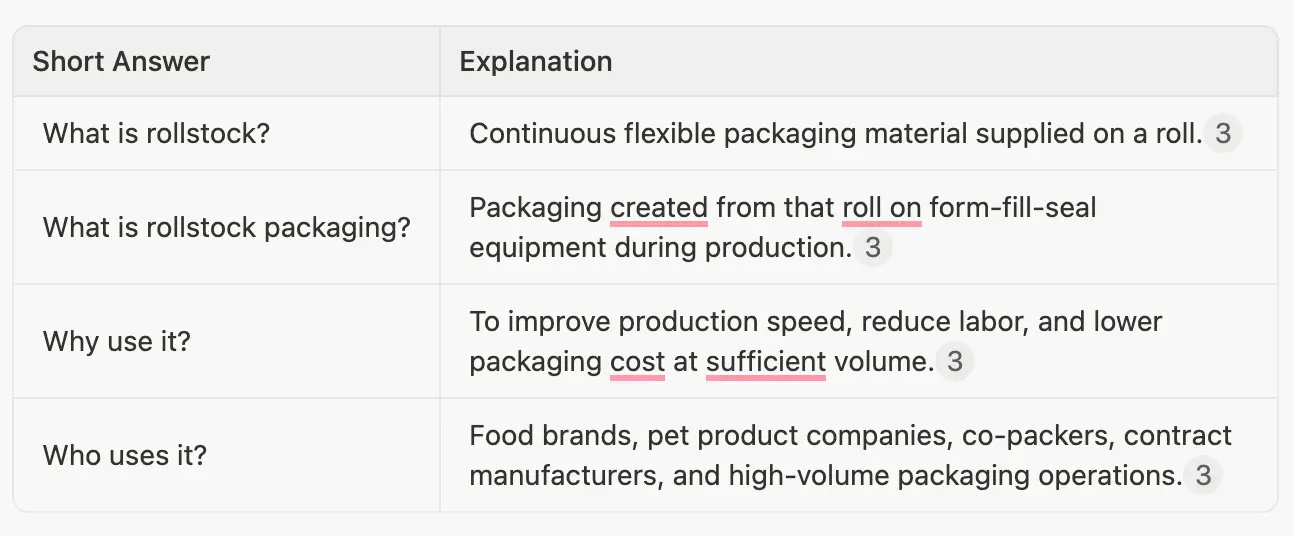
Rollstock packaging is flexible packaging film supplied on a continuous roll and used in form-fill-seal packaging machines to create packages during production. Instead of buying finished pouches, the buyer purchases rollstock film that is then formed, filled, sealed, and cut on automated equipment.
This approach is especially useful when a company needs higher-speed packaging, lower per-unit packaging costs at scale, and a packaging format compatible with existing automation. It is commonly used for food, pet products, powders, stick packs, sachets, pillow pouches, and some more advanced pouch styles depending on the machinery involved.
Rollstock Definition: What Does “rollstock” Actually Mean?
The easiest way to understand the rollstock meaning is to think about the difference between a finished package and a package substrate. A premade pouch arrives already converted into its final form. Rollstock arrives as the packaging substrate itself, wound around a core in a continuous roll. That roll may be plain, printed, laminated, metallized, recyclable, or designed with specific barrier layers depending on the application.
When buyers search for rollstock definition or what is a rollstock, they are usually trying to understand whether the term refers to a material, a machine process, or a type of package. The answer is that it starts as a material format, but it is closely tied to a packaging process. Rollstock is the film format; rollstock packaging is the finished package produced from that film through form-fill-seal or related automated packaging operations.
This distinction is useful because many packaging decisions fail when teams talk about film, package format, and equipment as though they are the same thing. They are related, but they are not identical. A buyer choosing rollstock is also choosing a production method, machine compatibility requirements, and a certain level of line integration.
How Rollstock Packaging Works
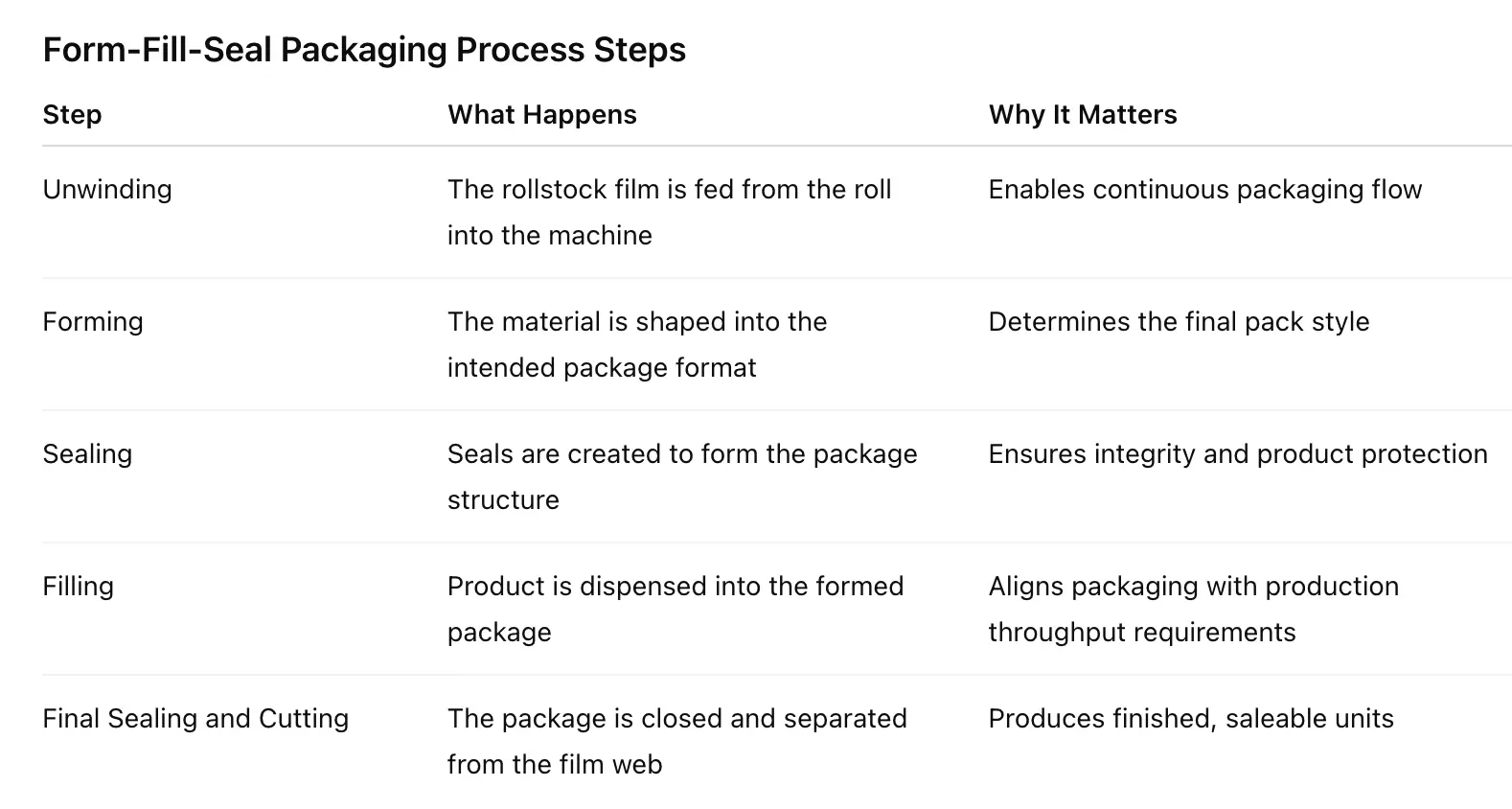
The core logic behind rollstock is simple: the material enters the line as a roll and exits as a filled package. Here’s a five-step sequence for rollstock packaging: unwinding, pouch forming, sealing, filling, and final sealing and cutting.
Rollstock refers to continuous rolls of flexible packaging materials, such as plastic, paper, foil, or laminates, used in form-fill-seal machines to create pouches or bags. Instead of using pre-made pouches, rollstock allows packaging to be formed, filled, and sealed in one streamlined process, making it a cost-efficient and high-speed solution for large-scale production.
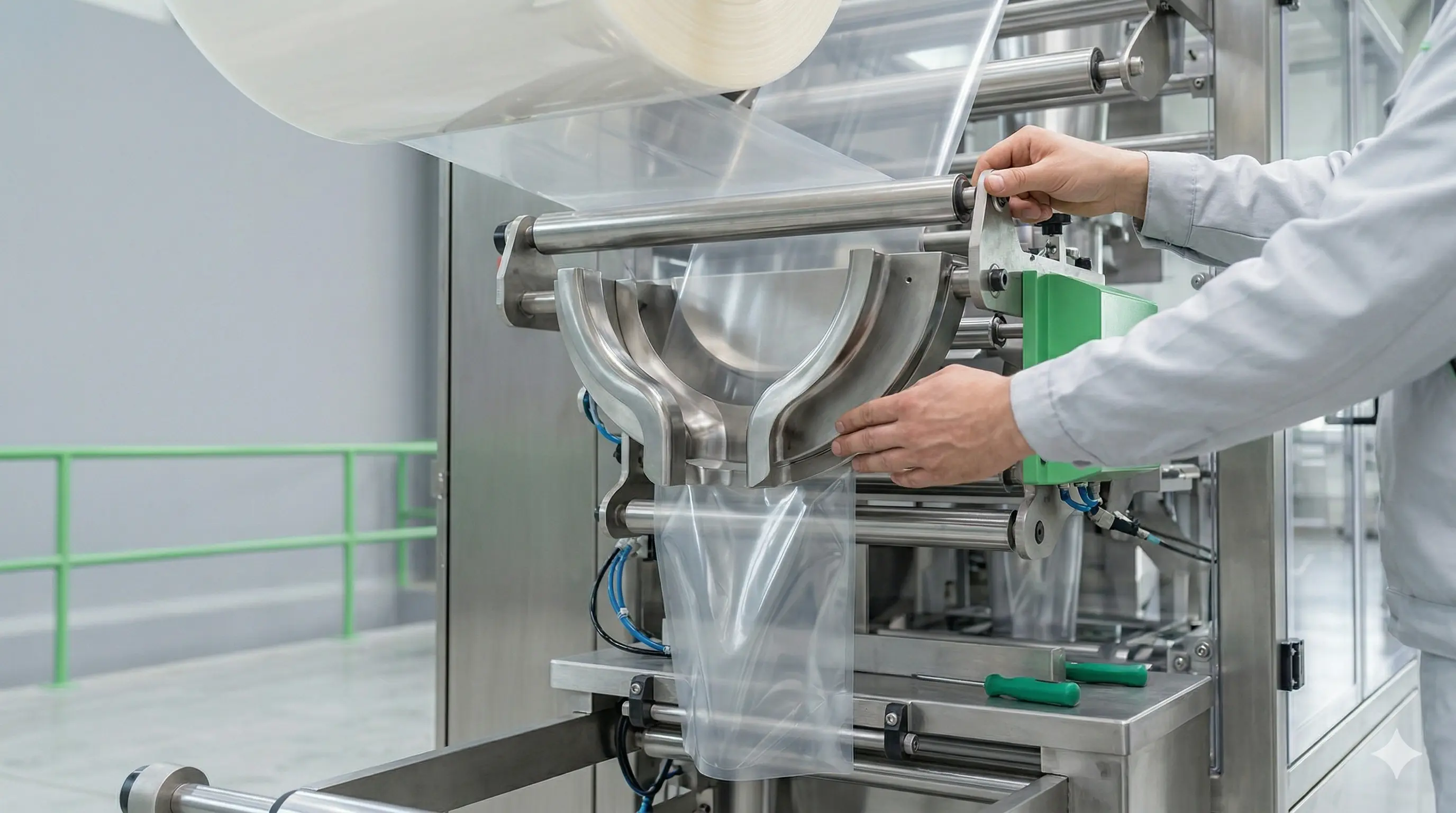
The actual line setup can vary, but the basic process typically works like this. First, the film roll is loaded onto the packaging machine and unwound. Second, the material is shaped according to the package design. Third, the machine creates seals using heat, pressure, ultrasonic sealing, or another suitable method. Fourth, the product is dispensed into the package. Fifth, the package is sealed, closed and cut to final dimensions.
This integrated process is why rollstock packaging is often favored in automated environments. Because forming and filling happen on the same line, the process can run at significant speed and scale when everything is set up properly.
Rollstock vs Premade Pouches: What is the Difference?
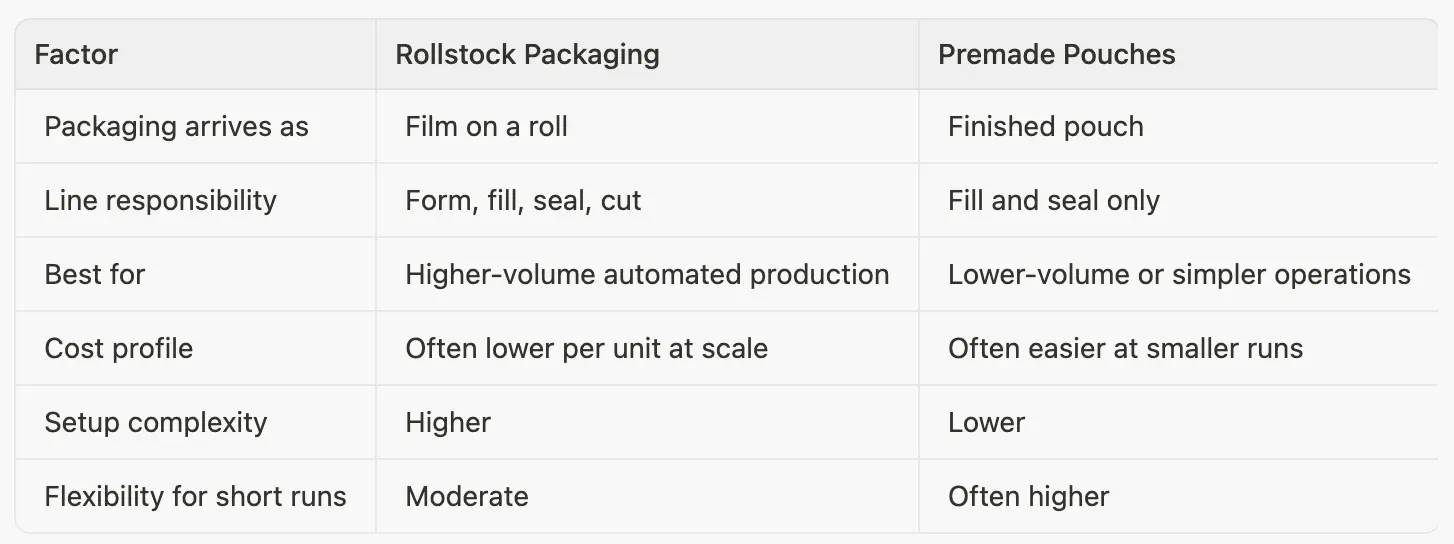
The most important comparison for many buyers is not rollstock versus another film spec. It is rollstock versus premade pouches. Premade pouches are convenient because the package is already formed, which can simplify some production setups. Rollstock, by contrast, shifts more work to the packaging line, but that tradeoff can unlock faster throughput and lower unit economics at volume.
A premade pouch program may be the better choice if a brand is still testing the market, running lower volumes, using semi-manual filling processes, or prioritizing short-run flexibility. Rollstock often becomes more attractive when a business has steady demand, automated lines, or a co-packer that already runs compatible form-fill-seal equipment.
The operational difference is significant. With premade pouches, the line fills and seals a finished pouch. With rollstock, the line forms the pouch before filling and sealing it. That means rollstock can reduce the cost of buying finished converted pouches, but it requires the machinery, expertise, and setup discipline to convert the roll into a finished pack consistently.
What Types of Packaging can be Made from Rollstock?
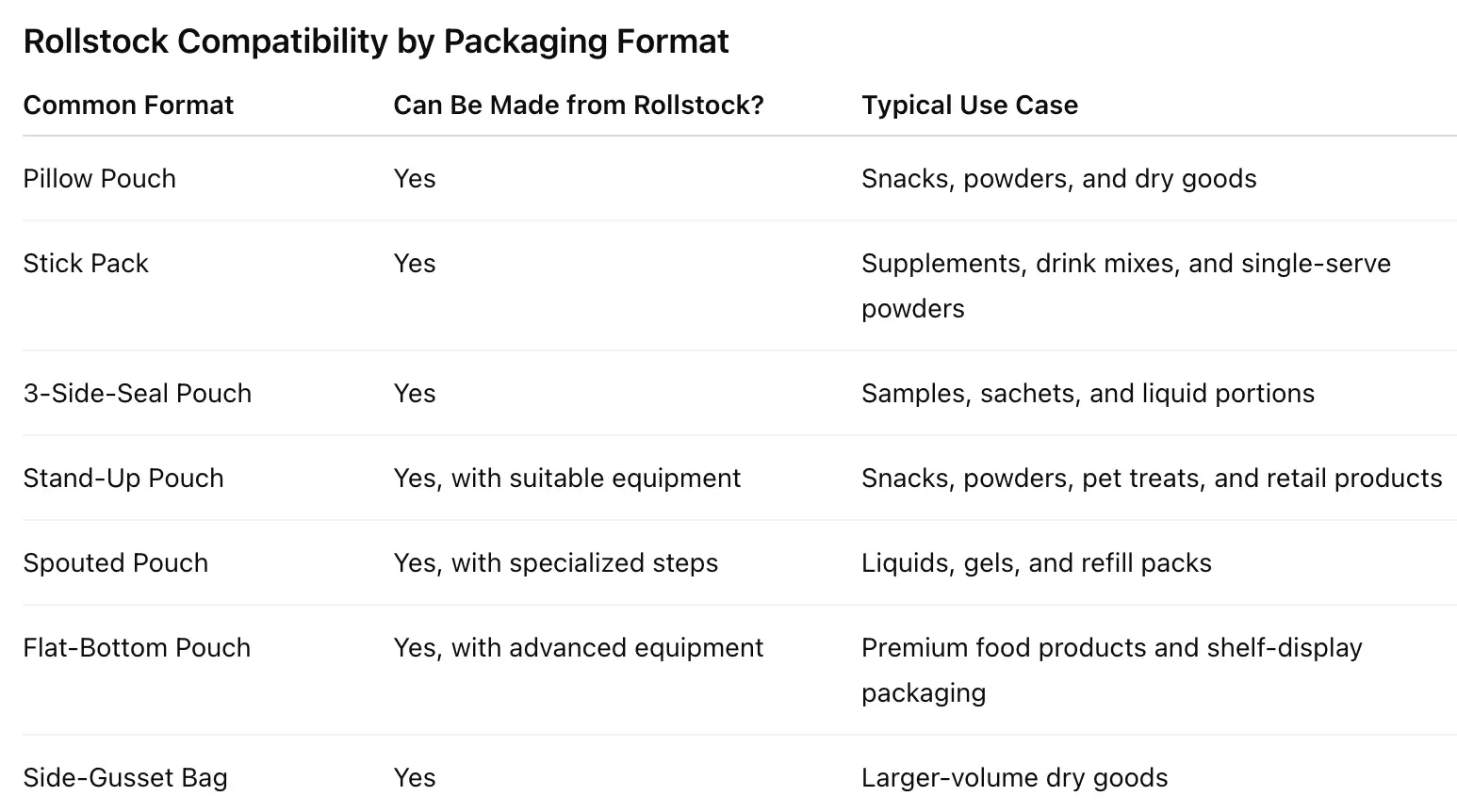
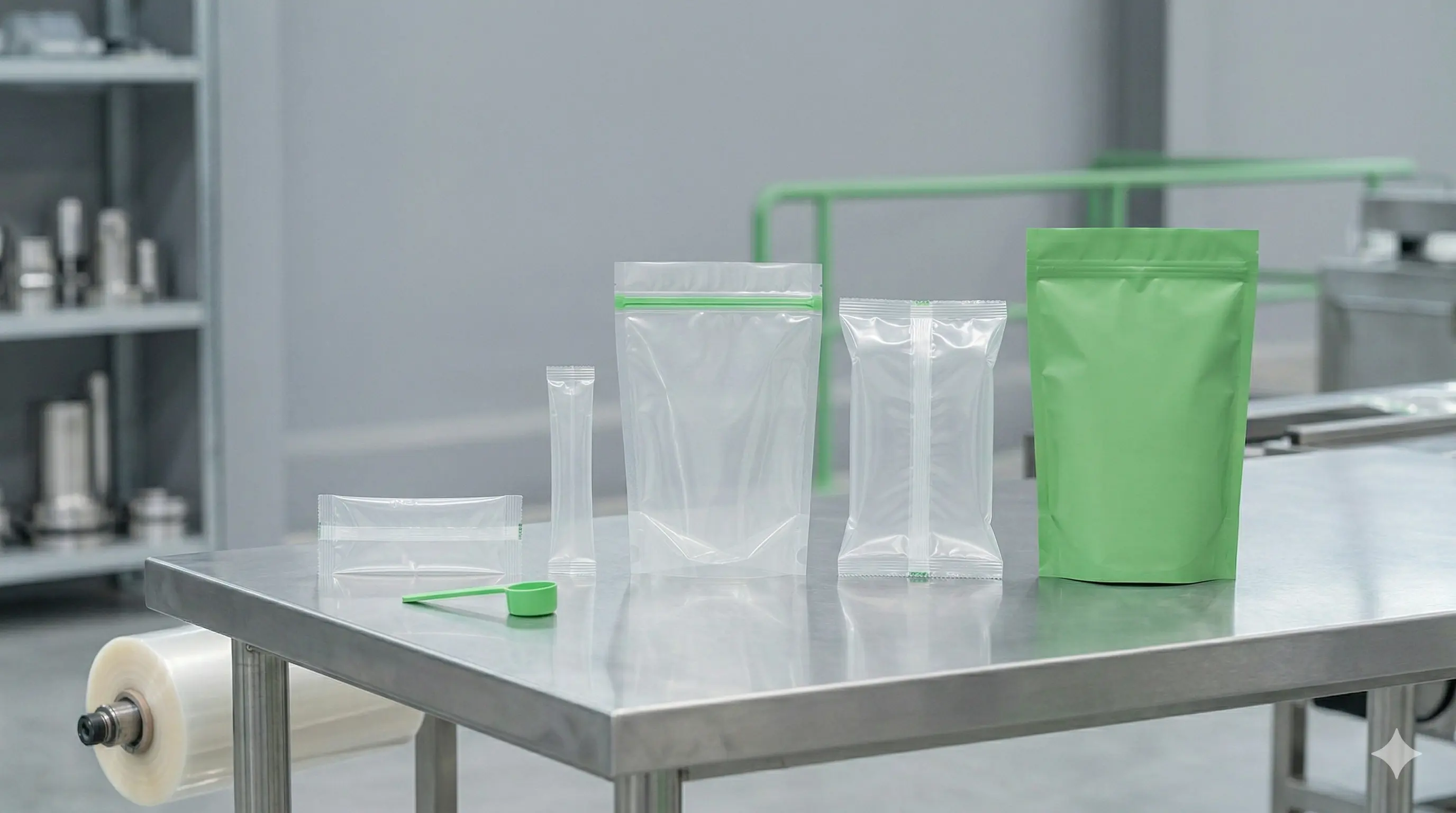
One of the biggest misconceptions about rollstock is that it only produces one or two generic package types. In reality, rollstock can support a broad range of formats when paired with the right equipment. Rollstock can be used to form flat sachets, 3-side-seal pouches, stand-up pouches, pillow pouches, stick packs, spouted pouches, flat-bottom pouches, and gusseted side-seal bags.
That range is commercially important because it means rollstock is not just for cheap commodity packaging. It can serve entry-level single-serve formats, mainstream snack and powder packs, and more advanced retail-ready configurations. The question is not whether rollstock can form a useful package. The question is whether the available machinery can form the specific package your application requires.
For example, stick packs and pillow pouches are relatively familiar rollstock outputs. More advanced pouch formats such as stand-up or flat-bottom pouches may require more specialized horizontal form-fill-seal setups or added equipment steps.
A brand considering rollstock therefore needs to evaluate package ambition alongside equipment reality.
What Machines are Used for Rollstock Packaging?
The machine question is central to any realistic discussion of flexible packaging rollstock. There are two major machine categories: vertical form-fill-seal and horizontal form-fill-seal systems.
These machine types do not simply package at different angles; they often shape what formats, speeds, and product types are practical.
A VFFS machine feeds film vertically, forms it around a tube, fills product from the top, and seals it into the finished shape. This setup is commonly used for pillow pouches, gusseted bags, and stick packs.
It is a common fit for snacks, dry mixes, powders, and flowable products that work well with gravity-fed filling.
An HFFS machine moves the film horizontally and can support more complex pouch structures in a single pass. Horizontal systems are used for stand-up pouches, 3-side-seal pouches, and flat pouches.
In many applications, HFFS systems are preferred when the package design is more sophisticated or when the product needs a broader, more stable pouch profile.
The machine decision matters because brands sometimes fall in love with a pouch style before verifying line compatibility. That creates delays, added cost, or avoidable redesign. The packaging structure must match the machine’s capabilities, sealing profile, registration tolerance, and production rhythm.
When Should you use Rollstock Packaging?
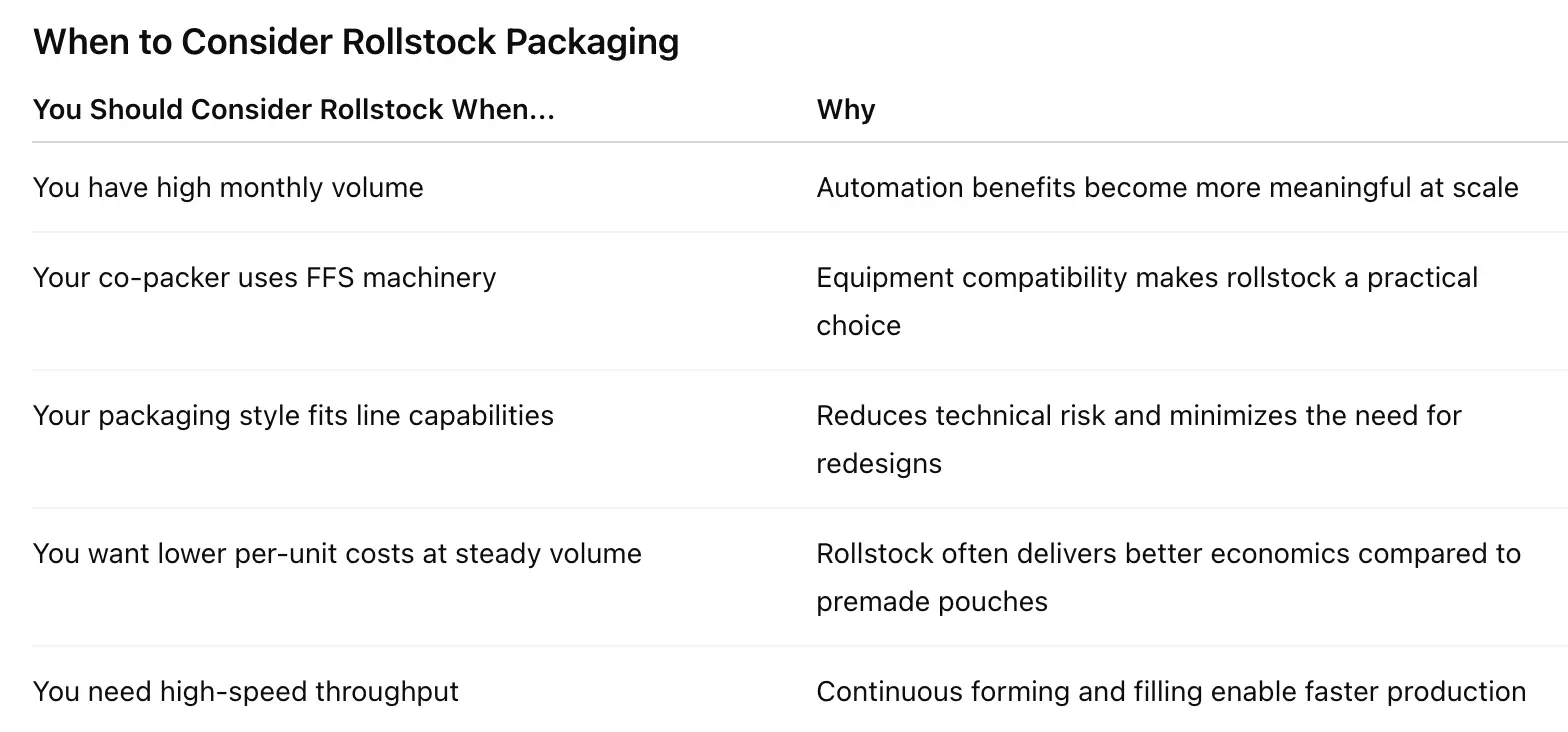
Rollstock makes the most sense when the packaging operation benefits from automation, throughput, and scale. Businesses packaging at least 50,000 to 100,000 units per month can realize substantial savings in material and labor, while companies running hundreds of thousands to millions of pouches per month may see even greater benefits. That does not mean those thresholds are universal, but it does provide a useful practical benchmark.
Brands should seriously consider rollstock when several conditions are true at the same time. First, production volumes are stable enough to justify line efficiency gains. Second, the business either owns suitable equipment or works with a co-packer that does. Third, the chosen format is compatible with the line. Fourth, the packaging program values lower per-unit economics and faster production more than the convenience of buying fully formed pouches.
Rollstock can also be an especially strong choice when a company is operating in categories where continuous packaging speed matters, such as snacks, powders, pet products, samples, medical applications, or high-volume food items. In those cases, even modest savings in material handling, labor, or throughput can compound significantly over time.
When Should you Avoid or Delay Rollstock?
Rollstock is not always the right answer. If a brand is still in early market testing, managing highly variable run sizes, or operating with limited packaging automation, premade pouches may offer more flexibility. Likewise, if the target package design requires specialized features that the production line cannot support reliably, the apparent cost savings of rollstock can disappear quickly.
A company should also be cautious if it does not yet understand the sealing behavior, registration requirements, barrier needs, or machine tolerances involved. Rollstock is powerful, but it rewards operational discipline. Poor setup can create issues with seal consistency, waste, downtime, or package performance. In that sense, rollstock is often best viewed not as a cheaper alternative in the abstract, but as a more efficient solution in the right production environment.
Industries that Benefit most from Rollstock Packaging
Rollstock appears across many industries, but it is especially useful where speed and repeatability are important. Food, pet food, cosmetics, and cannabis are key categories that benefit from rollstock packaging.
This list aligns with broader flexible packaging logic: the format works best where brands need volume, convenience, and adaptable package construction.
Food is the most obvious category because many products such as snacks, powders, drink mixes, confections, grains, frozen components, and sachet-style servings are well suited to automated packaging. Pet product brands often benefit for similar reasons, especially with treats, toppers, powders, and certain dry goods. Cosmetics and personal care use rollstock for sachets, sample packs, face masks, wipes-related packaging, and portable single-use formats. Specialized regulated sectors may use rollstock as well, provided the film structure and line setup support compliance and product protection.
What is Custom Printed Rollstock?
Custom printed rollstock is rollstock film that includes brand artwork, product information, design elements, and registration marks printed directly onto the packaging web before it is run on the line. Instead of applying a generic film and then labeling it separately, the package graphics are built into the film structure itself.
This matters for both branding and operations. Printed rollstock can create a more polished retail presentation, support brand consistency across SKUs, and reduce the need for secondary labeling steps. It can also improve efficiency in environments where preprinted film is integrated into automated packaging workflows.
Rollstock Film and Material Options
When buyers search for rollstock film, they are usually trying to understand what the material can be made from and how it should be specified. Rollstock offers flexible packaging material that may include plastic, paper, foil, or laminates. The material choice should support the required level of product protection while allowing room for sustainability goals.
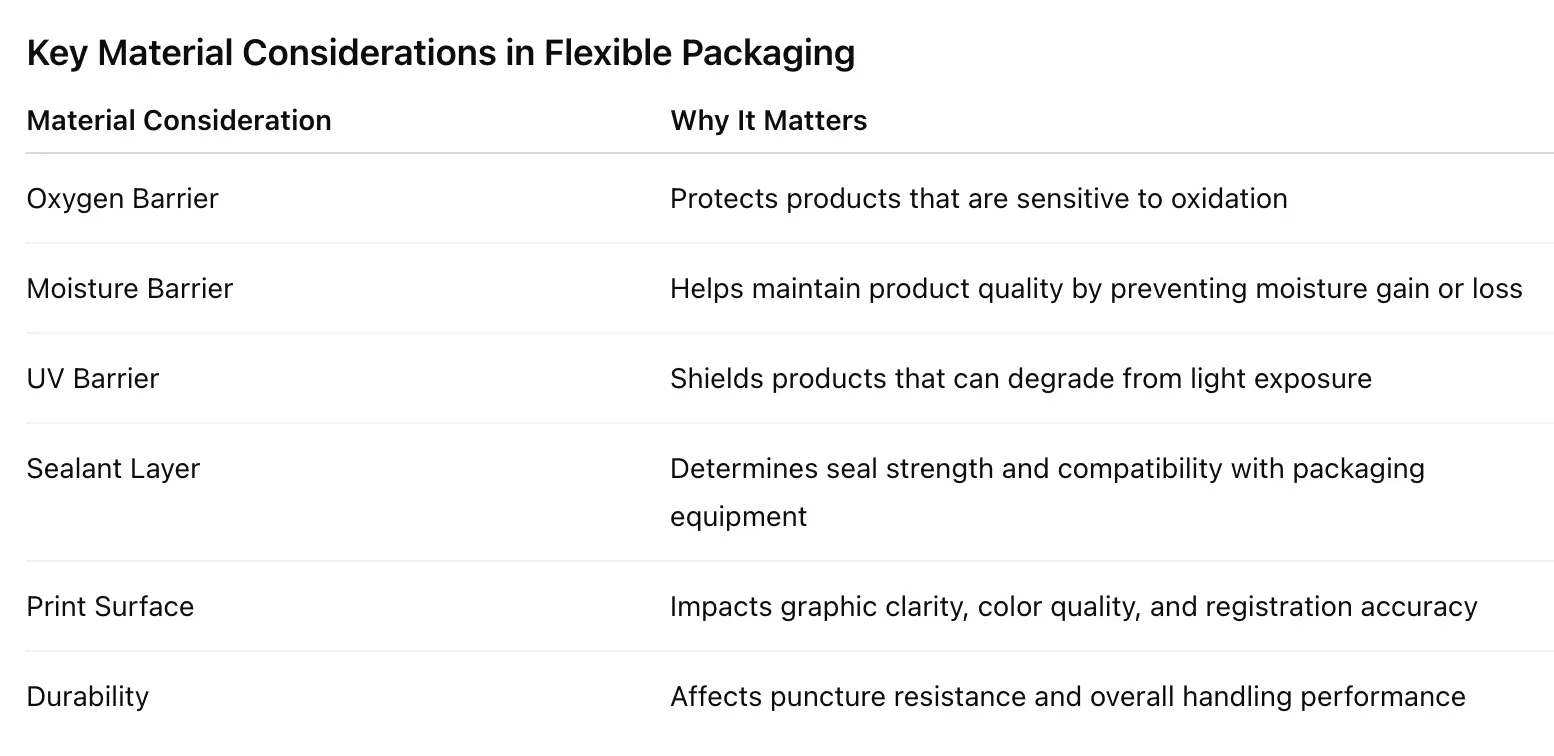
The right film depends on the application. Some products require moisture resistance. Others need oxygen barrier, grease resistance, puncture durability, aroma retention, UV protection, or freezer performance. The rollstock itself is not automatically protective; the protective performance comes from the film structure and sealing system chosen for the package.
The question to ask is,, “What kind of rollstock film does my product require?” The answer depends on product sensitivity, distribution conditions, shelf-life targets, and machine sealing demands.
What is High Barrier Rollstock?
High barrier rollstock refers to film structures engineered to provide stronger protection against external elements such as oxygen, moisture, aroma loss, or light exposure. Barrier level is important because many food, supplement, coffee, and specialty products need more than a basic film if they are going to maintain quality across storage, shipping, and shelf life.
Rollstock supports the same barrier properties available in other pouch formats, including oxygen, moisture, and UV barriers. That means the choice between rollstock and premade pouches does not eliminate barrier packaging options. Instead, it changes the package manufacturing format while still allowing brands to specify suitable protective structures.
Sealing Methods in Rollstock Packaging
The package is only as good as its seals. There are three major sealing methods in rollstock packaging: heat sealing, ultrasonic sealing, and cold sealing. These distinctions are highly relevant to brands because the wrong seal approach can undermine package integrity even if the film itself is well chosen.
Heat sealing is common and reliable for many high-speed applications, especially in food, pet food, pharmaceuticals, and cosmetics.
Ultrasonic sealing can be useful for heat-sensitive materials or products that risk contaminating the seal area, because it concentrates sealing energy locally.
Cold sealing, which uses pressure and an adhesive rather than heat, is often appropriate for heat-sensitive products such as chocolate.
Sustainability and Recyclable Rollstock
Sustainable packaging is not simply about choosing the thinnest or newest material. It is about choosing a structure that protects the product effectively while aligning as closely as possible with end-of-life, waste reduction, and operational objectives. A package that fails and causes spoilage is not truly sustainable, even if its substrate sounds attractive in theory.
For that reason, the best sustainability guidance for rollstock is practical rather than ideological. Brands should define product protection requirements first, then evaluate recyclable or more sustainable rollstock structures that still meet performance needs.

Rollstock and Co-packers: What Brands Need to Know
It’s important for brands working with third-party packagers or co-manufacturers to first understand what equipment the co-packer uses. This is often the difference between a successful rollstock launch and an expensive packaging mismatch.
If a co-packer runs a specific vertical or horizontal form-fill-seal platform, the rollstock specifications must fit that equipment. That includes film gauge, width, core size, sealing profile, registration layout, pouch geometry, and added features. A package concept that looks great in a design presentation may not run properly if it is not built around the line’s actual capabilities.
For many brands, the first step is not choosing artwork. It is confirming whether their current co-packer can run the desired film and format consistently.
How to Know if Rollstock is Right for your Business
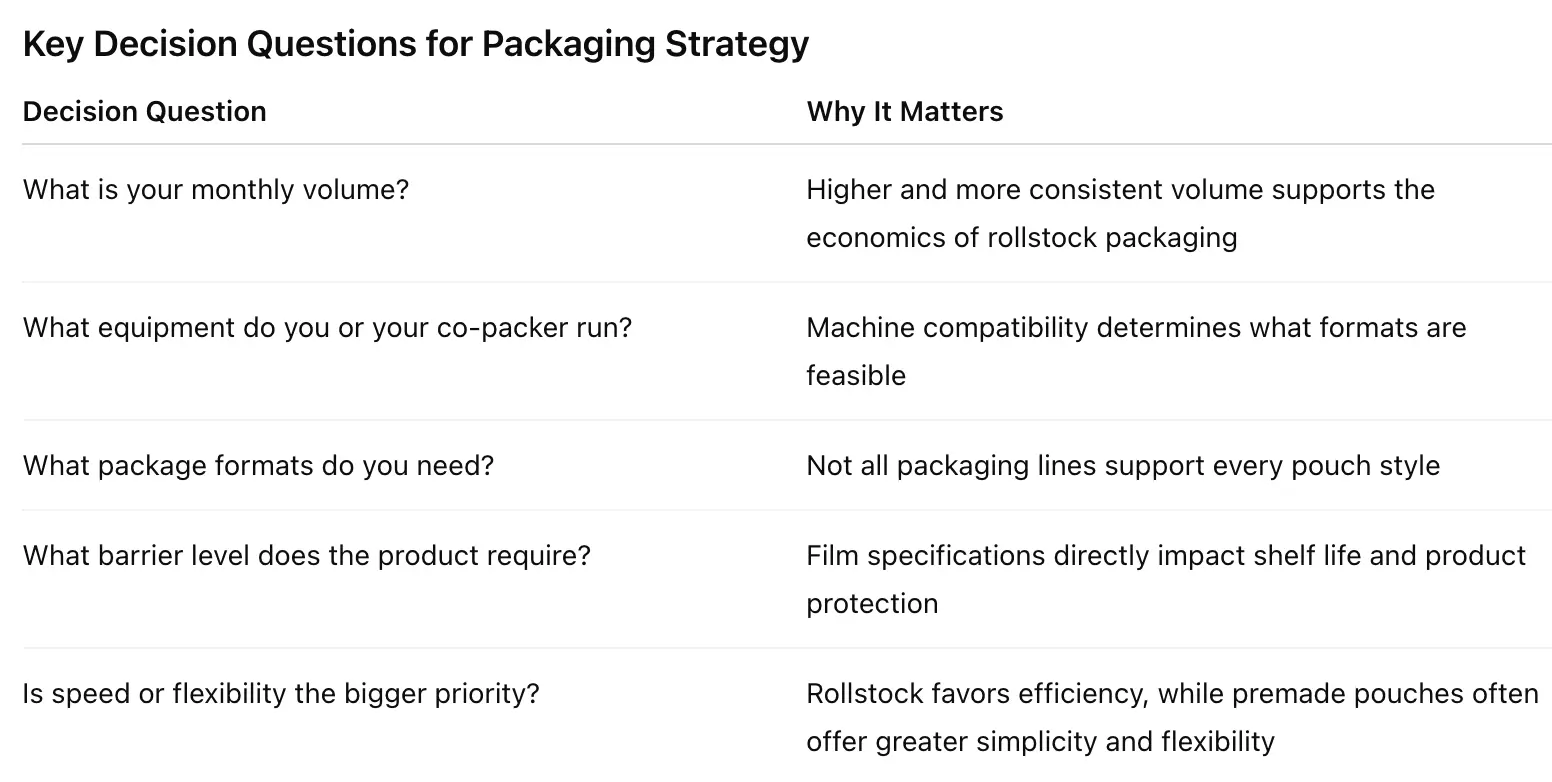
The best way to decide whether rollstock fits your operation is to evaluate five areas together: volume, equipment, product type, package format, and business goals. If you have enough volume to benefit from automation, a line that can run the chosen material, a product well suited to FFS packaging, and a business goal centered on throughput and per-unit efficiency, rollstock is likely worth serious consideration.
If, on the other hand, your volumes are inconsistent, your formats change frequently, your equipment is limited, or your team needs the easiest possible packaging workflow, premade pouches may still be the better choice.
Rollstock Packaging FAQ
What is rollstock?
Rollstock is flexible packaging material supplied as a continuous roll rather than as a finished pouch. It is typically used in packaging equipment that forms and seals the final package during production.
What is rollstock packaging?
Rollstock packaging is packaging produced from rollstock film on form-fill-seal equipment. The machine unwinds the film, forms the package, fills it, seals it, and cuts it to final shape in one integrated process.
What is a rollstock?
In packaging, a rollstock is the roll of packaging substrate itself. It may be printed or unprinted and can be made from plastic, paper, foil, laminates, or specialty structures depending on the application.
What is high barrier rollstock?
High barrier rollstock is rollstock film engineered to provide stronger protection against oxygen, moisture, light, or aroma transmission. It is commonly used for products that need extended shelf life or stronger product protection.
What is the difference between rollstock and premade pouches?
Rollstock arrives as film on a roll and is converted into packaging on the line, while premade pouches arrive already formed and only need to be filled and sealed. Rollstock is often better for automated, higher-volume production; premade pouches are often simpler for lower-volume operations.
What products use rollstock packaging?
Rollstock is commonly used for snacks, coffee-adjacent dry goods, powders, stick packs, pet products, sample sachets, cosmetics, and other products that run efficiently on form-fill-seal equipment.
When should you use rollstock packaging?
You should consider rollstock when you have sufficient volume, access to compatible machinery, and a packaging program that benefits from automation, throughput, and lower per-unit packaging cost at scale.