

Is Your Pet Product Packaging Protecting Shelf Life and Ease of Use?
A practical guide to pet food packaging, covering stand-up pouches, spouts, closures, barrier films, print methods, and design strategies that protect freshness, boost shelf impact, and improve usability for dry and wet products.
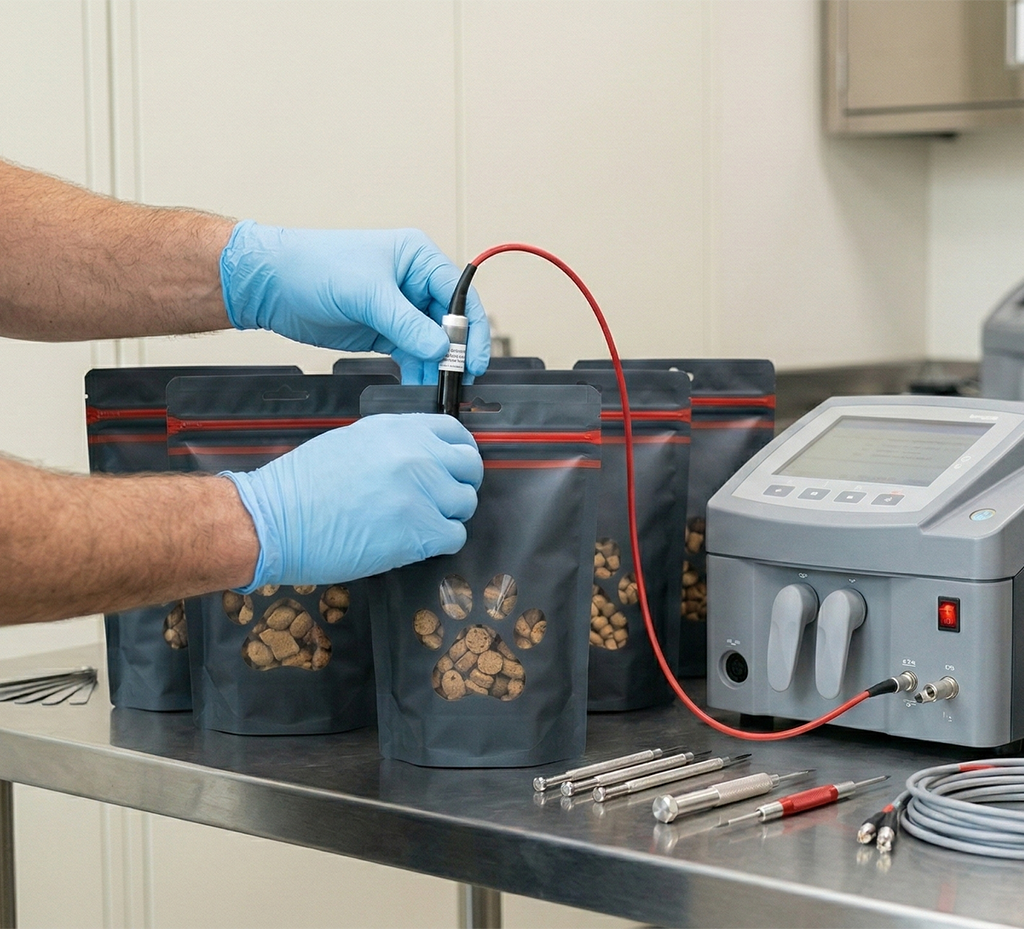
In the pet aisle, decisions are made in seconds, and the bag does most of the talking. For brand owners and co-packers, pet product packaging isn’t just artwork; it’s food safety, shelf impact, and throughput in one system.
On shelf and on-screen, the package makes the first sale. Pet parents judge quality, freshness, and convenience in seconds, so pet product packaging has to command attention and protect what’s inside. Real performance starts with high-barrier protection against oxygen, moisture, and light, controls that slow staling, guard fats from oxidation, and lock in aroma without adding weight.
Expect a practical lens on formats for kibble, jerky treats, and wet toppers; how pouches, windows, closures, and spouts influence usability and shelf life; which specs matter (OTR, WVTR, light control, seal design); printing choices that signal quality; and sustainability that holds up, mono-material, PCR, and compostables, without losing control of cost or compliance.
If you’re weighing how to balance striking visuals with oxygen and moisture protection and everyday convenience, start with the fundamentals of dog food packaging design, the decisions that shape shelf impact and freshness from the first zipper to the bottom gusset.
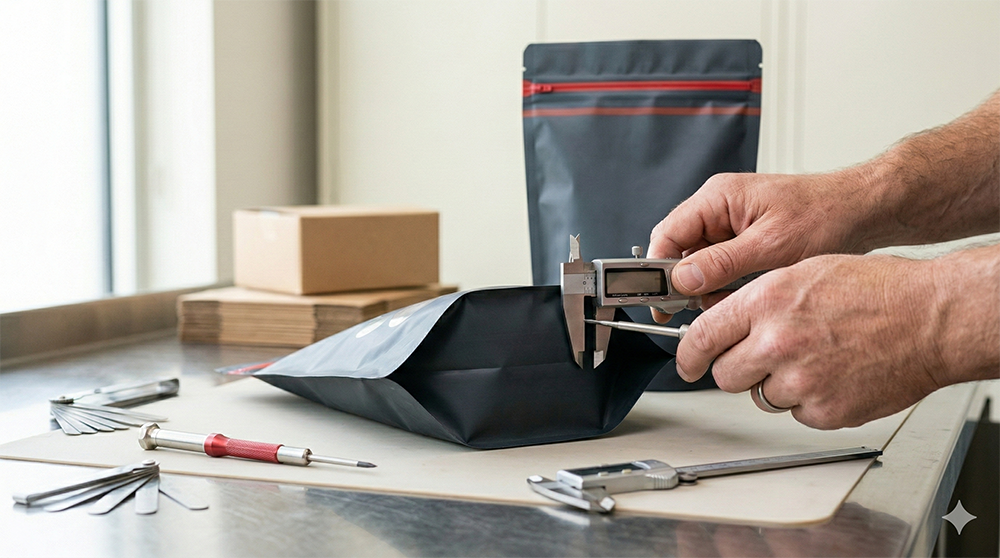
Best dog food packaging design: how to balance impact, barrier, and cost
Dog food packaging design succeeds when form and function converge in a pouch that looks premium, stands securely, and protects aroma and crunch. The right combination of finishes, windows, closures, and barrier films turns a split-second glance into a confident purchase while preserving shelf life.
Eye-catching stand-up pouch ideas for dog treats and kibble
Soft-touch matte with selective gloss creates visual hierarchy without glare. A velvety base finish draws the hand, while spot gloss on the logo or key claims directs the eye and improves legibility under retail lighting. High-resolution digital printing keeps fur detail and ingredient photography crisp, which matters when shoppers decide in seconds.
Windows shaped like paws or bones add charm and proof-of-product. Keep haze controlled so treats remain visible without spotlighting dusting. Many brands target a moderate haze range to balance viewability and perceived cleanliness. If you need both visibility and protection, specify clear high-barrier coatings such as ALOx or SiOx over PET to approach metallized performance while maintaining transparency. For oxidation-prone formulas, consider light-blocking inks in targeted panels.
Closures shape daily use. Powder-proof, dual-track zippers resist crumb infiltration and align consistently, reducing consumer frustration and staling. Sliders make sense above 2 lb formats, while low-profile press-to-close tracks preserve billboard space and run efficiently on smaller 4–12 oz treats. A stable bottom gusset completes the structure, choose the format that matches fill weight and product geometry.
How to Choose the Right Barrier to Keep Kibble Fresh Longer
Barrier is the invisible engine behind shelf life. Oxygen Transmission Rate (OTR) measures oxygen ingress; Moisture Vapor Transmission Rate (MVTR or WVTR) measures water vapor ingress. For dry kibble and treats, many brands target approximately:
- OTR under 1 cc/m²/day
- WVTR under 1 g/m²/day
Testing standards commonly include ASTM D3985 for OTR and ASTM F1249 for WVTR. These targets help slow rancidity, texture loss, and aroma fade.
Select film structures based on product sensitivity:
- PET/VMPET/PE (polyester/metallized polyester/polyethylene) delivers strong oxygen and light barrier for oil-rich recipes.
- PET/EVOH-PE provides robust oxygen protection with potential recyclability advantages in certain markets, though EVOH performance declines under high humidity.
- ALOx- or SiOx-coated PET with a PE seal layer maintains clarity while approaching metallized oxygen and moisture performance.
If omega-rich fats or fish oils are present, integrate light-blocking inks, internal black layers, or metallization to reduce photo-oxidation. Premium appearance should always align with measurable protection.
Doyen vs. K-Seal vs. Plow-Bottom: Which Gusset Is Best?
Doyen
A curved, center-sealed bottom suitable for lighter fills and fine particulates. It forms efficiently on most pouch lines and stands well on narrow shelves, though heavy or sharp treats can stress the center seam.
K-seal
Angled seals distribute weight away from the bottom fold, improving stability for medium-to-heavy treats and irregular shapes. A common upgrade when pouches slump or when stronger corners are needed for eCommerce drop performance.
Plow-Bottom (Flat Bottom)
A box-like footprint that maximizes shelf stability and case-pack efficiency. Offers five panels for graphics and a premium presence, ideal for larger formats and high-end product lines. It uses more material and adds structural complexity.
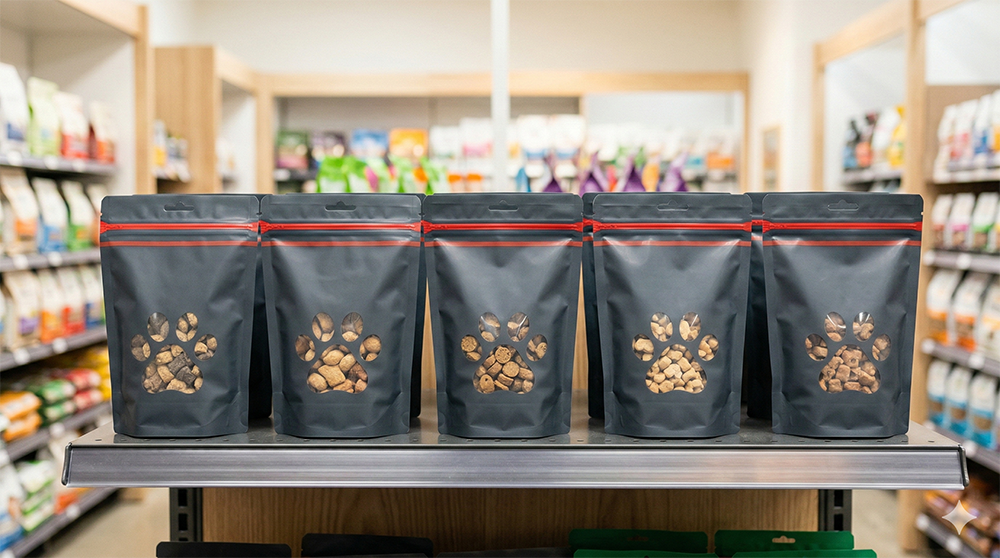
Case study: how a treat pouch upgrade improved shelf impact and freshness
A jerky treat brand upgraded from a basic PET/PE pouch with a standard zipper to a soft-touch PET/VMPET/PE structure paired with a powder-proof dual-track closure. The redesign included:
- A paw-shaped ALOx window
- Selective gloss on the brandmark
- A switch from Doyen to K-seal for improved standability at 8 oz
Shelf testing showed faster product recognition. Laboratory results confirmed OTR under 1 cc/m²/day and WVTR under 1 g/m²/day, supporting a six- to nine-month shelf-life goal aligned with the product’s oil content.
Consumer feedback improved as well. The dual-track zipper reduced crumb buildup near the seal, improving reclosure reliability and maintaining crunch over time. Flexible formats also reduced primary packaging weight compared to rigid alternatives, helping lower freight costs without altering case counts or retail footprint.
When refining specifications, start with a PET/VMPET/PE or PET/EVOH-PE baseline and adjust film gauge to meet drop, burst, and seal-strength targets before layering on finishes and visual effects. Structure should protect first, then amplify brand recognition.
Custom-Shaped Pouches for Pet Treat Brands: Design, Cost, and Merchandising Wins
Custom-shaped pouches can transform a standard bag into a brand signature, but only if the structure is engineered as carefully as the graphics. The right die-cut profile boosts recognition on crowded pegs while preserving seal integrity, zipper performance, and barrier continuity through curves. The key is balancing creativity with production realities in pet product packaging.
Shape With Purpose: Bones, Paws, and Brand Silhouettes
Choose a silhouette that reinforces your brand story and reads clearly from several feet away. Bones and paw shapes deliver instant category recognition. A simplified brand outline can be equally distinctive while using smoother curves that run more efficiently on packaging lines.
Respect the Radius to Protect Seals
Maintain practical structural tolerances:
- Minimum inside radii of 3–6 mm at tight curves
- Seal flanges of 8–12 mm around the perimeter
Sharp corners concentrate stress and may reduce peel strength or cause seal creep during filling. Validate seal strength using ASTM F88, targeting roughly 3–6 N/15 mm for standard treat packs.
Barrier Continuity at the Edge
Complex outlines must maintain oxygen and moisture protection:
- Metallized PET supports strong oxygen and light barrier through intricate shapes
- Clear ALOx or SiOx coatings allow visibility while maintaining sub–1 cc/m²/day OTR when laminated correctly
Avoid placing ultra-tight curves where clear windows transition to opaque films, as this can increase micro-cracking risk.
Zipper Placement That Works With Curves
Keep functional elements simple even if the outline is custom:
- Position the zipper straight and 15–20 mm below the top seal
- Use laser scoring for easy-open features that follow the outer shape
- Avoid crossing the zipper track with tear notches
Misalignment can increase tear force or produce ragged openings.
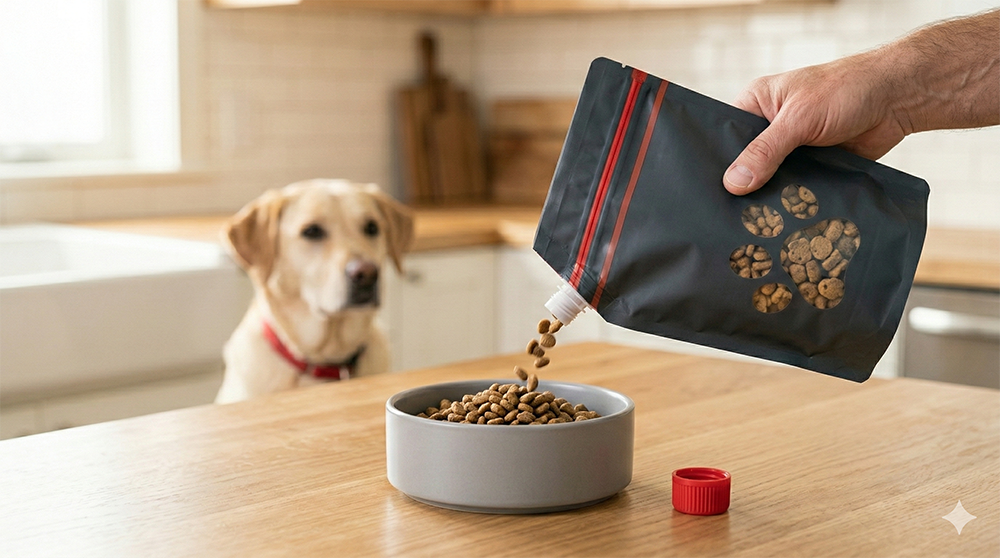
Stand Stability: Gusset Choice Still Matters
Shaped sidewalls often reduce the base footprint, so the bottom gusset must compensate.
- Doyen gussets suit lighter treats and display well
- K-seal gussets distribute weight better for denser jerky or clusters
- Plow-bottom structures provide maximum stability and premium shelf presence
Match gusset style to fill weight and product geometry to prevent tipping or “nose-diving.”
Hang Holes for Pegged Displays
For pegged retail environments:
- Place round or sombrero-style hang holes in a reinforced header above the zipper
- Center the hole on the package’s center of gravity
- Leave 6–10 mm between the hole edge and top seal
- Validate hang strength to at least 2–3 kg to prevent tear-out
Artwork Mapping to the Die Line
Custom shapes require careful graphic alignment:
- Pre-distort artwork to fit the final contour
- Add 0.2–0.3 mm trapping along curved color transitions
- Place logos and key visuals within the widest central area
- Keep critical elements away from seal jaws and gusset folds
What It Costs to Go Custom
Expect:
- A one-time die charge
- A modest per-unit cost premium that decreases with volume
- Approximately one to two additional weeks for tooling and approvals
Symmetrical shapes with smooth radii run faster and generate less film waste than intricate designs with narrow extensions.
Yield and Sustainability Considerations
Complex outlines can increase trim scrap. Work with your converter to nest parts efficiently and reduce waste. If targeting recyclable mono-PE structures:
- Keep header and zipper materials compatible
- Avoid ultra-tight curves that require specialty reinforcements
Validation You Shouldn’t Skip
Before launch, perform:
- ASTM F1140 burst testing at worst-case fill weight
- ASTM D5276 drop testing focused on narrow tips and necks
- Peripheral seal inspections after vibratory conveyance
Curved edges experience higher localized fatigue during distribution and must be verified under real-world conditions.
When engineered correctly, a custom-shaped pouch delivers instant recognition without sacrificing freshness or production efficiency. Once your dry treat structure is optimized, you can extend innovation to wet formats where flow control, dosing accuracy, and fitments redefine packaging performance.
Best Packaging for Wet Pet Food: Why Spouted Pouches Win on Use and Logistics
Wet recipes demand clean pouring, airtight reclosure, and a structure that survives transit without dents, paneling, or leaks. Spouted pouches meet those needs by turning gravies and broths into portionable, resealable formats while reducing packaging weight and shipping cube. Within pet product packaging, few solutions combine consumer convenience and engineering control as effectively as a well-specified spouted pouch.
Spout Placement: Function First
Spout position affects both usability and shelf impact.
- Top-center spouts pour like a kettle, ideal for thinner gravies and fast, direct dispensing into bowls.
- Side spouts slow the stream for better dosing over kibble and allow the pouch body to function as a handle for one-handed use.
On shelf, a side spout creates a distinctive silhouette that stands out in peg sets and online thumbnails. Left- or right-leaning placements can even align with dominant shopper habits identified in research.
Cap Geometry and Safety
Cap design influences flow, grip, and consumer trust.
- Wide-bore caps improve pour speed and reduce glugging.
- Ribbed textures enhance grip with wet hands.
- Tamper-evident bands provide visible assurance.
- Anti-choke sizing and vented patterns support safety compliance.
Validate torque settings during production to prevent leaks without creating opening difficulty. For thicker toppers, an orifice reducer can improve striping control.
Fitment Weld and Seal Architecture
The spout flange bonds to the laminate using controlled heat, pressure, and dwell time. Consistency prevents leak paths at the weld.
Reinforce this connection with:
- Double or triple seal passes
- Burst and drop validation testing
- Dye ingress tests for channel leaks
- Vacuum chamber bubble tests for gross failures
- Vacuum decay for non-destructive assurance
Improving burst strength and qualifying to structured drop protocols can significantly reduce damage claims and protect brand perception.
Film Structures for Wet Applications
Formulation and process determine laminate selection.
- Hot-fill gravies require films that retain seal strength during cooling.
- Retort applications demand oriented PET for stability, aluminum foil or high-barrier alternatives for oxygen and light protection, and cast PP sealants that remain ductile after 121°C sterilization.
- Ambient broths benefit from ultra-low oxygen and moisture transmission to protect fat-rich bases.
Clear ALOx-coated films can offer visibility while maintaining strong barrier performance. Position clear zones away from weld areas and reinforce surrounding seals to avoid thinning.
Fitments and caps must carry the same process rating as the film to prevent structural mismatch.
Filling Strategy and Air Management
Choose between:
- Fill-through-spout systems, which simplify cleanliness and reduce seal contamination
- Top-fill and seal systems, often faster at higher volumes but requiring immaculate seal surfaces
Incorporate nitrogen dosing or headspace control to maintain panel stability and drop resistance.
Merchandising and Economics
Spouted pouches often outperform cans in logistics and damage resistance.
- Reduced package weight lowers freight costs
- Improved cube efficiency increases units per pallet
- Elimination of dent risk simplifies secondary packaging
When evaluated across materials, conversion, and freight, many brands achieve cost parity or improvement, especially as damage rates decline. Short-run digital printing supports pilot programs before transitioning to flexographic or rotogravure at scale.
Design as a Functional Feature
Treat the spout and shoulder area as branding real estate.
- Use color bands to differentiate proteins or flavors
- Place pour icons near the cap to cue usage
- Position key claims opposite the spout to remain visible during pouring
- Use matte finishes to reduce glare under cooler lighting
A small, strategically placed clear window can communicate viscosity while preserving barrier elsewhere.
Sustainability Considerations
Spouted pouches typically use less material than rigid tubs or cans and eliminate metal ends, reducing transport emissions.
Emerging options include:
- Mono-material recyclable structures for certain applications
- PCR integration where regulations permit
- Alignment with retailer recycling programs to support credible on-pack claims
Evaluate compatibility between film and fitment when targeting recyclability pathways.
Spouted pouches succeed when the fitment, film, and seal system are engineered as one integrated unit. With cap safety, weld integrity, and process ratings validated, you gain a format that pours cleanly, ships efficiently, and performs well both in-store and online.
Next, evaluate sustainable material pathways, recyclable mono-structures, PCR, and compostable options, to ensure wet formats meet performance targets and program requirements without compromise.

Digital vs Flexo vs Rotogravure: Which Printing Method Makes Your Pet Food Packaging Look Its Best?
Choosing a print process is a strategic decision because it determines image clarity, finish capabilities, color consistency, lead time, and cost per unit. For brands planning new launches, line extensions, or seasonal SKUs, the right match between digital, flexographic, and rotogravure printing influences how accurately pet imagery reproduces, how quickly artwork reaches shelves, and which premium effects are realistic at your run size. The print method you select directly impacts pet product packaging performance, inventory exposure, and cash flow.
Digital Printing: Speed and Agility
Digital printing excels when flexibility and speed are priorities.
- No plates or cylinders required
- Ideal for short runs, market tests, and versioned SKUs
- Consistent color control across repeat runs
- Strong reproduction of gradients, fine detail, and small copy
This makes digital well-suited for lifelike pet photography and limited-edition flavors. The trade-offs include higher per-unit costs at larger volumes and fewer specialty finishing options. Metallic effects typically rely on metallized films rather than metallic inks, and tactile coatings may be more limited compared to analog presses.
Flexographic Printing: Scalable Efficiency
Flexographic printing becomes attractive as demand stabilizes and volumes increase.
- Moderate plate investment
- Lower unit cost at mid-to-high volumes
- Strong spot-color accuracy and expanded gamut capability
- Compatible with soft-touch matte and selective gloss applications
Modern plate technology and screening deliver reliable color consistency across runs. Compared with digital, version changes are less economical. Compared with gravure, extremely fine tonal transitions and certain high-impact metallic effects may be less pronounced.
Rotogravure Printing: Premium at Scale
Rotogravure is designed for long-run national programs where image fidelity and finish consistency must remain precise across high volumes.
- Engraved cylinders provide uniform ink laydown
- Rich solids and smooth gradients
- Crisp microtype reproduction
- Consistent application of soft-touch coatings, high-gloss varnishes, and metallic layers
Cylinder costs and lead times are the highest of the three methods. Gravure is best suited for stable artwork and production volumes large enough to justify the upfront tooling investment.
Choosing the Right Path
Align your decision with product stage, projected volume, and finish expectations:
- Use digital to launch, iterate, and validate artwork with minimal upfront cost.
- Transition to flexographic printing as velocity grows and matte/gloss enhancements become core to the brand look.
- Commit to rotogravure when national scale and premium finish complexity warrant cylinder investment.
Regardless of process, prioritize color management and design-for-process planning. Lock brand color targets, determine how metallic or soft-touch effects will be achieved, and size runs to prevent excess inventory. When approached strategically, print selection becomes a growth lever rather than a production constraint.
Freshness by Design: Avoid These Barrier-Spec Pitfalls
Shoppers decide in seconds, but freshness failures surface weeks later. In pet product packaging, small mistakes in barrier selection or seal design can shorten shelf life, cause leaks, and drive returns. Use the following pitfalls as a pre-production checklist before locking specifications.
Oxygen vs. Moisture: Picking the Wrong Barrier
Teams often focus heavily on either oxygen or moisture protection, rarely both, resulting in rancidity for fatty kibble or moisture pickup in jerky treats.
Match barrier to product risk:
- For dry kibble or high-fat treats, target OTR ≤1 cc/m²/day and include light barrier.
- For jerky or soft chews prone to caking or mold, aim for WVTR ≤0.5–1 g/m²/day.
Example: A salmon treat transitioned from PET/PE to PET/VMPET/PE and extended shelf-life stability by significantly reducing oxygen ingress.
Clear Window, No Light Plan
Standard PET windows improve visibility but allow UV and visible light to accelerate fat oxidation and color degradation.
Mitigation strategies:
- Use ALOx- or SiOx-coated clear barrier films.
- Add UV-absorbing inks or overprint varnish.
- Keep opaque artwork behind oil-rich product zones.
Example: A brand maintained a paw-shaped window but introduced UV-absorbing lacquer, keeping peroxide values within specification for nine months.
Seal and Zipper Under-Specified for Fines
Powdery toppers and crumb-heavy treats can contaminate seal areas and standard zippers, creating micro-channels and slow leaks.
Strengthen closure performance:
- Specify dual-track or powder-resistant zippers.
- Increase seal width to 8–10 mm for larger formats.
- Validate with ASTM F2054 burst and ASTM F88 peel testing.
Example: Switching to a hook-and-loop closure with a dust flap reduced zipper complaints by 70 percent on a topper SKU.
Overengineering With Foil
Foil delivers near-zero barrier but increases cost, adds crease sensitivity, and complicates recyclability.
A smarter path:
- Start with metallized PET or PET/EVOH-PE.
- Escalate to foil only if shelf-life testing demands it.
Example: A treat line replaced foil with MET-PET, maintained OTR under 1 cc/m²/day, lowered material costs, and improved durability.
Skipping Headspace Oxygen Control
Even high-performance films cannot compensate for high residual oxygen levels at sealing.
Best practices:
- Nitrogen flush to ≤2 percent residual oxygen.
- Consider oxygen scavengers for sensitive formulas.
- Audit with in-line oxygen sensors and periodic package testing.
Controlling residual oxygen can measurably reduce hexanal formation and preserve aroma integrity.
Thin Gauge and Low Puncture Resistance
Under-gauged sealant layers and missing abuse-resistant films increase the risk of pinholes from sharp kibble edges and transit abrasion.
Prevention strategies:
- Increase sealant thickness appropriately.
- Add oriented nylon or high-modulus PET for durability.
- Validate with ISTA drop and vibration testing, plus pinhole and creep evaluation.
Example: Increasing the sealant layer by 10–15 microns eliminated transit leaks on a 3 lb kibble pouch without affecting line performance.
Correct barrier and seal specifications prevent rancidity, staling, and leakage before they happen, protecting both margin and brand trust. Validate with laboratory data and pilot runs before scaling production.
Conclusion
When packaging works as a system, film, seals, closures, gussets, and print tuned to product chemistry and route to market, you win the moment at shelf and the months that follow in pantry. The throughline is measurable performance: match OTR/WVTR and light control to recipe risk, engineer seals and zippers for daily use, then select finishes and print processes that communicate quality at your scale while meeting sustainability targets. If you’re ready to turn concept into validated specs and line-ready files, Red Dot Packaging can help translate goals into structures, proofs, and tests that protect margin and brand trust. Get a custom quote with low MOQs, fast turnaround, and collaborative support from a team with 40+ years of flexible packaging expertise in pet product packaging.
You now have the specs that decide whether your kibble stays crisp and your toppers pour cleanly, barrier targets, gusset choices, zipper types, spout placement, and print method. Turning those decisions into a pouch that stands, seals, and ships without issues takes integrated engineering, material selection, and validation. Locking structure and print early protects shelf life and production timelines, instead of discovering oxygen or moisture gaps during scale-up.
Red Dot Packaging brings film science, closure know‑how, and in‑house digital, flexographic, and rotogravure printing under one roof to deliver custom pouches, spouted formats, and rollstock that run right and look premium. We help set OTR and WVTR targets, specify PET/VMPET/PE or ALOx clear options, validate seals and fitments, and align finishes with your artwork, so your pet product packaging performs on shelf and on the line. Ready to model your structure, timeline, and pricing? Get a Quote.
Frequently Asked Questions: Pet Food Packaging Design, Materials, and Performance
What are the most eye-catching stand-up pouch designs for pet food brands?
Pair a soft-touch matte base with spot gloss on your logo and key claims to create contrast without glare. Add a paw- or bone-shaped window with controlled haze so treats are visible without highlighting dust. Use high-resolution digital printing to keep fur texture and ingredient photography crisp. If you need both visibility and protection, specify clear high-barrier ALOx or SiOx coatings and add targeted light-blocking inks where fats are oxidation-prone.
Which resealable features make pet food easier for customers to use every day?
Powder-resistant, dual-track zippers resist crumb infiltration and align reliably, helping maintain freshness. Sliders perform well on packages above 2 lb, while low-profile press-to-close tracks preserve billboard space on 4–12 oz packs. Add laser scoring for easy-open performance and keep tear notches clear of zipper tracks. Position the zipper straight and approximately 15–20 mm below the top seal for consistent sealing and consumer-friendly access.
What eco-friendly packaging options are realistic for pet food without compromising performance?
Recyclable mono-material structures, often mono-PE, are emerging options but require compatible zippers and fitments to remain in the same recycling stream. PCR content can reduce virgin resin usage where regulations allow. Lightweight flexible packaging reduces transport emissions compared with rigid cans or tubs. Compostables may work in limited scenarios but often trade barrier performance and durability for end-of-life benefits. Avoid overengineering with foil if metallized PET or PET/EVOH-PE meets oxygen and moisture targets at lower cost and improved durability.
Can I make custom-shaped pet treat pouches, and what should I watch for?
Yes—bone, paw, or brand silhouettes can differentiate your product if engineered properly. Maintain inside radii of approximately 3–6 mm and seal flanges around 8–12 mm to preserve seal strength. Keep zipper runs straight even if the exterior outline curves. Use metallized PET for strong oxygen and light protection or clear ALOx/SiOx-coated PET for visibility. Avoid tight curves at transitions between clear and opaque films. For pegged displays, center the hang hole above the zipper, leave 6–10 mm to the top seal, and validate hang strength around 2–3 kg.
What’s a better option than cans for wet pet food or broths?
Spouted pouches offer clean pouring, airtight reclosure, and lighter shipping weight. Top-center spouts enable quick pours into bowls, while side spouts allow better dosing and ergonomic grip. Choose caps with ribbed grip, tamper-evident bands, and anti-choke geometry. Validate torque settings and engineer fitment welds with multiple seal passes. Test with burst, drop, dye ingress, and vacuum methods. Match film structures to your process—hot-fill or retort—and keep clear windows away from weld areas.
How can premium printing make pet food packaging stand out, and which process should I choose?
Digital printing is ideal for short runs, fast changes, and photographic detail without plate costs. Flexographic printing lowers unit cost at mid-to-high volumes and supports soft-touch matte, spot gloss, and strong spot-color control. Rotogravure suits large, stable programs requiring maximum image fidelity and consistent specialty coatings, though it requires higher tooling investment. Metallic effects are most consistent when achieved with metallized films and compatible varnishes across flexo and gravure processes.
Which materials and barriers keep kibble and treats fresh the longest?
For most dry products, target an Oxygen Transmission Rate under 1 cc/m²/day and a Moisture Vapor Transmission Rate under 1 g/m²/day, validated to ASTM D3985 and ASTM F1249. PET/VMPET/PE provides strong oxygen and light protection for oil-rich formulas. PET/EVOH-PE offers robust oxygen barrier with potential recyclability advantages in certain markets. Clear ALOx or SiOx coatings maintain visibility while approaching metallized performance. For products containing omega-rich fats or fish oils, incorporate light-blocking inks, internal black layers, or metallization to slow photo-oxidation.
What packaging options work best for small-batch or startup pet food brands?
Begin with digital printing to eliminate plate costs and accelerate SKU testing. Use proven barrier baselines such as PET/VMPET/PE or PET/EVOH-PE, then adjust film gauge to meet drop, burst, and seal-strength targets before adding premium finishes. Consider rollstock for compatibility with co-packer equipment and lower conversion expense. As volumes grow, transition to flexographic or gravure printing to improve unit economics.
How should pet food pouches be tested to ensure seal integrity and transit durability?
Validate seals using ASTM F88 peel testing and ASTM F1140 burst testing, and perform dye ingress tests to detect channel leaks. Use vacuum chamber bubble or vacuum decay testing for leak detection. Qualify distribution performance with ASTM D5276 drop testing and vibration protocols, paying close attention to corners, seams, and shaped edges. Confirm barrier performance through OTR and WVTR testing to ASTM D3985 and ASTM F1249. Manage headspace oxygen with nitrogen flushing or scavengers, and evaluate zipper alignment and reclose strength under crumb exposure during line trials.
How can growing pet food brands lower packaging costs while improving design and protection?
Replace foil with metallized PET when laboratory data confirms barrier requirements are met. Right-size sealant gauges to prevent punctures without unnecessary resin use. Adopt rollstock where feasible and standardize gussets and closures across SKUs. Transition print processes from digital to flexo or gravure as volumes scale. Flexible packaging reduces freight costs and minimizes damage compared with rigid containers by lowering weight and eliminating dent risk. Lock the structure first, then apply premium finishes such as soft-touch matte and selective gloss to enhance shelf appeal without adding complexity.