

Gauge to Microns: Flexible Packaging Conversion Guide

If you work with flexible packaging film, sooner or later you will need to convert gauge to microns. Buyers, designers, converters, and co-packers often see film thickness listed in different units depending on the supplier, press setup, specification sheet, or region. A pouch film might be described in gauge, while a technical data sheet uses microns, and a U.S. converter may still reference mils. This guide explains how these units relate to each other, how to convert them correctly, and how to use thickness data when evaluating flexible packaging materials.
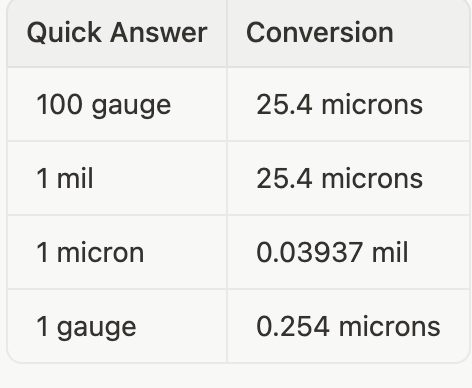
In practical terms, gauge is a shorthand thickness unit often used for plastic film, mils are thousandths of an inch, and microns measure thickness in metric units. For standard plastic film conversions, one mil equals 25.4 microns, and gauge is commonly expressed as 100 times the mil value. That means a 1.0 mil film is 100 gauge and 25.4 microns.
What Does Gauge Mean in Flexible Packaging?
In flexible film packaging, gauge is commonly used as a thickness expression for plastic film. It is not a direct SI or imperial base unit in the way inches or millimeters are. Instead, it is a packaging-industry shorthand that helps suppliers and buyers communicate film thickness quickly. According to SolveTech’s plastic film thickness reference, the gauge equals 100 times the thickness in mils.
That relationship matters because gauge can sound more technical than it really is. If a film is 0.6 mil thick, it is 60 gauge. If it is 1.2 mil thick, it is 120 gauge. For Red Dot Packaging customers, this matters most when reviewing pouch structures, rollstock specifications, barrier layers, and print-web requirements because thickness affects stiffness, puncture resistance, seal performance, and overall package feel.
What is a Micron in Packaging Film?
A micron, also called a micrometer, is a metric unit equal to one-thousandth of a millimeter. In flexible packaging materials, microns are widely used to describe film thickness because they provide a more precise and globally recognized measurement than gauge. Suppliers working across North America, Europe, and Asia often standardize around microns for technical documentation, especially when comparing multi-layer laminations, barrier films, and sealant webs.
For example, if a packaging spec calls for a 25-micron film, that thickness is roughly equivalent to 1.0 mil or 100 gauge. Because microns are more precise, they are especially useful when working with high-performance films where small thickness changes can affect oxygen barrier, moisture protection, seal initiation, or machinability.
Gauge to Microns Conversion Formula
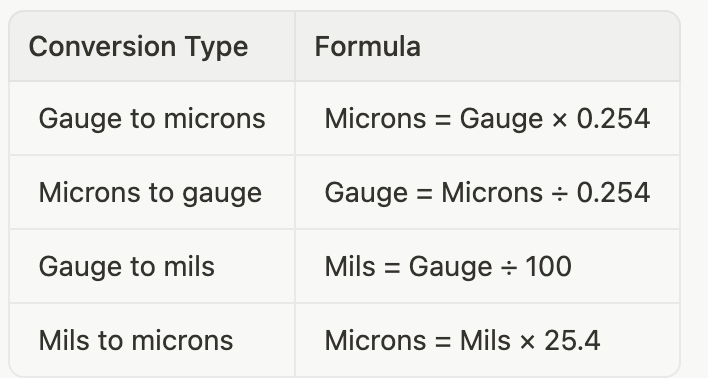
The standard conversion path is straightforward once you know the relationship between gauge, mils, and microns. Since gauge equals 100 times mils, and one mil equals 25.4 microns, the formula for converting gauge to microns is:
Microns = Gauge × 0.254
You can also work backward:
Gauge = Microns ÷ 0.254
And if you are converting through mils:
Mils = Gauge ÷ 100Microns = Mils × 25.4
Common Gauge to Microns Conversion Chart
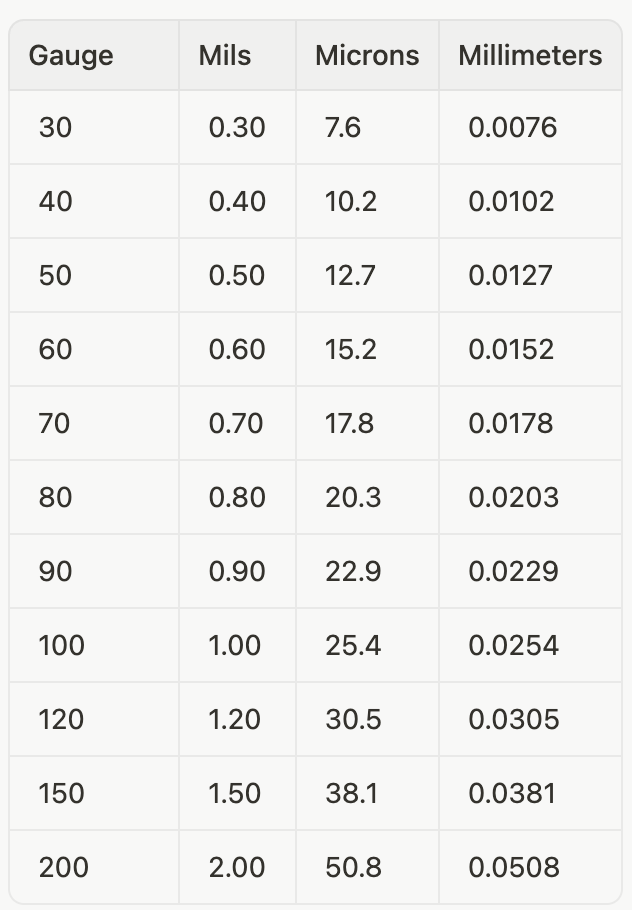
Below is a practical conversion table for commonly used flexible packaging film thicknesses. These values are based on the standard film relationship published by SolveTech.
Why Film Thickness Matters in Flexible Packaging
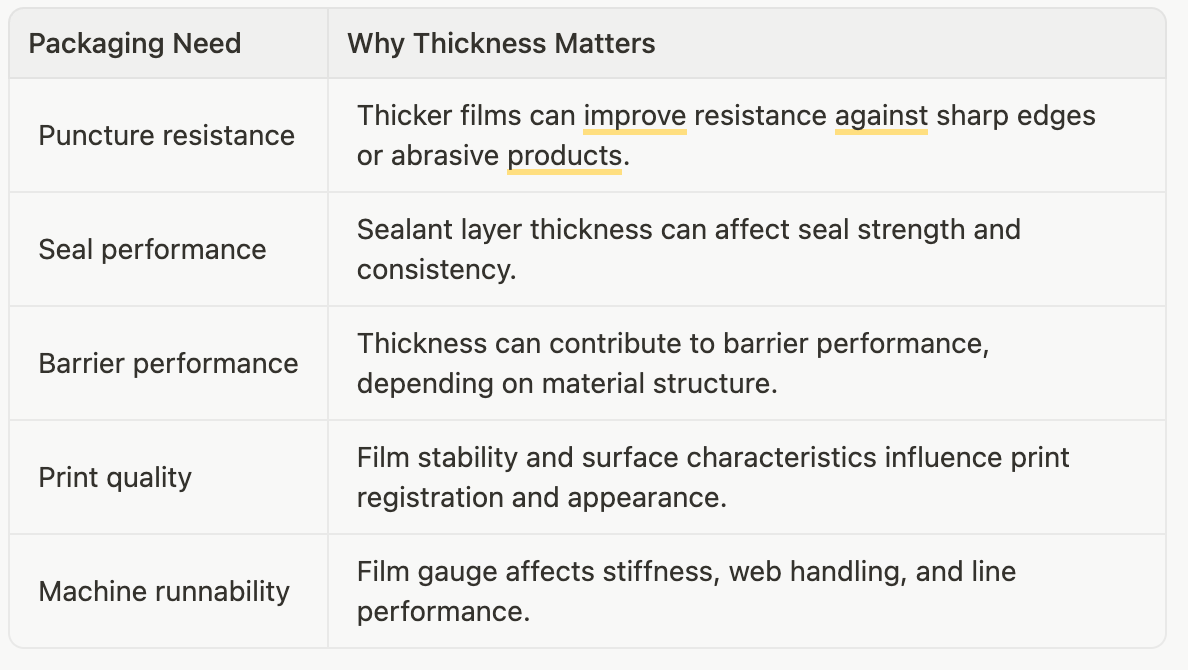
Thickness is not just a specification detail. It affects how a package performs on the shelf, on the filling line, and in the consumer’s hands. In flexible packaging films, the right thickness can influence puncture resistance, flex-crack performance, print appearance, seal consistency, dead-fold behavior, and product protection. A film that is too thin for the application may fail during filling, leak during transit, or provide inadequate barriers. A film that is too thick may create unnecessary cost, reduce yield, or limit machine efficiency.
For this reason, converting gauge to microns accurately is useful not only for purchasing teams but also for brand managers, packaging engineers, and operations teams comparing material options from different vendors. It creates a consistent language for evaluating flexible packaging materials.
When Should you Use Gauge, Mils, or Microns?
In the United States, many suppliers still discuss film in gauge or mils, especially in sales conversations or legacy specifications. In international sourcing and more technical documentation, microns are often preferred because they are more universally recognized and more precise.
As a rule, gauge is useful for quick shorthand, mils are useful when working from U.S.-based film thickness conventions, and microns are best when writing packaging specifications that need to be clear across teams and supply chains. If Red Dot Packaging publishes product specifications in more than one unit, customers can compare materials more easily and reduce confusion during quoting and production planning.
Gauge to Microns Examples for Packaging Buyers
A few real-world examples make the conversion easier to remember. If a film is listed as 80 gauge, multiply 80 by 0.254 to get 20.3 microns. If a rollstock structure is 120 gauge, the thickness is 30.5 microns. If a spec sheet lists 38.1 microns, divide by 0.254 and you get 150 gauge.
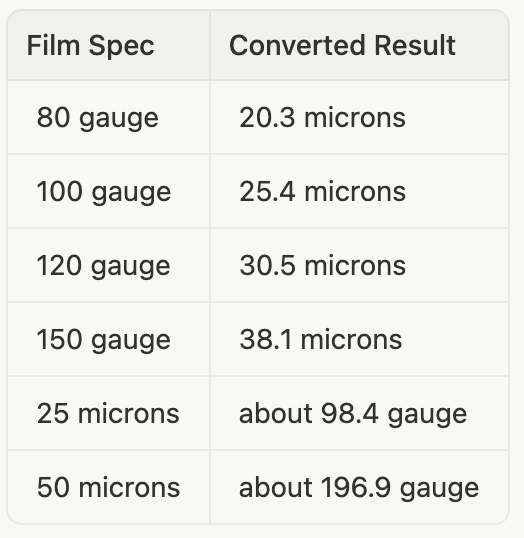
These examples are especially useful when comparing quotes from multiple flexible packaging suppliers. One supplier may describe a web in gauge, while another may list the same thickness in microns. Without conversion, the materials can seem different when they are actually comparable.
Thickness Alone does not Define Package Performance
It is important to note that thickness does not tell the whole story. Two films with the same micron value may perform very differently depending on resin type, orientation, lamination structure, sealant layer, barrier layer, and application. A 25-micron PET web does not behave the same way as a 25-micron PE or BOPP web. That is why thickness should always be reviewed together with material type, barrier requirements, seal conditions, product characteristics, and packaging line needs.
For brands sourcing flexible packaging material, the best approach is to use thickness conversion as a starting point, then evaluate the complete structure. That includes print layer, barrier layer, sealant layer, and any performance demands such as freezer durability, aroma retention, grease resistance, or puncture resistance.
How Red Dot Packaging can Help
At Red Dot Packaging, thickness conversion is part of a much larger packaging decision. If you are comparing pouch films, rollstock structures, or custom flexible packaging materials, the right film choice depends on your product, filling equipment, distribution environment, and shelf-life goals. Converting gauge to microns helps create a common starting point, but selecting the best structure requires a broader review of materials, barriers, seals, and application requirements.
If your team is evaluating flexible packaging film for food, pet products, supplements, sauces, frozen items, or other packaged goods, Red Dot Packaging can help you review thickness, structure, format, and production-fit questions before quoting or sampling.
Frequently Asked Questions
What is flexible packaging?
Flexible packaging is packaging made from materials such as plastic film, foil, paper, or laminations that can bend or flex rather than hold a fixed shape. Common examples include pouches, sachets, wraps, and rollstock.
What is flexible film packaging?
Flexible film packaging refers specifically to packaging made with flexible film substrates, whether mono-material or multi-layer. These films can be printed, laminated, sealed, and converted into pouches, wraps, or rollstock depending on the application.
What is flexible packaging material?
Flexible packaging material is any substrate or structure used to create flexible packages. This can include polyethylene, polyester, polypropylene, nylon, foil, paper, and multi-layer laminations designed for specific barrier, seal, or durability needs. Thickness is only one part of evaluating these materials; performance depends on the full construction.
Is gauge the same as microns?
No. Gauge and microns both describe thickness, but they are not the same unit. Gauge is an industry shorthand often used for plastic film, while microns are a metric measurement. In standard film conversion, one gauge equals 0.254 microns, and 100 gauge equals 25.4 microns.
Is gauge the same as mil?
No. Gauge is based on mils, but it is not identical to mils. One mil equals 1/1000 of an inch, and gauge is commonly calculated as 100 times the mil thickness. A 1.0 mil film is therefore 100 gauge.
Why do packaging suppliers use different thickness units?
Different units are used because packaging supply chains often combine U.S. conventions, international metric specifications, legacy material standards, and customer preferences. Suppliers may quote in gauge, engineers may document in microns, and older specifications may still use mils.
Does a thicker film always mean better packaging?
Not always. A thicker film may improve certain physical properties, but the right film depends on the full structure and application. Material choice, barrier layer, sealant behavior, machine compatibility, and product needs matter as much as thickness.