

Which Film and Fitment Specs Make Spouted Pouches Production-Ready?
A technical guide to spouted pouch packaging, covering film structures, fitments, filling methods, barrier performance, testing standards, and engineering practices for reliable large-scale production efficiency.

Spouted pouches succeed, or fail, on engineering details most shoppers never see: seal geometry, barrier selection, cap torque, and how the fitment bonds to the film. Miss one, and the costs show up as leaks, short shelf life, or downtime on your filler.
For packaging engineers, product developers, and procurement teams, a clear, technical map of materials, processes, and test methods turns guesswork into specifications. At Red Dot Packaging, those choices happen daily on press and on the pouch lines, and this guide reflects that production-floor reality, what runs on existing equipment, meets food-contact rules, and survives distribution, complete with temperatures, OTR/WVTR targets, and the QC checkpoints that catch issues early.
What follows traces the build from film design and printing through lamination and curing, pouch forming, spout welding, filling, and final testing, plus current pathways to recyclable mono-material designs. First, align on the format itself, what it is, where it excels, and why it’s replacing rigid options in so many liquid and semi-solid applications.

Best Practices to Engineer Spout Pouches for Shelf Life
Spouted pouches are not simply bags with a cap. They are engineered systems designed to meter flow, protect sensitive contents, and withstand both thermal processing and distribution stresses. Their performance depends on the integration of multilayer films, matched spout-and-cap systems, and precise converting tolerances that maintain leak-free seams and welds at production speeds.
Engineering Considerations in Spout Pouch Design
- Multilayer Film Structures: These determine oxygen, moisture, and light barrier performance, which directly impacts product shelf life.
- Spout and Cap Systems: Properly matched fitments ensure controlled dispensing, leak resistance, and compatibility with filling equipment.
- Converting Precision: Seam integrity, spout weld quality, and laminate bonding tolerances are essential for preventing leaks and maintaining structural strength.
- Production Efficiency: Engineering choices influence scrap rates, line speeds, and overall manufacturing reliability.
Stand-up pouches can significantly reduce packaging weight compared to rigid containers. According to the Flexible Packaging Association, they may reduce packaging mass by up to 70 percent, lowering transport costs and environmental impact while maintaining product protection.
Design for Manufacturing
Effective spout pouch engineering begins with design decisions that align with production requirements.
- Film Stack Selection: Determines heat-seal windows, barrier levels, and torque retention.
- Spout Geometry: Influences filling method, pour control, and consumer usability.
- Line Parameters: Temperature, pressure, dwell time, and cap torque settings directly affect defect rates and throughput.
Optimizing these factors early in development reduces downtime, scrap, and post-production complaints.
Film Structures and Barrier Options
Common spout pouch constructions combine several functional layers to achieve print quality, mechanical strength, and barrier protection.
Typical layers may include:
- PET or PA Print Webs: Provide durability and high-quality graphics.
- Barrier Layers: EVOH, metallized films, or aluminum foil protect against oxygen and light.
- Sealant Layers: PE or PP layers provide heat-seal performance and pouch integrity.
Mono-material PE or PP laminates are increasingly used where shelf-life targets allow. These structures simplify recycling streams and improve sorting compatibility while still providing sufficient barrier for many applications.

Spout Fitments and Closure Systems
Spout materials and dimensions must align with product viscosity, filling conditions, and consumer use.
Key considerations include:
- Material Selection: Common fitment materials include HDPE and PP.
- Thread Standards: Ensure cap compatibility and consistent torque performance.
- Orifice Diameter: Determines flow rate and dispensing control.
- Tamper Evidence: Required for many food, beverage, and consumer product categories.
Properly engineered spouts also improve product evacuation and reduce residual waste inside the pouch.
Quality Testing and Validation
Performance must be validated through standardized testing to ensure pouch integrity throughout production and distribution.
Common testing methods include:
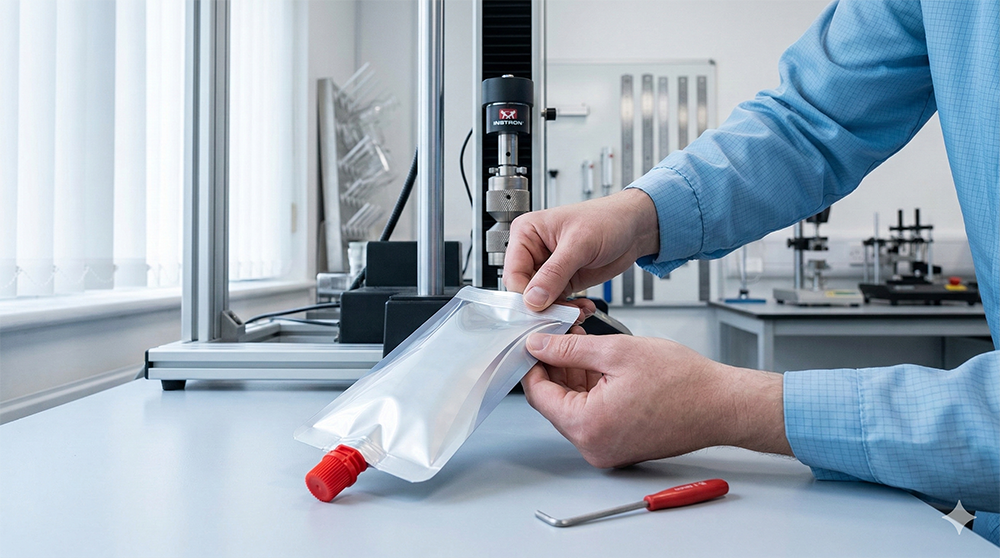
- ASTM F88: Seal strength testing.
- ASTM F1140 or ASTM F2054: Burst testing for internal pressure resistance.
- ASTM D1894: Coefficient of friction testing to ensure web stability on high-speed lines.
Additional production validation often includes cap torque checks, drop testing, and line trials to confirm compatibility with filling equipment.
Sustainability Considerations
Sustainability is increasingly integrated into spout pouch engineering.
Important strategies include:
- Solventless Lamination: Reduces solvent emissions during manufacturing.
- Right-Sized Fitments: Minimizes plastic usage while maintaining functionality.
- Mono-Material Structures: Improve recyclability by simplifying material streams.
- Optimized Barrier Design: Maintains required OTR and WVTR performance while reducing material complexity.
Balancing environmental considerations with product protection ensures packaging that meets both sustainability goals and performance requirements.
Application-Based Design
Material structures and fitment systems should be matched to the product category and distribution environment.
Typical applications include:
- Juices and smoothies
- Sauces and condiments
- Household detergents and cleaners
- Personal care products
Each use case requires different barrier levels, viscosity handling, and dispensing requirements.
What Makes a Stand-Up Pouch with a Spout Work
At first glance, a spouted pouch looks simple: a flexible package with a small plastic fitment and cap. In practice, it is a coordinated system built from three interdependent components. The flexible film body forms the container and branding surface. The spout, or fitment, creates the rigid interface between the flexible wall and the dispensing point. The cap manages dispensing and resealing after the package is opened.
Together, these components determine how the product pours, how securely the package travels through distribution, and how naturally it performs in a consumer’s hand.
The Pouch Body: Structure, Stability, and Shelf Presence
The flexible body provides storage capacity, barrier protection, and visual branding, but it also plays a structural role.
- Stand-Up Base: Most spouted pouches use a Doyen, K-seal, or flat-bottom gusset. When filled, the gusset expands to create a stable base that allows the pouch to stand upright on a shelf or countertop.
- Gusset Geometry: A narrower base works well for low-viscosity beverages, reducing wobble. Wider gussets improve stability for heavier or thicker products such as shampoos or sauces.
- Side Seams: These seams act like the structural frame of the pouch, resisting peel forces when the consumer grips and squeezes the package.
- Flexible Reservoir: As product is dispensed, the pouch walls collapse inward, minimizing air intake and maintaining smoother flow compared to rigid containers.
This combination allows the pouch body to function as both a container and a structural support system while maintaining a lightweight form factor.
The Spout Fitment: Controlled Flow and Structural Interface
The spout is the engineered connection between rigid dispensing hardware and the flexible film.
- Orifice Diameter: Determines flow rate and compatibility with product viscosity.
- Around 8–10 mm for products such as fruit purees or beverages.
- Around 10–16 mm for sauces, detergents, and thicker liquids.
- Around 8–10 mm for products such as fruit purees or beverages.
- Thread Design: Ensures consistent cap engagement and torque performance.
- Weld Flange: The flange distributes mechanical stress into the pouch wall, protecting the seal area during shipping and handling.
- Fitment Placement: Location affects both ergonomics and product flow.
Spout Placement: Corner vs. Center
Spout placement is selected based on how the consumer interacts with the product.
- Corner Spouts:
- Provide a natural pouring angle.
- Keep the dispensing area away from the user’s face.
- Common for sauces, oils, shampoos, and refill packs.
- Provide a natural pouring angle.
- Center-Top Spouts:
- Offer symmetry for sip-and-seal formats.
- Work well for smoothies, baby food, and energy gels.
- Improve alignment for direct consumption.
- Offer symmetry for sip-and-seal formats.
Flat-bottom pouches often combine higher fill weights with corner spouts for stable pouring, while slim profiles frequently use center spouts for portability and on-the-go consumption.

Technician assembling spouted pouches with red caps on production line
The Closure System: Dispensing Control and Reseal
The cap completes the dispensing system and influences the consumer experience.
- Threaded Caps: Provide reliable reseal and leak protection.
- Tamper-Evident Bands: Offer visual confirmation that the product has not been opened.
- Orifice and Cap Design: Work together to control flow and prevent stringing or drips.
- Torque Performance: Opening force must be consistent yet comfortable for the consumer.
When cap torque, thread design, and fitment geometry are aligned with the product’s viscosity, dispensing becomes predictable and clean.
Filling Methods and Production Considerations
Manufacturing choices influence pouch performance throughout its lifecycle.
- Through-Spout Filling:
- Ideal for low-foam liquids.
- Reduces additional sealing steps that could become failure points.
- Ideal for low-foam liquids.
- Top-Opening Filling:
- Often preferred for thicker products or those containing particulates.
- Often preferred for thicker products or those containing particulates.
Line parameters such as sealing temperature, pressure, dwell time, and cap torque must be optimized to match both the film structure and fitment design.
Logistics Advantages Over Rigid Bottles
Spouted pouches provide significant advantages in transportation and storage compared to rigid containers.
- Reduced Packaging Weight: Many applications see weight reductions of roughly 50–80 percent compared to comparable rigid bottles.
- Improved Cube Efficiency: Flexible packaging collapses unused air space, allowing more units per pallet.
- Flat Storage Before Filling: Unfilled pouches ship and store flat, reducing warehouse space requirements.
- Impact Resistance: Flexible walls absorb shock in distribution environments such as parcel shipping.
These logistics benefits make spouted pouches particularly attractive for e-commerce distribution and refill packaging.
Real-World Consumer Use
The effectiveness of a spouted pouch becomes clear when observing real usage scenarios.
- A chef pours a glaze from a corner-spout pouch with precise control.
- A caregiver offers a child a resealable puree pouch without needing utensils.
- A consumer refills a household cleaner reservoir using one hand while holding the appliance steady with the other.
In each case, portability, controlled dispensing, and resealability arise from careful coordination of pouch body design, fitment geometry, and closure engineering.
Transition to Material Structure
While the anatomy explains how a spouted pouch functions, its reliability ultimately depends on the materials hidden inside the film structure. Barrier layers, sealants, adhesives, and fitment polymers determine whether the pouch can protect acidic beverages, tolerate hot filling, or withstand exposure to chemicals.
The next section examines those material layers in detail, showing how barrier design and laminate selection translate this flexible format into dependable shelf-life performance.
What Goes in a Spouted Pouch?
Most packaging teams evaluate spout fitments and film structures only after defining where the package must perform. Real product applications quickly reveal the stresses placed on the format, from oxygen-sensitive beverages to viscous sauces and chemical cleaners. Understanding these use cases helps determine the appropriate material stack, fitment geometry, and filling parameters.
High-Acid Juices and Functional Beverages
- Shelf-stable juices typically target oxygen transmission rates below approximately 1 cc/m²·day (23°C, 0% RH).
- Foil laminates or high-barrier metallized films are commonly used to maintain flavor and nutrient stability.
- Products are often hot-filled through the spout at 85–95°C.
- Typical spout orifice diameters range from 8.6–10 mm to balance smooth flow with controlled sipping.
- Light barriers help protect color and sensitive vitamins from degradation.
Sauces, Condiments, and Purees
- Product viscosity may range from 500 to 50,000 cP, requiring fitments that allow consistent dispensing.
- Corner spouts improve ergonomic control for squeezing thicker products.
- Orifice diameters of 10–16 mm help prevent shear or clogging.
- PP sealant layers are often used in structures designed for retort processing up to 121°C.
- Abrasion-resistant inks protect printed graphics from damage during distribution when products contain particulates.
Baby Food and Clinical Nutrition
- Typical pouch volumes range from 90–120 mL.
- Designs often incorporate soft, sip-friendly caps and wide-bore closures that meet small-parts safety guidelines such as 16 CFR Part 1501 in the United States.
- Transparent windows allow caregivers to view the contents for reassurance.
- Barrier levels are set according to hot-fill or mild thermal treatment requirements.
- Torque specifications are optimized to prevent caregiver over-tightening while maintaining leak resistance.
Personal Care: Shampoos, Conditioners, and Gels
- Surfactants and fragrances require solvent-resistant inks and adhesives.
- HDPE or PP spouts are chosen for stress-crack resistance.
- Through-spout filling reduces foaming during production.
- Travel-size formats at or below 100 mL comply with airline carry-on regulations.
- Refill pouches typically use 16–22 mm fitments to enable fast decanting into rigid pump bottles or dispensers.
Home Care: Detergents and Household Cleaners
- Chemical compatibility often determines polymer and adhesive selection more than barrier performance.
- Anti-slip outer finishes improve grip when hands are wet.
- E-commerce distribution requires strong drop and leak resistance.
- Secondary packaging and validated cap torque settings help prevent closure back-off during shipping.
- Testing commonly follows standards such as ISTA and ASTM protocols.
Automotive and Industrial Fluids
- Oils, additives, and diesel exhaust fluid (DEF) benefit from puncture-resistant laminates containing PA layers.
- Fitments and cap liners must be chemically compatible with petroleum-based or reactive fluids.
- Large orifice diameters allow faster pouring into funnels or equipment reservoirs.
- Opaque or metallized films protect light-sensitive additives.
- Tamper-evident closures are essential for safety and product authenticity.
Frozen and Chilled Smoothies or Purees
- Films must maintain toughness at low temperatures down to approximately −20°C to prevent brittle cracking.
- Oxygen barrier requirements may be lower for short refrigerated shelf life.
- Seal strength and pouch durability remain critical to handle stress from ice-crystal formation and freezer handling.
Ready-to-Serve Cocktails and Alcoholic Bases
- Ethanol compatibility must be considered when selecting adhesives, coatings, and inks.
- Aliphatic-resistant adhesive systems prevent softening or stress whitening.
- Light barriers protect flavor stability in spirits and cocktail bases.
- Child-resistant closures may be required for certain retail channels or regulatory environments.
Why End-Use Drives Specification
This range of applications illustrates why specification work begins with product chemistry, viscosity, and distribution requirements. Each category imposes different demands on barrier properties, fitment geometry, and production parameters.
Once the end-use environment is defined, engineers can select the correct film structure, spout design, and closure system to achieve shelf life, consumer usability, and reliable performance at production speeds.
Mistakes That Derail Spouted Pouch Projects (And How to Fix Them)
Even well-planned spouted pouch programs can encounter technical problems that only appear during production or distribution. Small specification oversights can lead to leaks, seal failures, shelf-life problems, or line downtime. The checklist below highlights common pitfalls and practical ways to prevent them when moving from specification to full-scale production.
Barrier Specification Doesn’t Match Product and Process
Teams sometimes select film structures with EVOH or metallized PET that appear sufficient on paper, but factors such as humidity, acidity, or thermal processing push oxygen or moisture transmission beyond acceptable limits.
How to Fix It
- Define numeric barrier targets before selecting materials.
- Example: High-acid juice with long shelf life may require OTR below 1 cc/m²·day.
- Use foil or higher-EVOH laminates for aggressive products or retort processing.
- Use metallized or clear-barrier films for moderate barrier needs.
- Validate performance with accelerated aging tests and confirm barrier stability after hot-fill or retort conditioning.
Spout Polymer and Sealant Are Not Compatible for Welding
A mismatch between spout material and sealant layer, such as PP fitments welded to PE sealants, can produce weak or inconsistent welds.
How to Fix It
- Specify matched material systems such as PP-to-PP or PE-to-PE whenever possible.
- Use a compatible tie layer if mixed materials are unavoidable.
- Define a validated weld window.
- Example: 190–230°C welding range with optimized dwell time.
- Example: 190–230°C welding range with optimized dwell time.
- Maintain alignment tolerances around ±0.2 mm.
- Perform pull tests on spout welds and run vacuum or bubble microleak checks for each lot.
Spout Placement Creates Forming or Usability Conflicts
Improper spout placement can interfere with pouch forming, disrupt stability, or cause collisions with sealing jaws or conveyor components.
How to Fix It
- Maintain minimum clearances on the dieline.
- Typical guidance: 8–10 mm from edge seals and gusset folds.
- Typical guidance: 8–10 mm from edge seals and gusset folds.
- Confirm cap diameter clearance throughout the entire forming path.
- Build a 3D mockup and run a short forming trial to verify stability, ergonomics, and equipment compatibility before final tooling.
Coefficient of Friction and Varnish in Seal Paths Cause Line Instability
Matte coatings or varnish extending into seal zones can weaken seals, while incorrect coefficient of friction values can lead to misfeeds or scuffing on high-speed lines.
How to Fix It
- Define no-ink and no-varnish zones around all heat-seal areas and spout weld zones.
- Specify coefficient of friction values according to ASTM D1894.
- Example targets:
- External COF: 0.25–0.40 for stable conveying.
- Internal COF tuned to match forming and filling equipment.
- External COF: 0.25–0.40 for stable conveying.
- Confirm COF values during press pulls and adjust slip additives or overprint varnish windows before full production.
Cap Torque Not Validated After Thermal Cycling
Caps that perform well at room temperature may loosen after hot-fill cooling or retort processing, or become too tight for consumers to open.
How to Fix It
- Establish a validated torque range with the closure supplier.
- Example: 8–14 lbf·in for 10–16 mm thread sizes, depending on cap design.
- Test for leaks after hot-fill cooling cycles or retort processing.
- Document capper setup parameters tied to specific product lots and temperature profiles.
Spout Welding Before Lamination Fully Cures
Welding spouts onto laminations that have not fully cured can cause delamination, trapped solvent, or bubbles near the weld interface.
How to Fix It
- Respect adhesive cure windows, typically 24–48 hours depending on structure.
- Confirm laminate bond strength before welding.
- Example target: ≥2 N per 15 mm peel strength (structure dependent).
- Example target: ≥2 N per 15 mm peel strength (structure dependent).
- Heat-age sample panels to simulate welding exposure.
- Perform peel tests and vacuum leak tests on welded samples before approving the batch.
Why These Checks Matter
Addressing these technical details early prevents production downtime, scrap, and consumer complaints. It also creates documented process windows that make future product changes or line adjustments easier to manage.
Choosing the Right Spouted Pouches
Packaging decisions made today will influence cost, compliance, and operational flexibility for years. The most resilient spouted pouch programs treat packaging as a system rather than a one-time specification. Materials, fitments, closures, artwork, and quality data should all be designed to adapt to new regulations, evolving product lines, and changing distribution channels.
Align Packaging with Recycling and Policy Trends
Regulatory frameworks are increasingly shaping packaging design decisions.
- The European Union’s Packaging and Packaging Waste Regulation (PPWR) proposals emphasize recyclability targets by 2030.
- U.S. Extended Producer Responsibility (EPR) programs, including California SB 54 and emerging legislation in Oregon, Colorado, and Maine, are tying fees to design-for-recycling performance.
To prepare for these trends:
- Prioritize mono-material film structures when possible.
- Use all-PE laminates for compatibility with store-drop film recycling streams.
- Consider all-PP systems where regional recycling infrastructure supports them.
- Match spout and cap polymers to the primary film family to simplify material recovery.
Foil layers should be reserved for applications that require the highest barrier levels. Many products can meet shelf-life requirements with EVOH-based structures while maintaining recyclability pathways.
Balance Barrier Performance with Recyclability
Barrier selection must balance shelf-life protection with recycling compatibility.
- EVOH coextrusions in the 3–7 percent range within a laminate structure can achieve oxygen transmission rates below 1–2 cc/m²·day at 23°C and 0% RH.
- These structures can support many acidic food and personal care products while aligning with recycling guidance such as APR design recommendations.
- When product visibility is required, clear barrier films with EVOH layers can replace metallized structures while maintaining protective performance.
Thoughtful barrier selection keeps future recycling options open without sacrificing product stability.
Standardize Fitments for Operational Efficiency
Reducing variation in spout and cap systems simplifies production and inventory management.
- Standardize on one or two thread profiles across product lines.
- Limit spout diameters to two or three core sizes whenever possible.
- Consolidate closure types to reduce component inventory and spare parts requirements.
This approach improves torque consistency, simplifies validation procedures, and streamlines line setup across multiple SKUs.
Design for Future Processing and Distribution Needs
Even if a package currently runs under one set of conditions, specifications should anticipate future processing scenarios.
- If a product is hot-filled today but may transition to retort processing, validate sealant layers and adhesives capable of withstanding 121°C thermal exposure.
- Define lamination bond strength targets above worst-case conditions, for example ≥2.5–3.5 N per 15 mm peel strength, depending on structure and application.
For brands expanding into e-commerce:
- Validate packaging against distribution tests such as ASTM D5276 drop testing and ISTA parcel simulations.
- Reinforce spout weld areas and seal zones to withstand repeated impacts.
- Balance coefficient of friction specifications to support both line speed and abrasion resistance during shipping.
Lightweighting Without Compromising Performance
Material reduction strategies can improve sustainability and reduce costs without weakening packaging integrity.
- Spout lightweighting: 10–20 percent reduction in fitment mass is achievable through optimized molding and geometry.
- Film down-gauging: Reductions of approximately 5–10 microns are possible when puncture resistance, gusset geometry, and distribution packaging are optimized together.
Successful lightweighting programs rely on testing and system-level design rather than isolated material reductions.
Build Data and Traceability into the System
Modern packaging programs increasingly rely on production data to support quality control and regulatory documentation.
Recommended practices include:
- Inline vision systems at spout welding stations to verify alignment and weld integrity.
- Seal strength monitoring using ASTM F88 testing.
- Leak detection through ASTM F2054 vacuum decay testing.
Digital identification technologies also improve traceability.
- QR codes or digital watermarks can connect each production lot to film structure, spout resin, torque ranges, and processing conditions.
- This data supports root-cause analysis, quality improvement initiatives, and compliance documentation under regulatory frameworks such as FDA 21 CFR and EU Regulation 10/2011.
Design Artwork for Flexibility and Regional Variation
Artwork strategies can also influence long-term operational efficiency.
- Maintain a print architecture that allows updates to nutrition panels, languages, or promotional content without changing dielines.
- Use modular design elements to support regional product variations and retailer requirements.
This flexibility enables faster product updates without requalifying packaging structures.
Enable Refill and Accessory Ecosystems
As refill packaging grows, consistent fitment platforms become more valuable.
- Using a shared family of spouts and caps enables closed-loop refill systems.
- Accessories such as dosing caps, pumps, or dispensing adapters can be developed without redesigning the entire package.
A consistent fitment ecosystem accelerates innovation while minimizing requalification costs.
Building a Flexible Packaging Platform
Future-ready spouted pouch programs prioritize flexibility and option space.
Key principles include:
- Select polymer families that align with emerging recycling streams.
- Standardize thread profiles and closure systems.
- Validate packaging for the most demanding thermal and distribution scenarios likely to occur.
- Integrate quality data and traceability systems from the start.
With these foundations in place, packaging teams can adapt quickly to new products, regulations, and retail channels while maintaining reliable performance.
Conclusion
Behind every pouch with a spout is a coordinated system where multilayer films, precision forming, and secure spout welding work together to deliver clean dispensing, shelf stability, and consumer convenience. Effective results come from fit-for-purpose engineering: aligning print layers, barrier structures, sealant materials, and HDPE or PP fitments with the product formula, filling method, distribution environment, and regulatory requirements, then validating performance through rigorous testing. Sustainability is increasingly part of that process, with mono-material PE or PP structures, lighter gauges, and bio-based resins providing more responsible options without sacrificing protection.
Red Dot Packaging manufactures custom printed pouches in the United States and supports the entire process, from artwork and film selection to fitments, pouch converting, and quality control. The team reviews product characteristics, production volumes, and filling equipment to recommend optimized structures and closures, and assists with line trials for both pilot runs and large-scale rollouts. Request a free quote to receive pricing, lead times, and a clear path from concept to finished cartons.