

Custom Printed Rollstock Explained
A practical guide to custom printed rollstock packaging, explaining film structures, barrier materials, printing methods, line setup, regulatory compliance, quality testing, material selection, sustainability considerations, and how rollstock performs reliably and efficiently on form-fill-seal production lines.
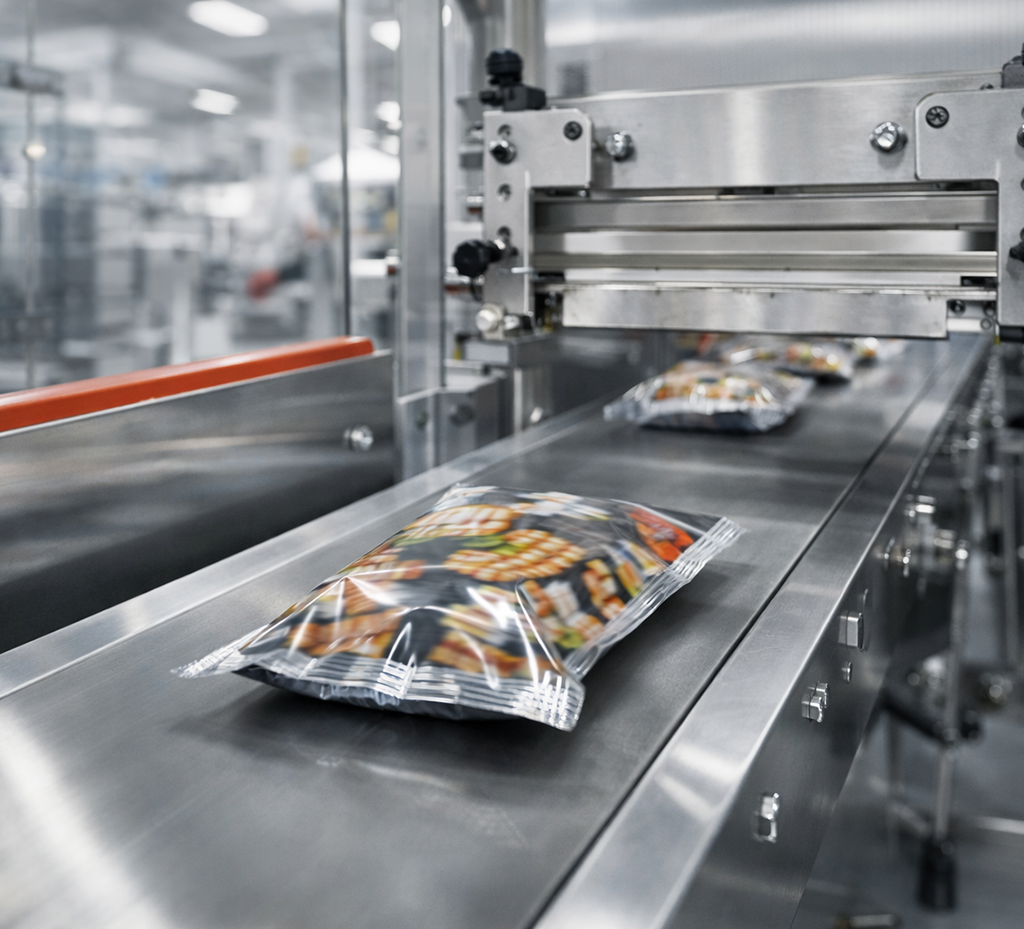
Throughput, unit cost, and shelf impact often come down to a narrow ribbon of film moving through your line. If you’re weighing premade pouches against custom printed rollstock, the right call hinges on volume, changeovers, barrier needs, and the machinery you run, or plan to run.
Red Dot Packaging designs and supplies flexible packaging from concept through production, so we see where roll formats excel and where they create friction. Expect clear definitions, real production considerations, and decision frameworks grounded in how form‑fill‑seal (FFS) equipment actually works. You’ll get practical links between film structures, OTR/MVTR targets, print methods, and food‑contact compliance, so decisions stick on the plant floor as well as on the shelf. First, the foundation: what rollstock packaging is and how film on a core becomes finished packs at speed.

When to Choose Rollstock
Packaging performance now depends on how quickly you can respond to shifting forecasts without sacrificing margin or service levels. Custom printed rollstock gives brands and co-packers the ability to scale fast while maintaining tight brand control and consistent output.
As SKUs multiply and artwork refreshes accelerate, automated form-fill-seal (FFS) systems become a strategic advantage, producing high volumes with fewer operators and less manual handling. For stable, growing product lines, rollstock often delivers stronger unit economics and higher sustained speeds than premade formats.
Rollstock performs best when speed, consistency, and automation align. Key advantages include:
- Higher throughput: Vertical and horizontal FFS lines can run 60–300+ packs per minute once optimized.
- Lower total cost per unit: Less material waste, fewer handling steps, and better labor efficiency.
- Scalable automation: One roll feeds continuous production with precise dosing and sealing.
- Consistent quality control: Validated settings for web tension, COF, seal temperature, and print registration reduce variability.
While premade pouches remain ideal for pilots and short runs, rollstock becomes the smarter long-term solution when SKUs stabilize and volumes climb, offering predictable output, improved margins, and operational resilience.
Rollstock Explained: How Custom Printing and Structure Work Together
Rollstock is continuous flexible packaging film wound on a core, designed to run on automated form-fill-seal (FFS) equipment where it’s formed, filled, and sealed into finished packages. What makes rollstock “custom” is the integration of your artwork, material structure, and machine specifications, so print registers accurately, seals consistently, and the film performs at speed. Unlike unprinted base film, custom printed rollstock includes precise registration marks, surface treatments for ink adhesion, controlled slip properties, and finishes (matte, gloss, tactile) engineered for both branding and machinability.
Customization extends beyond graphics into structure and performance. Typical laminations include PET/PE for clarity and stiffness, BOPP/CPP for snack flow-wrap, nylon/PE for puncture resistance, and high-barrier builds with EVOH, metallized films, or foil for oxygen- and light-sensitive products. Key performance variables include:
- Sealant layer selection (LDPE, mPE, CPP) to widen sealing windows and reduce leakers
- Gauge selection (often 1.5–5.0 mil finished thickness) based on product weight and durability needs
- Print repeat and no-copy zones to protect seals and maintain brand consistency
- Roll build specs (core size, OD limits, splice policies, wind direction) to protect uptime
In short, “custom” rollstock is a fully engineered specification, uniting artwork, barrier performance, and machine compatibility so your packaging runs right the first time and scales efficiently.
How to choose rollstock materials and barriers for your product
Choosing the right rollstock structure means balancing product protection, machinability, and sustainability. Barrier layers determine oxygen (OTR) and moisture (MVTR) control, while substrates and sealants influence line speed, sealing windows, and durability. EVOH cores provide strong oxygen barrier when protected from humidity; metallized films offer robust oxygen and moisture resistance with strong shelf appeal; and foil delivers near-zero transmission rates for highly sensitive products, though with added stiffness and recycling complexity.
Base films and sealants complete the performance profile:
- PET laminates: Excellent print quality, stiffness, and heat resistance for high-speed applications
- OPP/CPP: Cost-effective clarity for snacks and bakery, with moderate heat tolerance
- Nylon (PA): Added puncture and flex-crack resistance for rugged or sharp products
- PE sealants: Wide sealing windows and impact strength; ideal for mono-material recyclable builds
Machinability ties it together, COF, gauge, and sealing range must match your specific VFFS or HFFS equipment to maintain OEE and reduce leakers. The practical approach: define barrier targets first, select the appropriate barrier route (EVOH, metallized, or foil), then optimize facestock and sealant layers to protect speed, shelf life, and sustainability goals.
Machinery Readiness and Line Integration
Even with the right custom printed rollstock, packaging lines can stumble when small setup details are overlooked. The following pitfalls appear frequently during VFFS and HFFS installations and trials, but each issue has a straightforward fix.
Specifying the Wrong Slip (COF) for Your Machine
Film that is too grippy drags on the forming collar, while film that is too slippery fails to track correctly on belts. Both problems lead to registration drift, scuffed graphics, and inconsistent seals.
Fix
- Define a target COF based on surface and machine type.
- Example guideline: VFFS outside COF approximately 0.25–0.35; product side lower to support product drop.
- Specify ASTM D1894 test method in the material specification.
- Include acceptance ranges and verify COF during incoming roll inspection.
Overlooking Roll Geometry Your Unwind Cannot Handle
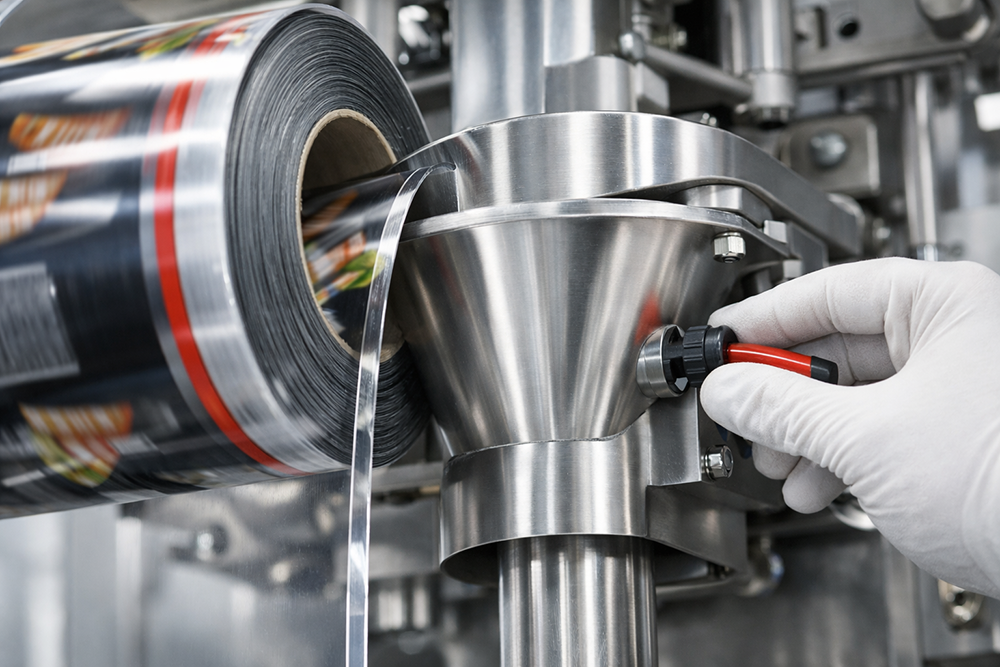
Using the wrong core size, oversized outer diameters, telescoping rolls, or edge weave can cause frequent stoppages and scrap. Tight or uneven winding may also turn gauge bands into wrinkles when the film reaches the forming collar.
Fix
- Specify the following in roll specifications:
- Core ID
- Maximum outer diameter
- Maximum roll weight
- Winding quality standards
- Core ID
- Require no telescoping and camber within supplier standards.
- Limit splice counts per roll.
- Require flagged, machine-detectable splices.
- Inspect roll profile during receiving.
Chasing Temperature Instead of Establishing a Sealing Window
Increasing jaw temperature to fix leaking seals often creates additional problems such as film distortion, ink pick-off, or burn-through when dwell time or pressure is actually the root cause.
Fix
- Run a small DOE to determine the sealing window.
- Test combinations of temperature, dwell time, and pressure.
- Verify seal strength using ASTM F88.
- Typical seal targets range from 2.5–3.5 lb/in depending on packaging structure.
- Document validated settings as SOPs for each film structure.
Weak Registration Control From Sensor or Tension Setup
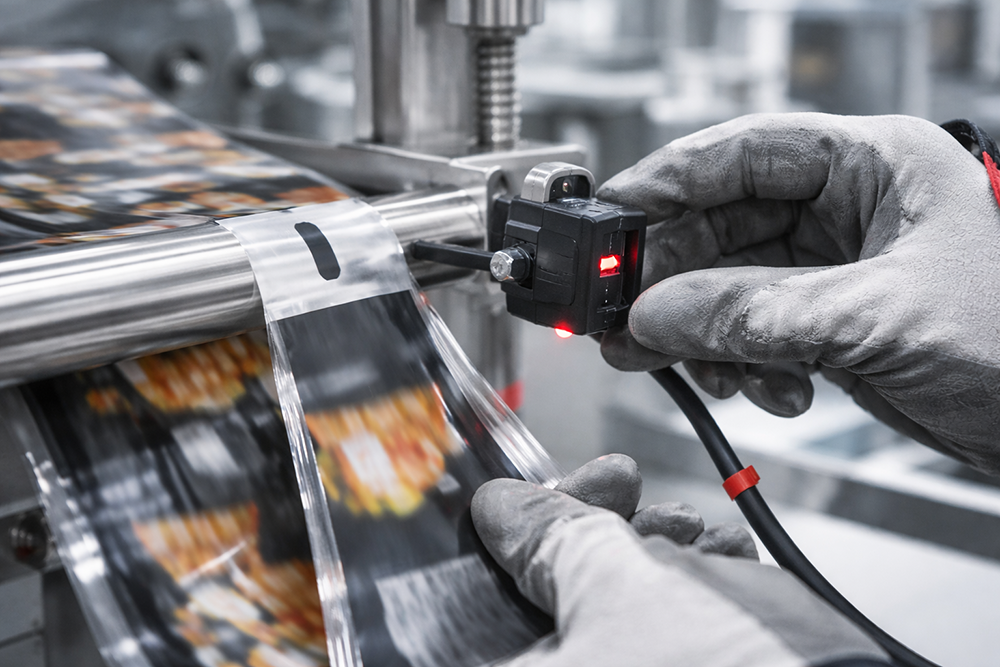
Low-contrast registration marks, incorrect photo-eye settings, or unstable web tension cause print-to-cut errors that gradually worsen during a run.
Fix
- Use high-contrast registration marks with clear margins.
- Place marks away from sealing areas.
- Calibrate sensors and encoder counts at startup.
- Set dancer or tension-zone setpoints.
- Verify registration stability within ±1–2 mm throughout production.
Adding Nitrogen or MAP Without Validating Timing and Flow
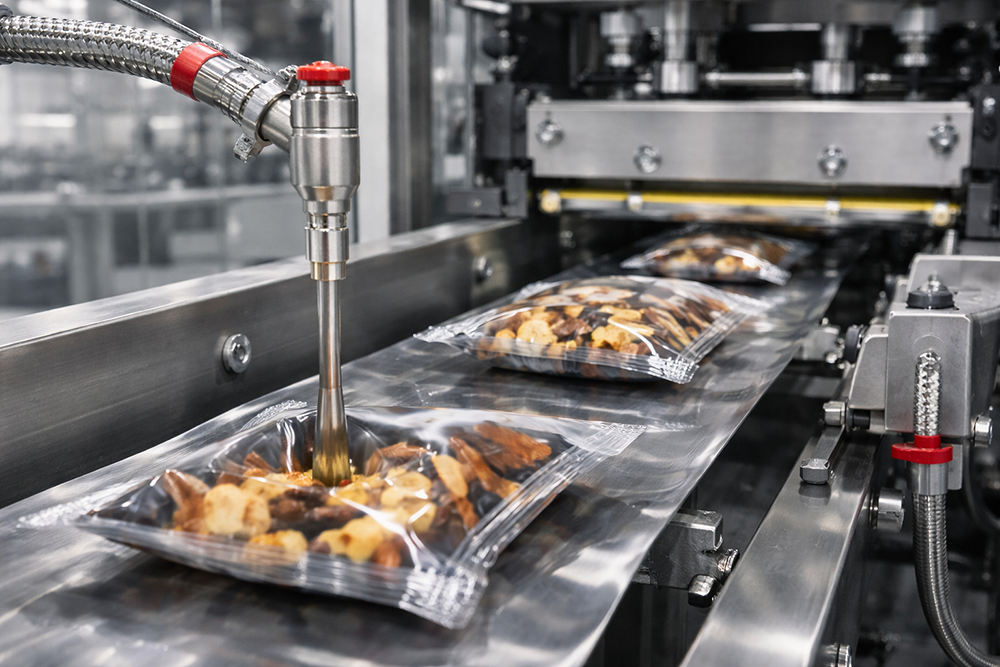
High gas flow introduced at the wrong time can disturb product placement, trap gas in the seal area, or create overinflated packages that burst. Teams frequently skip headspace verification during setup.
Fix
- Time the gas flush immediately before the final end seal.
- Adjust flow to reduce turbulence.
- Measure residual oxygen using a headspace analyzer.
- Typical snack targets are below 2% oxygen.
- Recheck seal strength after modifying MAP settings.
Assuming Zippers or Valves Run In-Line Without Proper Hardware
Ordering film with pre-applied closures or planning in-line application without confirming machine compatibility often leads to stalled startups and wasted film.
Fix
- Confirm zipper profile, width, and valve type with the equipment OEM.
- Ensure the line has compatible applicators, guides, and sealing jaws.
- Use chilled or serrated jaws when required.
- Conduct factory acceptance tests with sample film and closures before production.
Scale Smart: Align Format With Throughput and Margin
Rollstock is less a packaging format than a production decision: it excels when your operation prizes speed, scale, and repeatability, and when formats stay consistent across long runs. Premade pouches win when agility matters, short runs, frequent changeovers, or feature-rich packs, without tying up capital or floor space.
The right path weighs barrier needs and brand impact alongside operational readiness and true per‑unit economics, including changeover time, scrap, and labor. Audit your volumes, SKU stability, and equipment access, then work with a packaging partner to validate materials, print, and lead times, whether that points to custom printed rollstock on high‑efficiency lines or the premade pouch that best fits your stage of growth.
Choosing the right film structure, print clarity, and line performance is what keeps runs predictable and margins healthy. Red Dot Packaging partners with operations and brand teams to spec custom printed rollstock that meets your product’s barrier needs, color standards, and VFFS/HFFS requirements, backed by testing and proofs that cut risk and waste.
If you want packaging that fits right, protects in transit, and ships on schedule without costly trial-and-error, our engineers and print specialists can take you from concept to production with confidence. Call for a quote and we’ll review your SKUs and line parameters, recommend materials and gauges, provide color-matched proofs, and share clear timelines so you can plan your next run.
Custom Printed Rollstock Frequently Asked Questions
What is custom printed rollstock and how does it work on form-fill-seal lines?
Custom printed rollstock is continuous flexible packaging film wound onto a core. On VFFS or HFFS equipment, the machine forms the film into a package, fills it with product, and seals it into finished packs. The film is engineered for your artwork, barrier requirements, and machine specifications so that print registers correctly, seals perform reliably, and the web runs at high speed. Rollstock can include registration marks, surface treatments that improve ink adhesion, controlled slip properties, and matte or gloss finishes optimized for both branding and machinability.
When should I choose rollstock instead of premade pouches?
Rollstock is typically the better choice when production volumes are stable or increasing and you want higher throughput with lower unit cost. Automated form-fill-seal systems often run between 60 and more than 300 packs per minute while reducing handling steps and improving process control. Premade pouches are usually preferred for pilot launches, very short runs, or packaging formats that require frequent changeovers or complex features.
Which film structures are common for rollstock and how do I select one?
Common structures include PET/PE for strong print quality and stiffness, BOPP/CPP for snack and bakery flow-wrap applications, and nylon/PE for puncture resistance. High-barrier laminations may include EVOH layers, metallized films, or aluminum foil. Selection should begin with defining oxygen transmission rate (OTR) and moisture vapor transmission rate (MVTR) targets based on the product’s shelf-life needs. Once barrier performance is defined, the outer print layer and inner sealant layer can be selected to support machine speed, seal integrity, and package durability.
How do OTR and MVTR targets influence material choice?
Barrier requirements determine which materials or laminations are appropriate. EVOH provides strong oxygen barrier when protected from humidity within the laminate structure. Metallized films offer good oxygen and moisture resistance while also providing light barrier and shelf appeal. Foil provides near-zero oxygen and moisture transmission for highly sensitive products but increases stiffness and can complicate recycling considerations.
What print methods make sense for custom rollstock?
Digital printing works well for short runs, frequent artwork changes, and product testing because it eliminates printing plates and lowers minimum order quantities. Flexographic printing is typically used for core SKUs produced in higher volumes because it offers strong color consistency and lower cost across longer runs. In both cases, artwork should include accurate registration marks and defined no-copy zones to protect seal areas and maintain consistent branding.
How should I set and verify COF for my FFS machine?
The coefficient of friction should match the requirements of your specific packaging equipment. Many VFFS applications perform well with an outside surface COF around 0.25 to 0.35. Slip performance should be verified on incoming rolls using ASTM D1894 testing. If web tracking, drag, or wrinkling issues appear, the film formulation may need adjustment. Proper COF helps prevent print drift, reduces wrinkles, and minimizes unplanned machine stoppages.
How do I validate seal performance before scaling production?
Seal performance should be validated by mapping the sealing window on the actual packaging equipment. This involves testing combinations of sealing temperature, dwell time, and pressure to identify reliable operating ranges. Seal strength should be verified using ASTM F88 testing, and validated samples should be retained to establish pass criteria. Defining a sealing window prevents leaks and reduces the need for constant adjustments during production.
What roll build details should I specify to protect uptime?
Rollstock specifications should include core size, maximum outer diameter, maximum roll weight, winding direction, splice limits, and winding quality requirements that match your machine’s unwind system and web path. Poor roll geometry or excessive and poorly marked splices can lead to registration loss and production stoppages. Clear roll specifications help maintain smooth changeovers and consistent line performance.
Can rollstock support short runs and fast artwork changes?
Yes. Modern form-fill-seal equipment can change over quickly, and digital printing allows shorter production runs without requiring new plates or major film redesign. When film structures and machine settings are standardized, operations can change artwork while maintaining consistent speed and package quality. Many facilities operate between 80 and 180 or more packs per minute while managing multiple SKUs.
What compliance steps are required for food-contact rollstock?
Food-contact rollstock should use substrates, inks, and adhesives that comply with applicable food packaging regulations. Manufacturers typically provide documentation such as compliance statements and testing data. Ink and adhesive migration must be controlled through appropriate laminations and curing processes. Oxygen and moisture barrier targets should also support product safety and shelf life. Traceable lot records and incoming quality inspections help ensure that film, print, and sealing performance consistently meet specifications.