

Stand Up Pouches or Cartons: What’s Right for Custom Frozen Food Packaging?
Frozen food packaging must protect flavor at –20°C, blocking oxygen and moisture to prevent freezer burn. This article provides a data-driven framework for selecting the optimal barrier materials and formats.
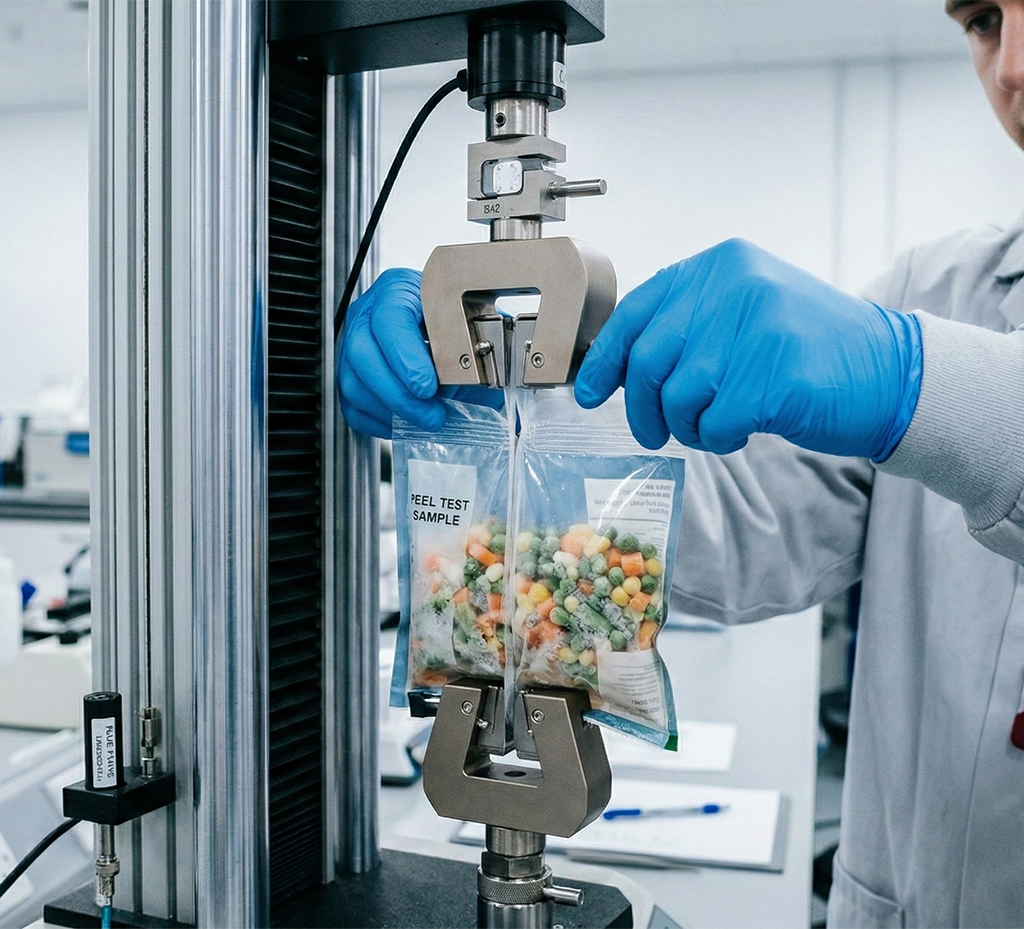
Frozen food packaging has one job: protect flavor, texture, and trust in an environment that punishes weak materials. At –20°C, plastics stiffen, inks can crack, seals become brittle, and even tiny leaks let oxygen and moisture in, leading to freezer burn, ice crystals, and disappointed customers. Add thaw–refreeze cycles and rough distribution, and the margin for error shrinks fast.
That is why frozen packaging is not just a bag or a box, it is a performance system. It must block oxygen and moisture, resist low-temperature impacts, seal consistently on your line, and keep graphics readable through frosted freezer doors. If dwell time is off or the sealant is wrong, failures show up in the field. If barrier targets are misjudged, shelf life suffers.
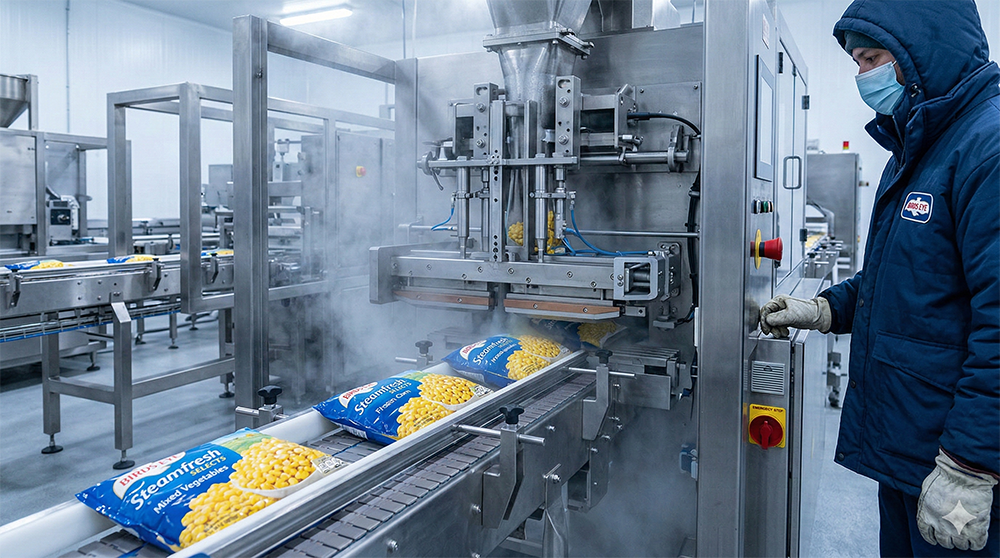
The smartest designs connect material science with real production constraints. Choosing between PE, PET, PA (nylon), EVOH, or mono-material structures with PCR is only the beginning. You also have to consider machinability on VFFS or HFFS equipment, compliance with FDA 21 CFR or EU 10/2011, validated OTR and MVTR performance, and supplier quality systems such as BRCGS or FSSC 22000.
In the freezer aisle, most battles are won, or lost, with bags and pouches. The right format, barrier lamination, and sealing window, matched precisely to your product and packaging line, determine whether your brand delivers peak freshness or frozen disappointment.
Frozen Aisles Are Unforgiving: Packaging Must Protect and Persuade
The freezer aisle is not just another retail environment, it is a stress test. At –18°C (0°F), the USDA’s recommended storage temperature, films stiffen, seals are under strain, doors fog, and shoppers make decisions in seconds through glass. Your packaging must function like precision equipment while still acting as a high-impact billboard behind a frosted door.
Protection Under Physics, Not Promises
Freezer burn is not a cosmetic flaw, it is a packaging failure. Ice crystals form when moisture migrates. Rancidity develops when oxygen penetrates weak barriers. Even in frozen storage, oxygen transmission rate (OTR, ASTM D3985) and water vapor transmission rate (WVTR, ASTM F1249) directly influence quality retention. Seal strength (ASTM F88) and low-temperature impact resistance (ASTM D1709) determine whether a pouch survives drops in sub-zero distribution centers.
Material selection matters at every layer. Inks, adhesives, and sealants must resist cold cracking and meet food-contact migration standards. If they do not, problems surface as leaking seams, off-odors, brittle flexing, or costly line stoppages. In frozen packaging, minor weaknesses compound quickly.
Merchandising Through Glare and Frost
Performance alone does not sell. Freezer doors reflect overhead lighting, accumulate condensation, and often carry a tint. Shoppers typically view products from six to eight feet away. Winning packs use:
- High-contrast color systems
- Clear, bold typography that reads at distance
- Disciplined message hierarchy highlighting flavor and cook time
- Selective anti-fog windows that reveal product without sacrificing barrier
Matte-and-gloss finishes help control glare hotspots. Graphics must remain legible even when partially obscured by frost or reflection. Clarity is not optional, it is conversion.
A Practical, End-to-End Framework
Effective frozen packaging starts with barrier engineering tailored to product sensitivity. Ice cream requires aggressive oxygen and light protection. Frozen vegetables demand strong moisture control and puncture resistance. Proteins often require both barrier and structural toughness.
From there:
- Select a format that survives distribution and sub-zero handling
- Align materials with credible sustainability pathways
- Ensure compliance with FDA 21 CFR (U.S.) or EU 10/2011 (EU)
- Validate performance using recognized ASTM standards
- Choose printing and converting processes that maintain color and structural integrity in cold environments
Every decision must balance lab performance with real-world manufacturability.

Custom frozen food packaging products on display in a freezer
What This Means for Your Team
Frozen packaging decisions cannot live in silos. Brand, R&D, quality, and operations need a shared scorecard to manage trade-offs such as:
- Barrier strength versus recyclability
- Cube efficiency versus structural rigidity
- Window size versus condensation risk
- Premium finishes versus seal reliability
Without alignment, aesthetics can override physics, and physics always wins in the freezer.
This article applies a practical, data-driven framework to custom frozen food packaging. You will find clear performance targets, relevant test methods, and supplier expectations designed to move projects from pilot to production with confidence.
From Promise to Proof
With the aisle realities defined, the next step is setting the right oxygen, moisture, and seal targets for your specific product and use case. Turn to preservation science to establish OTR and WVTR benchmarks, and build structures engineered to resist freezer burn from day one.
Best Barrier Materials and Structures to Prevent Freezer Burn
In frozen packaging, science comes before shelf appeal. Even at –18°C to –25°C, oxygen and water vapor continue to migrate through films. That slow ingress drives lipid oxidation, flavor fade, and sublimation, the process behind visible freezer burn. In custom frozen food packaging, the barrier structure, seal design, and cold-temperature toughness must function as one engineered system, validated with the right test methods.
Oxygen vs. Moisture , What Each Damages
Oxygen fuels oxidation, creating rancid or cardboard off-notes in fat-containing foods. Moisture loss causes sublimation, rough texture, surface dehydration, and ice crystal growth.
Two core metrics guide design:
- OTR (Oxygen Transmission Rate) , how much oxygen passes through the film
- WVTR (Water Vapor Transmission Rate) , how much moisture passes through
Set targets based on product chemistry first, then confirm with shelf-life and sensory testing over time.
Indicative Targets by Category
Measured under standard ASTM conditions:
- Frozen vegetables and fruit:
OTR ≤ 50–100 cc/m²·day (23°C, 0% RH)
WVTR ≤ 1–2 g/m²·day (38°C, 90% RH) - Seafood and dairy:
OTR ≤ 1–10 cc/m²·day
WVTR ≤ 0.3–1.0 g/m²·day
(Fats oxidize quickly and flavors are delicate.) - Frozen bakery:
Typically falls between these ranges; confirm with real-time sensory evaluation.
These are starting points. Product formulation, fat content, inclusions, and storage duration will refine final specs.
Polymer Building Blocks , What Each Contributes
Each resin in a structure carries part of the performance load:
- PE (LDPE or mLLDPE) , primary sealant and moisture barrier
- PP , stiffness and dimensional stability in cold
- PET , stiffness, print surface, scuff resistance
- PA (nylon) , puncture resistance and low-temperature toughness
- EVOH , high oxygen barrier (must be protected from humidity with outer layers like PET or PA)
Resins behave differently under cold flex. The stack-up must distribute stress so no single layer becomes a failure point.
Barrier Enhancers: Metallization and Foil
When higher protection is required:
- Metallized PET or OPP increases oxygen and light barrier (optical density ~2.0 is common), suitable for dairy and light-sensitive products.
- Aluminum foil provides near-zero OTR and WVTR but can crack if sharply folded at –20°C.
Foil should be used only where necessary and validated for flex durability (ASTM F392).
Coextrusion vs. Lamination , Building the Wall
Coextruded structures (e.g., PE/EVOH/PE):
- Fewer adhesive interfaces
- Better recyclability pathways
- Efficient for pillow bags and VFFS lines
Laminated structures (e.g., PET/adhesive/PE or PET/foil/PE):
- Higher stiffness and print quality
- Stronger extreme barriers
- Require cold-crack-resistant adhesives and low-migration chemistry
The choice depends on barrier demands, line capability, sustainability goals, and cost.
Seal Integrity at Sub-Zero Temperatures
At –20°C, seals that perform well at room temperature can become brittle or develop micro-channels if the sealant resin is not optimized.
Best practices:
- Validate seal strength using ASTM F88
- Monitor process capability (Cpk) to keep low-end seals above functional thresholds
- Use bubble emission leak testing (ASTM F2096) to detect channels
- Consider dual-seal patterns or wider seal lands to reduce leakers on high-speed lines
Seal reliability is often the difference between a stable product and a costly recall.
Low-Temperature Impact and Flex Performance
Films lose elongation below –10°C and become more notch-sensitive. Validate:
- Dart impact (ASTM D1709)
- Tensile properties (ASTM D882)
- Performance after refrigeration and freezing
Nylon layers and mLLDPE sealants help absorb shock from frozen particulates such as sauce cubes or sharp-edged vegetables during distribution.
Case Example: Peas vs. Ice Cream
Not all frozen foods require the same barrier intensity.
- Blanched peas may perform well in PET12/PE70 with:
OTR ~50 cc/m²·day
WVTR ~1.5 g/m²·day - Premium ice cream or inclusions benefit from stronger structures such as:
Metallized PET12/PE80
or PET12/EVOH/PE90
OTR < 10 cc/m²·day
WVTR < 0.5 g/m²·day
plus high white opacity to block light
Barrier strategy follows product sensitivity, not category assumptions.
Headspace and Residual Oxygen Management
Lowering residual oxygen to under ~2% via nitrogen flushing or tighter drawdown meaningfully slows oxidation in seafood and dairy. However, gas control must work in tandem with a low-OTR film. One without the other rarely delivers the intended shelf life.
Odor and Light Control
Seafood requires odor containment to prevent taint transfer in shared freezer environments. PET, metallized layers, or foil reduce aroma transmission.
Dairy and herbaceous sauces benefit from light barrier, white ink laydowns or opaque layers protect flavor and color.
Test What You Specify
Qualify films with:
- ASTM F1249 (WVTR)
- ASTM D3985 (OTR)
Then validate real packs with freezer cycling, drop, and compression testing under distribution conditions. Confirm barrier retention after flexing (ASTM F392) to detect microcracks that increase permeability in real-world handling.
Define barrier performance early, and you eliminate failures that no graphic redesign can repair later. With oxygen and moisture strategy established, the next step is selecting a format and structure capable of surviving the full cold chain without compromise.
Stand-Up Pouch or Carton for Frozen Aisles: How to Choose
Choosing between a stand-up pouch and a paperboard carton with an inner bag may look like a branding decision, but in the freezer, it is an engineering choice with retail consequences. The format you select affects barrier performance, readability behind frosted doors, cube efficiency, damage rates, sustainability claims, and line complexity. The wrong call can surface later as freezer burn complaints, crushed corners, leakers, or a pack that visually disappears at six feet under glass.
The smarter approach is to frame the decision as trade-offs tied to product risk, retail environment, and total system cost, not habit.
Protection and Mechanics Come First
A laminated pouch places the barrier directly around the food. Moisture control (WVTR), oxygen protection (OTR), and seal integrity determine performance, not an outer shell. For free-flowing products like peas, corn, diced fruit, or shrimp, 2.5–3.5 mil pouch constructions with optimized seals often pass freezer cycling, ASTM D1709 dart impact, and ISTA 3A drops without needing secondary board.
They also win on cube efficiency. Compared to cartons of similar fill weight, pouches frequently deliver:
- 15–30% better pallet density
- Lower freight cost per unit
- Reduced warehouse handling
However, pouches are not universal solutions. Sharp inclusions (bone-in proteins, shellfish) and rigid internal components (frozen sauce pucks, skillet kits) increase puncture risk and stress seals at –20°C. Without proper gauge selection, nylon reinforcement, and tuned sealing windows, failure rates climb.
Cartons shift the protection dynamic. The board provides compression resistance and shields fragile shapes, waffles, pastries, coated bars, from corner crush and stacking damage. But cartons rely on an inner bag for real barrier performance. If that film underperforms, the board cannot compensate.
Merchandising and Shelf Visibility
In the freezer aisle, structure influences visibility.
Cartons offer:
- Large, flat billboard panels
- Clean message hierarchy
- Strong planogram presence
- Familiar shape for entrees and multipacks
This rigidity helps products read through glare and frost. It also keeps SKUs aligned and upright in doors with frequent openings.
Pouches, by contrast, may flex or slump depending on fill and gusset design. However, advances in matte/gloss contrast, anti-fog windows, and structured gussets have narrowed the visual gap. In some categories, especially vegetables and snackable frozen components, pouches read as fresher and more modern.
Operationally, cartons introduce additional variables: gluing, lock-bottom integrity, and secondary packing steps that must perform at speed. Pouches eliminate that layer but require careful seal validation.

Channel and Sustainability Considerations
Channel mix often tilts the decision.
- E-commerce: Cartons offer top-load resistance and stacking stability in insulated shippers.
- Club/value packs: Pouches often win on pallet density and freight savings.
- Hybrid (bag-in-box): Combines structural strength with barrier efficiency.
From a sustainability lens, both formats carry trade-offs:
- Mono-material PE or PP pouches reduce material weight and improve barrier-to-weight efficiency, though recyclability depends on store drop-off infrastructure.
- Paperboard cartons are widely curbside-recyclable, if coatings and liners align with local MRF capabilities.
- Lifecycle analysis often shows product loss dominates environmental footprint. Preventing even 1–2% additional freezer burn can outweigh small material increases.
Visibility strategies also differ. Anti-fog windows in pouches or die-cut windows with treated films in cartons can improve product view while maintaining barrier performance.

The Practical Synthesis
Format should follow product, channel, and plant capability, not preference.
Cartons with validated inner bags often make sense for:
- Delicate or crush-sensitive items
- High-SKU entrée lines requiring rigid facings
- E-commerce-heavy distribution
Pouches often lead for:
- Free-flowing produce and fruit
- Resealable snack or component items
- High-density shipping programs
The clearest path forward is a paired trial. Run both formats through:
- Freezer cycling
- ASTM F88 seal strength
- Dart impact and puncture testing
- Drop and distribution simulation
- In-store readability checks behind glass
Then model freight, scrap, and handling costs.
In custom frozen food packaging, side-by-side validation replaces opinion with data, and almost always reveals which format aligns best with your product risk profile and business constraints.
Conclusion
Winning in the freezer aisle comes from treating packaging as applied science backed by design discipline. Set barrier and seal specs from product chemistry, verify them under freezer conditions, and build a platform that can flex with channels, regulations, and supply swings, so decisions serve both shelf life and shelf impact. When brand, R&D, quality, and operations share one scorecard and test method, trade-offs get clearer: protection before aesthetics, clarity through glare, recyclability without compromising performance. If you’re ready to turn insights into line-ready specs for custom frozen food packaging, request samples matched to your product and run them through your cold chain; proof in your own data is the fastest path from pilot to scale.
You’ve defined what success looks like in the freezer: verified OTR and WVTR, seals that hold at –20°C, impact resistance, and graphics that read through glare and frost. The most reliable way to lock decisions is to run candidate films on your own equipment and through your lanes, so performance is proven, not assumed. If your team is aligning brand, R&D, and operations around custom frozen food packaging, the next step is hands-on validation.
Red Dot Packaging manufactures U.S.-made pouches and rollstock for frozen applications, with high‑barrier structures, freezer‑grade closures, and dependable print quality. We’ll match samples to your product, format, and shelf-life targets, and support you from material selection through QA with quantities sized for pilots or scale. Use the link to request free sample, and we’ll ship structures you can run immediately to confirm seal strength, barrier, and runnability on your lines.
FAQs for Custom Frozen Food Packaging
Q: What are the key principles of designing effective frozen food packaging?
A: Combine strong oxygen and moisture barriers, low-temperature impact resistance, dependable seals, and clear, anti-fog visibility. Packaging must protect at about –18°C to –25°C while still communicating clearly behind frosted, reflective doors. Start with barrier engineering, choose formats that survive the cold chain, design graphics for harsh optics, align sustainability with performance, and validate to recognized standards.
Q: How do oxygen and moisture barriers help prevent freezer burn, and why do they matter?
A: Oxygen ingress drives lipid oxidation and off-notes, while moisture loss causes sublimation and ice crystals. Set OTR and WVTR targets by category: vegetables often need ≤50–100 cc/m²·day OTR and ≤1–2 g/m²·day WVTR; seafood and dairy are tighter at about ≤1–10 cc/m²·day and ≤0.3–1.0 g/m²·day. Verify with ASTM D3985 (OTR) and ASTM F1249 (WVTR), then confirm with real and accelerated shelf-life tests.
Q: How should packaging be engineered to maintain seal strength and impact resistance at low temperatures?
A: Select sealants and adhesives with cold-crack resistance and match dwell time and temperature to the structure. Validate seal strength per ASTM F88 and check for microchannels using ASTM F2096. Build toughness with layers like nylon and mLLDPE, and confirm impact and tensile performance at frozen states with ASTM D1709 and D882.
Q: What are common causes of failures in frozen food packaging and how can they be prevented?
A: Failures often stem from oxygen and moisture ingress, inks that crack under cold stress, and seals that split due to mismatched chemistry or process settings. Symptoms include leakers, off-odors, and line stoppages in sub-zero distribution centers. Prevent them with low-temperature-capable inks, adhesives, and sealants; maintain process capability so low-end seals stay functional; and validate flex durability (ASTM F392) along with freezer cycling.
Q: How can packaging graphics and structure improve readability and appeal behind frosted or reflective freezer doors?
A: Design for 6–8 feet viewing through glare and condensation. Use high-contrast colors, typography that holds legibility at distance, and a clear hierarchy so flavor and cook time read instantly. Add selective anti-fog windows without sacrificing barrier and manage glare with a matte-and-gloss interplay.
Q: What are the general pros and cons of stand-up pouches compared to paperboard cartons for frozen foods?
A: Pouches wrap barrier directly around the food, often delivering 15–30% better cube efficiency, denser pallets, and fewer components, but they can struggle with sharp inclusions and zipper brittleness at –20°C. Cartons provide structure and strong billboard presence and handle compression well, yet usually rely on an inner bag for true barrier and add a secondary packing step. The right choice depends on product sensitivity, inclusion sharpness, channel mix, plant capability, and shelf optics.
Q: How can sustainability goals be balanced with the performance needs of frozen food packaging?
A: Start by preventing product loss, since even a small rise in freezer burn or returns can outweigh material savings. Where feasible, move to mono-PE or mono-PP structures with clearer end-of-life pathways and align on-pack claims with verified programs like How2Recycle. Track EPR rules and retailer scorecards, and pilot higher-barrier recyclable options while documenting trade-offs so barrier and recyclability remain in balance.
Q: What basic tests and checks should be used to validate frozen packaging performance from plant to freezer?
A: Measure OTR (ASTM D3985) and WVTR (ASTM F1249) on films, then confirm real packs with freezer cycling, ISTA 3A drops, and route-appropriate compression. Verify seals via ASTM F88 and screen for microleaks with ASTM F2096. Add impact and flex checks like ASTM D1709, D882, and F392 to catch embrittlement and microcracking that can raise permeation in use.
Q: What misconceptions exist about frozen food packaging and shelf life, and what actually determines performance?
A: A common misconception is that format or graphics alone drive success, but cold-chain performance is governed by measurable barrier, seal integrity, and low-temperature toughness. Another is that nitrogen flushing can replace strong OTR control; gas management only works when the package’s barrier holds residual oxygen down over time. Performance is proven with data and testing, not claims.
Q: What trends are shaping the future of frozen food packaging design across retail and e-commerce channels?
A: State EPR laws and retailer scorecards are pushing materials toward clearer recyclability while keeping barrier intact. Omnichannel fulfillment brings more touches, colder dwells, and higher compression, so validation now includes ISTA 3A with –20°C holds and routine leak checks. Brands are preparing for GS1 Sunrise 2027 with 2D barcodes and using QR or NFC for guidance and traceability, while standardizing bills of materials to stay agile amid resin shifts and faster artwork cycles.